

2.1 Effects Induced by Paracetamol Exposure
The toxicity of paracetamol (PCM) towards non-target, freshwater invertebrates has
been investigated on algae (Pseudokirchneriella subcapitata), cyanobacteria
(Cylindrospermopsis raciborskii), cnidarian (Hydra vulgaris), rotifers (Plationus
patulus), crustaceans (Daphnia magna, Daphnia longispina, and Moina
macrocopa), bivalves (Dreissena polymorpha and Corbicula fluminea), as well as
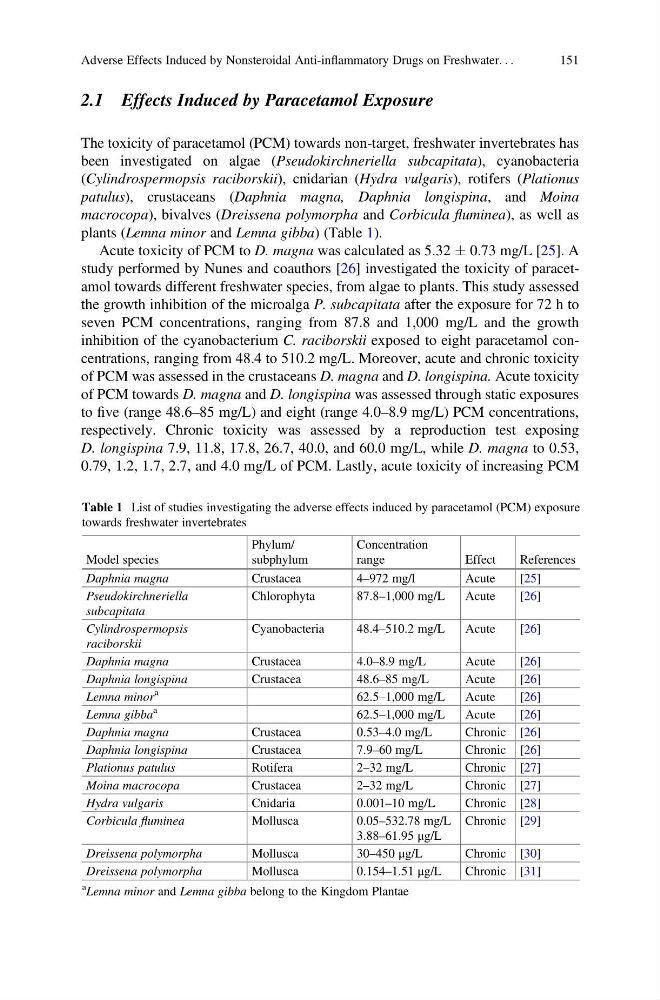
plants (Lemna minor and Lemna gibba) (Table 1).
Acute toxicity of PCM to D. magna was calculated as 5.32 Æ 0.73 mg/L [25]. A
study performed by Nunes and coauthors [26] investigated the toxicity of paracetamol towards different freshwater species, from algae to plants. This study assessed
the growth inhibition of the microalga P. subcapitata after the exposure for 72 h to
seven PCM concentrations, ranging from 87.8 and 1,000 mg/L and the growth
inhibition of the cyanobacterium C. raciborskii exposed to eight paracetamol concentrations, ranging from 48.4 to 510.2 mg/L. Moreover, acute and chronic toxicity
of PCM was assessed in the crustaceans D. magna and D. longispina. Acute toxicity
of PCM towards D. magna and D. longispina was assessed through static exposures
to five (range 48.6–85 mg/L) and eight (range 4.0–8.9 mg/L) PCM concentrations,
respectively. Chronic toxicity was assessed by a reproduction test exposing
D. longispina 7.9, 11.8, 17.8, 26.7, 40.0, and 60.0 mg/L, while D. magna to 0.53,
0.79, 1.2, 1.7, 2.7, and 4.0 mg/L of PCM. Lastly, acute toxicity of increasing PCM
Table 1 List of studies investigating the adverse effects induced by paracetamol (PCM) exposure
towards freshwater invertebrates
Model species
Phylum/
subphylum
Concentration
range
Effect
References
Daphnia magna
Crustacea
4–972 mg/l
Acute
[25]
Pseudokirchneriella
subcapitata
Chlorophyta
87.8–1,000 mg/L
Acute
[26]
Cylindrospermopsis
raciborskii
Cyanobacteria
48.4–510.2 mg/L
Acute
[26]
Daphnia magna
Crustacea
4.0–8.9 mg/L
Acute
[26]
Daphnia longispina
Crustacea
48.6–85 mg/L
Acute
[26]
Lemna minor
a
62.5–1,000 mg/L
Acute
[26]
Lemna gibba
a
62.5–1,000 mg/L
Acute
[26]
Daphnia magna
Crustacea
0.53–4.0 mg/L
Chronic [26]
Daphnia longispina
Crustacea
7.9–60 mg/L
Chronic [26]
Plationus patulus
Rotifera
2–32 mg/L
Chronic [27]
Moina macrocopa
Crustacea
2–32 mg/L
Chronic [27]
Hydra vulgaris
Cnidaria
0.001–10 mg/L
Chronic [28]
Corbicula fluminea
Mollusca
0.05–532.78 mg/L
3.88–61.95 μg/L
Chronic [29]
Dreissena polymorpha
Mollusca
30–450 μg/L
Chronic [30]
Dreissena polymorpha
Mollusca
0.154–1.51 μg/L
Chronic [31]
a Lemna minor and Lemna gibba belong to the Kingdom Plantae
Adverse Effects Induced by Nonsteroidal Anti-inflammatory Drugs on Freshwater. . .
151
The toxicity of paracetamol (PCM) towards non-target, freshwater invertebrates has
been investigated on algae (Pseudokirchneriella subcapitata), cyanobacteria
(Cylindrospermopsis raciborskii), cnidarian (Hydra vulgaris), rotifers (Plationus
patulus), crustaceans (Daphnia magna, Daphnia longispina, and Moina
macrocopa), bivalves (Dreissena polymorpha and Corbicula fluminea), as well as
plants (Lemna minor and Lemna gibba) (Table 1).
Acute toxicity of PCM to D. magna was calculated as 5.32 Æ 0.73 mg/L [25]. A
study performed by Nunes and coauthors [26] investigated the toxicity of paracetamol towards different freshwater species, from algae to plants. This study assessed
the growth inhibition of the microalga P. subcapitata after the exposure for 72 h to
seven PCM concentrations, ranging from 87.8 and 1,000 mg/L and the growth
inhibition of the cyanobacterium C. raciborskii exposed to eight paracetamol concentrations, ranging from 48.4 to 510.2 mg/L. Moreover, acute and chronic toxicity
of PCM was assessed in the crustaceans D. magna and D. longispina. Acute toxicity
of PCM towards D. magna and D. longispina was assessed through static exposures
to five (range 48.6–85 mg/L) and eight (range 4.0–8.9 mg/L) PCM concentrations,
respectively. Chronic toxicity was assessed by a reproduction test exposing
D. longispina 7.9, 11.8, 17.8, 26.7, 40.0, and 60.0 mg/L, while D. magna to 0.53,
0.79, 1.2, 1.7, 2.7, and 4.0 mg/L of PCM. Lastly, acute toxicity of increasing PCM
Table 1 List of studies investigating the adverse effects induced by paracetamol (PCM) exposure
towards freshwater invertebrates
Model species
Phylum/
subphylum
Concentration
range
Effect
References
Daphnia magna
Crustacea
4–972 mg/l
Acute
[25]
Pseudokirchneriella
subcapitata
Chlorophyta
87.8–1,000 mg/L
Acute
[26]
Cylindrospermopsis
raciborskii
Cyanobacteria
48.4–510.2 mg/L
Acute
[26]
Daphnia magna
Crustacea
4.0–8.9 mg/L
Acute
[26]
Daphnia longispina
Crustacea
48.6–85 mg/L
Acute
[26]
Lemna minor
a
62.5–1,000 mg/L
Acute
[26]
Lemna gibba
a
62.5–1,000 mg/L
Acute
[26]
Daphnia magna
Crustacea
0.53–4.0 mg/L
Chronic [26]
Daphnia longispina
Crustacea
7.9–60 mg/L
Chronic [26]
Plationus patulus
Rotifera
2–32 mg/L
Chronic [27]
Moina macrocopa
Crustacea
2–32 mg/L
Chronic [27]
Hydra vulgaris
Cnidaria
0.001–10 mg/L
Chronic [28]
Corbicula fluminea
Mollusca
0.05–532.78 mg/L
3.88–61.95 μg/L
Chronic [29]
Dreissena polymorpha
Mollusca
30–450 μg/L
Chronic [30]
Dreissena polymorpha
Mollusca
0.154–1.51 μg/L
Chronic [31]
a Lemna minor and Lemna gibba belong to the Kingdom Plantae
Adverse Effects Induced by Nonsteroidal Anti-inflammatory Drugs on Freshwater. . .
151