

2.6 Heat Inside Mines
61
Solution
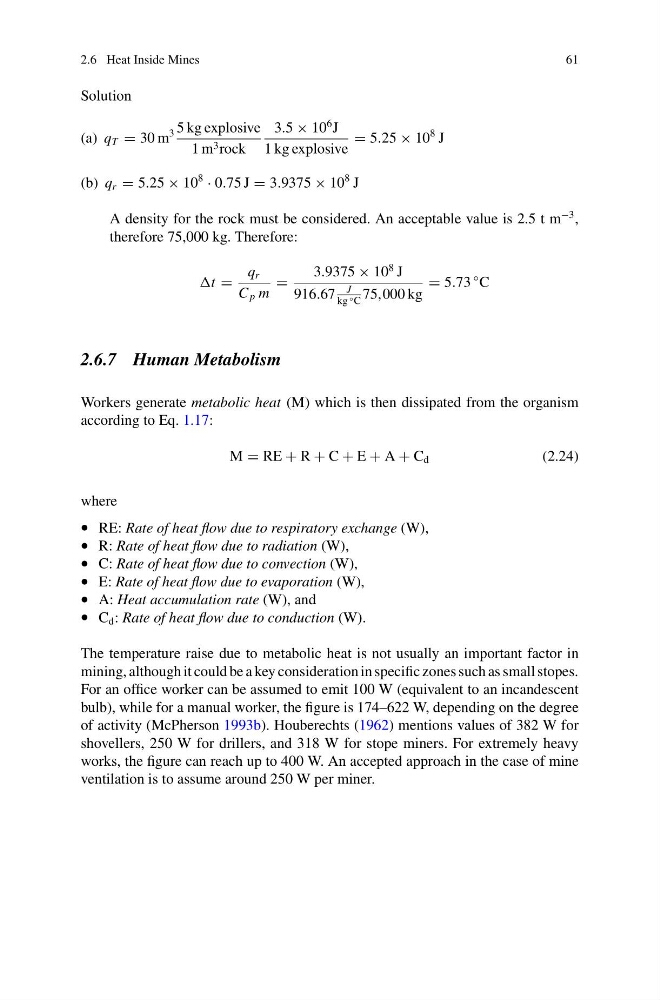
(a) q T = 30 m
3 5 kg explosive
1 m 3 rock
3.5 × 10
6 J
1 kg explosive
= 5.25 × 10
8 J
(b) q r = 5.25 × 10
8
· 0.75 J = 3.9375 × 10
8 J
A density for the rock must be considered. An acceptable value is 2.5 t m
−3 ,
therefore 75,000 kg. Therefore:
t =
q r
C p m
=
3.9375 × 10
8 J
916.67
J
kg ◦ C
75,000 kg
= 5.73
◦ C
2.6.7 Human Metabolism
Workers generate metabolic heat (M) which is then dissipated from the organism
according to Eq. 1.17:
M = RE + R + C + E + A + C d
(2.24)
where
• RE: Rate of heat flow due to respiratory exchange (W),
• R: Rate of heat flow due to radiation (W),
• C: Rate of heat flow due to convection (W),
• E: Rate of heat flow due to evaporation (W),
• A: Heat accumulation rate (W), and
• C d : Rate of heat flow due to conduction (W).
The temperature raise due to metabolic heat is not usually an important factor in
mining, although it could be a key consideration in specific zones such as small stopes.
For an office worker can be assumed to emit 100 W (equivalent to an incandescent
bulb), while for a manual worker, the figure is 174–622 W, depending on the degree
of activity (McPherson 1993b). Houberechts (1962) mentions values of 382 W for
shovellers, 250 W for drillers, and 318 W for stope miners. For extremely heavy
works, the figure can reach up to 400 W. An accepted approach in the case of mine
ventilation is to assume around 250 W per miner.
61
Solution
(a) q T = 30 m
3 5 kg explosive
1 m 3 rock
3.5 × 10
6 J
1 kg explosive
= 5.25 × 10
8 J
(b) q r = 5.25 × 10
8
· 0.75 J = 3.9375 × 10
8 J
A density for the rock must be considered. An acceptable value is 2.5 t m
−3 ,
therefore 75,000 kg. Therefore:
t =
q r
C p m
=
3.9375 × 10
8 J
916.67
J
kg ◦ C
75,000 kg
= 5.73
◦ C
2.6.7 Human Metabolism
Workers generate metabolic heat (M) which is then dissipated from the organism
according to Eq. 1.17:
M = RE + R + C + E + A + C d
(2.24)
where
• RE: Rate of heat flow due to respiratory exchange (W),
• R: Rate of heat flow due to radiation (W),
• C: Rate of heat flow due to convection (W),
• E: Rate of heat flow due to evaporation (W),
• A: Heat accumulation rate (W), and
• C d : Rate of heat flow due to conduction (W).
The temperature raise due to metabolic heat is not usually an important factor in
mining, although it could be a key consideration in specific zones such as small stopes.
For an office worker can be assumed to emit 100 W (equivalent to an incandescent
bulb), while for a manual worker, the figure is 174–622 W, depending on the degree
of activity (McPherson 1993b). Houberechts (1962) mentions values of 382 W for
shovellers, 250 W for drillers, and 318 W for stope miners. For extremely heavy
works, the figure can reach up to 400 W. An accepted approach in the case of mine
ventilation is to assume around 250 W per miner.