

2.5 Aerosols in Mining Environments
49
ν
Dry-bulb temperature (T d )
Humidity
ratio
Enthalpy
(H)
Percentage saturation
RH
T w
DT
Enthalpy (H)
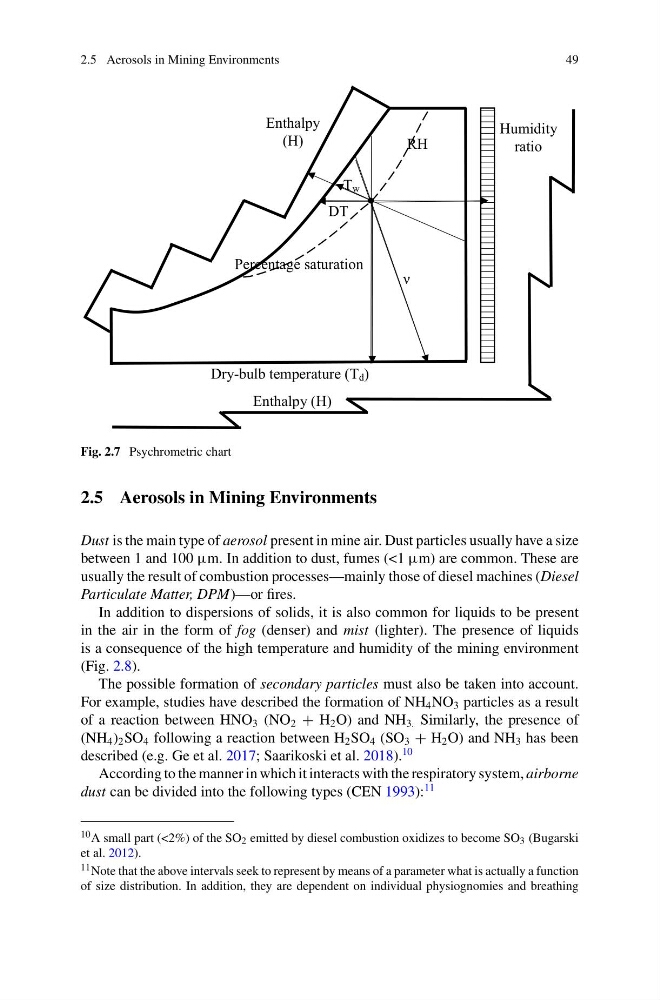
Fig. 2.7 Psychrometric chart
2.5 Aerosols in Mining Environments
Dust is the main type of aerosol present in mine air. Dust particles usually have a size
between 1 and 100 µm. In addition to dust, fumes (<1 µm) are common. These are
usually the result of combustion processes—mainly those of diesel machines (Diesel
Particulate Matter, DPM)—or fires.
In addition to dispersions of solids, it is also common for liquids to be present
in the air in the form of fog (denser) and mist (lighter). The presence of liquids
is a consequence of the high temperature and humidity of the mining environment
(Fig. 2.8).
The possible formation of secondary particles must also be taken into account.
For example, studies have described the formation of NH 4 NO 3 particles as a result
of a reaction between HNO 3 (NO 2 + H 2 O) and NH 3. Similarly, the presence of
(NH 4 ) 2 SO 4 following a reaction between H 2 SO 4 (SO 3 + H 2 O) and NH 3 has been
described (e.g. Ge et al. 2017; Saarikoski et al. 2018).
10
According to the manner in which it interacts with the respiratory system, airborne
dust can be divided into the following types (CEN 1993):
11
10 A small part (<2%) of the SO 2 emitted by diesel combustion oxidizes to become SO 3 (Bugarski
et al. 2012).
11 Note that the above intervals seek to represent by means of a parameter what is actually a function
of size distribution. In addition, they are dependent on individual physiognomies and breathing
49
ν
Dry-bulb temperature (T d )
Humidity
ratio
Enthalpy
(H)
Percentage saturation
RH
T w
DT
Enthalpy (H)
Fig. 2.7 Psychrometric chart
2.5 Aerosols in Mining Environments
Dust is the main type of aerosol present in mine air. Dust particles usually have a size
between 1 and 100 µm. In addition to dust, fumes (<1 µm) are common. These are
usually the result of combustion processes—mainly those of diesel machines (Diesel
Particulate Matter, DPM)—or fires.
In addition to dispersions of solids, it is also common for liquids to be present
in the air in the form of fog (denser) and mist (lighter). The presence of liquids
is a consequence of the high temperature and humidity of the mining environment
(Fig. 2.8).
The possible formation of secondary particles must also be taken into account.
For example, studies have described the formation of NH 4 NO 3 particles as a result
of a reaction between HNO 3 (NO 2 + H 2 O) and NH 3. Similarly, the presence of
(NH 4 ) 2 SO 4 following a reaction between H 2 SO 4 (SO 3 + H 2 O) and NH 3 has been
described (e.g. Ge et al. 2017; Saarikoski et al. 2018).
10
According to the manner in which it interacts with the respiratory system, airborne
dust can be divided into the following types (CEN 1993):
11
10 A small part (<2%) of the SO 2 emitted by diesel combustion oxidizes to become SO 3 (Bugarski
et al. 2012).
11 Note that the above intervals seek to represent by means of a parameter what is actually a function
of size distribution. In addition, they are dependent on individual physiognomies and breathing