

34
2 Environmental Conditions in the Mine
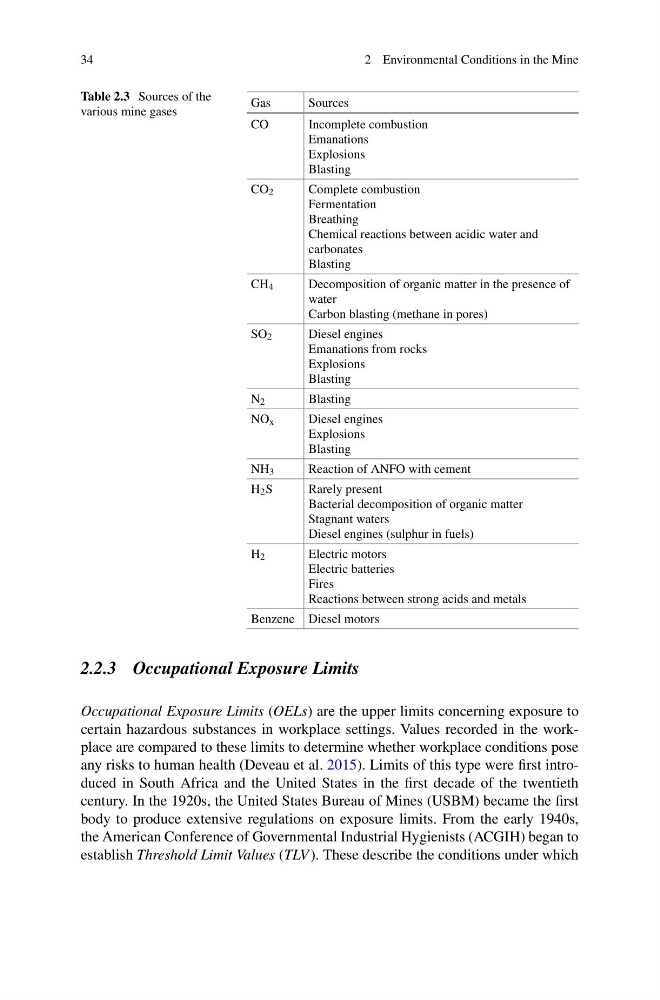
Table 2.3 Sources of the
various mine gases
Gas
Sources
CO
Incomplete combustion
Emanations
Explosions
Blasting
CO 2
Complete combustion
Fermentation
Breathing
Chemical reactions between acidic water and
carbonates
Blasting
CH 4
Decomposition of organic matter in the presence of
water
Carbon blasting (methane in pores)
SO 2
Diesel engines
Emanations from rocks
Explosions
Blasting
N 2
Blasting
NO x
Diesel engines
Explosions
Blasting
NH 3
Reaction of ANFO with cement
H 2 S
Rarely present
Bacterial decomposition of organic matter
Stagnant waters
Diesel engines (sulphur in fuels)
H 2
Electric motors
Electric batteries
Fires
Reactions between strong acids and metals
Benzene Diesel motors
2.2.3 Occupational Exposure Limits
Occupational Exposure Limits (OELs) are the upper limits concerning exposure to
certain hazardous substances in workplace settings. Values recorded in the workplace are compared to these limits to determine whether workplace conditions pose
any risks to human health (Deveau et al. 2015). Limits of this type were first introduced in South Africa and the United States in the first decade of the twentieth
century. In the 1920s, the United States Bureau of Mines (USBM) became the first
body to produce extensive regulations on exposure limits. From the early 1940s,
the American Conference of Governmental Industrial Hygienists (ACGIH) began to
establish Threshold Limit Values (TLV ). These describe the conditions under which
2 Environmental Conditions in the Mine
Table 2.3 Sources of the
various mine gases
Gas
Sources
CO
Incomplete combustion
Emanations
Explosions
Blasting
CO 2
Complete combustion
Fermentation
Breathing
Chemical reactions between acidic water and
carbonates
Blasting
CH 4
Decomposition of organic matter in the presence of
water
Carbon blasting (methane in pores)
SO 2
Diesel engines
Emanations from rocks
Explosions
Blasting
N 2
Blasting
NO x
Diesel engines
Explosions
Blasting
NH 3
Reaction of ANFO with cement
H 2 S
Rarely present
Bacterial decomposition of organic matter
Stagnant waters
Diesel engines (sulphur in fuels)
H 2
Electric motors
Electric batteries
Fires
Reactions between strong acids and metals
Benzene Diesel motors
2.2.3 Occupational Exposure Limits
Occupational Exposure Limits (OELs) are the upper limits concerning exposure to
certain hazardous substances in workplace settings. Values recorded in the workplace are compared to these limits to determine whether workplace conditions pose
any risks to human health (Deveau et al. 2015). Limits of this type were first introduced in South Africa and the United States in the first decade of the twentieth
century. In the 1920s, the United States Bureau of Mines (USBM) became the first
body to produce extensive regulations on exposure limits. From the early 1940s,
the American Conference of Governmental Industrial Hygienists (ACGIH) began to
establish Threshold Limit Values (TLV ). These describe the conditions under which