

26
1 Fundamental Concepts of Fluid Mechanics for Mine Ventilation
1.3.10 Shock Losses
Any variation from a straight duct of constant cross section generates shock losses.
11
These losses, from a physical point of view, are due to variations in the momentum,
as a consequence of changes in direction, speed and acceleration in fluid molecules.
They are usually divided into:
(a) Those due to changes of direction such as elbows, joints, or splits; and
(b) Those resulting from variations in the cross section such as obstructions,
expansions/contractions, entrances and exits of the fluid in the duct.
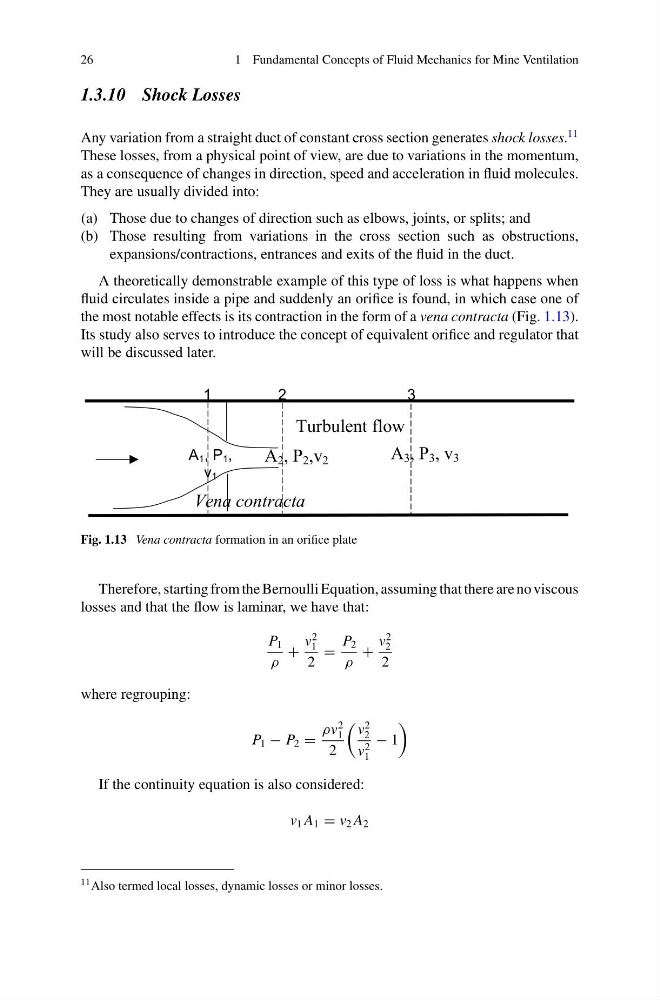
A theoretically demonstrable example of this type of loss is what happens when
fluid circulates inside a pipe and suddenly an orifice is found, in which case one of
the most notable effects is its contraction in the form of a vena contracta (Fig. 1.13).
Its study also serves to introduce the concept of equivalent orifice and regulator that
will be discussed later.
A 1 , P 1 ,
v 1
A 2 , P 2 ,v 2
Turbulent flow
1
2
3
A 3 , P 3 , v 3
Vena contracta
Fig. 1.13 Vena contracta formation in an orifice plate
Therefore, starting from the Bernoulli Equation, assuming that there are no viscous
losses and that the flow is laminar, we have that:
P 1
ρ
+
v
2
1
2
=
P 2
ρ
+
v
2
2
2
where regrouping:
P 1 − P 2 =
ρv
2
1
2
v
2
2
v
2
1
− 1
If the continuity equation is also considered:
v 1 A 1 = v 2 A 2
11 Also termed local losses, dynamic losses or minor losses.
1 Fundamental Concepts of Fluid Mechanics for Mine Ventilation
1.3.10 Shock Losses
Any variation from a straight duct of constant cross section generates shock losses.
11
These losses, from a physical point of view, are due to variations in the momentum,
as a consequence of changes in direction, speed and acceleration in fluid molecules.
They are usually divided into:
(a) Those due to changes of direction such as elbows, joints, or splits; and
(b) Those resulting from variations in the cross section such as obstructions,
expansions/contractions, entrances and exits of the fluid in the duct.
A theoretically demonstrable example of this type of loss is what happens when
fluid circulates inside a pipe and suddenly an orifice is found, in which case one of
the most notable effects is its contraction in the form of a vena contracta (Fig. 1.13).
Its study also serves to introduce the concept of equivalent orifice and regulator that
will be discussed later.
A 1 , P 1 ,
v 1
A 2 , P 2 ,v 2
Turbulent flow
1
2
3
A 3 , P 3 , v 3
Vena contracta
Fig. 1.13 Vena contracta formation in an orifice plate
Therefore, starting from the Bernoulli Equation, assuming that there are no viscous
losses and that the flow is laminar, we have that:
P 1
ρ
+
v
2
1
2
=
P 2
ρ
+
v
2
2
2
where regrouping:
P 1 − P 2 =
ρv
2
1
2
v
2
2
v
2
1
− 1
If the continuity equation is also considered:
v 1 A 1 = v 2 A 2
11 Also termed local losses, dynamic losses or minor losses.