

358
8 Secondary Ventilation
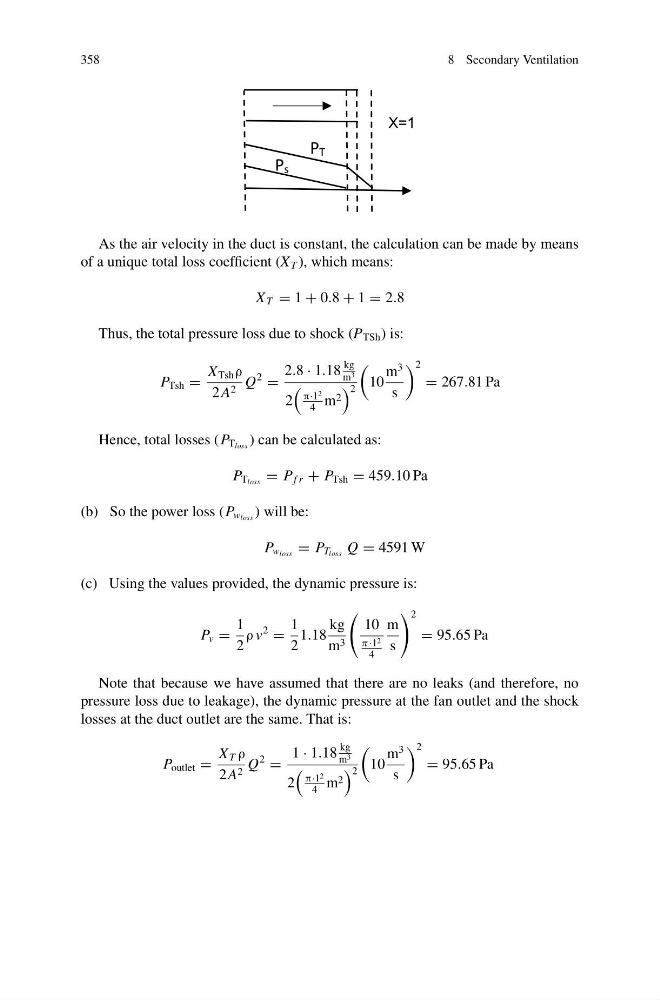
X=1
P T
P s
As the air velocity in the duct is constant, the calculation can be made by means
of a unique total loss coefficient (X T ), which means:
X T = 1 + 0.8 + 1 = 2.8
Thus, the total pressure loss due to shock (P TSh ) is:
P Tsh =
X Tsh ρ
2 A 2 Q
2
=
2.8 · 1.18
kg
m 3
2
π·1 2
4
m 2
2
10
m
3
s
2
= 267.81 Pa
Hence, total losses (P T loss ) can be calculated as:
P T loss = P f r + P Tsh = 459.10 Pa
(b) So the power loss (P w loss ) will be:
P w loss = P T loss Q = 4591 W
(c) Using the values provided, the dynamic pressure is:
P v =
1
2
ρ v
2
=
1
2
1.18
kg
m 3
10
π·1 2
4
m
s
2
= 95.65 Pa
Note that because we have assumed that there are no leaks (and therefore, no
pressure loss due to leakage), the dynamic pressure at the fan outlet and the shock
losses at the duct outlet are the same. That is:
P outlet =
X T ρ
2 A 2 Q
2
=
1 · 1.18
kg
m 3
2
π·1 2
4
m 2
2
10
m
3
s
2
= 95.65 Pa
8 Secondary Ventilation
X=1
P T
P s
As the air velocity in the duct is constant, the calculation can be made by means
of a unique total loss coefficient (X T ), which means:
X T = 1 + 0.8 + 1 = 2.8
Thus, the total pressure loss due to shock (P TSh ) is:
P Tsh =
X Tsh ρ
2 A 2 Q
2
=
2.8 · 1.18
kg
m 3
2
π·1 2
4
m 2
2
10
m
3
s
2
= 267.81 Pa
Hence, total losses (P T loss ) can be calculated as:
P T loss = P f r + P Tsh = 459.10 Pa
(b) So the power loss (P w loss ) will be:
P w loss = P T loss Q = 4591 W
(c) Using the values provided, the dynamic pressure is:
P v =
1
2
ρ v
2
=
1
2
1.18
kg
m 3
10
π·1 2
4
m
s
2
= 95.65 Pa
Note that because we have assumed that there are no leaks (and therefore, no
pressure loss due to leakage), the dynamic pressure at the fan outlet and the shock
losses at the duct outlet are the same. That is:
P outlet =
X T ρ
2 A 2 Q
2
=
1 · 1.18
kg
m 3
2
π·1 2
4
m 2
2
10
m
3
s
2
= 95.65 Pa