

7.9 Flammable Dusts
275
of dust decreases, they can more easily be raised from the ground and carried on air
currents.
Question 7.3 Indicate how the presence of a flammable dust affects the LEL of CH 4 .
Answer
Since both are explosive, the presence of one of the two acts by lowering the LEL
of the other.
7.10 Coefficients of Gases Indicating the Evolution of Fires
The presence of a fire inside a mine alters the composition of the mine gases. If other
more sophisticated devices are absent, fires in coal seams can be detected at their
earliest stages by the increase in temperature they cause, as well as by the rise in
humidity in the return air. If this heating persists, fog will form, accompanied by
exudation, or sweating, of walls. This will be followed by smells of oil or paraffin,
culminating in a typical smoke smell (Heiss and Herbst 1945).
One of the main indicators of the existence of a fire is the presence of CO 2 .
However, high concentrations CO 2 may also be due to people breathing, wood
decomposing, pyrites being oxidized, or the reaction of acidic water with carbonate
rocks, among other causes. Hence, ratios based on CO 2 concentration should be
taken with considerable caution. This is the reason that current indices consider not
just carbon dioxide, but other gases such as CO, H 2 , ethylene and propylene, which
are released sequentially as coal heats up. A compilation of the most common ratios
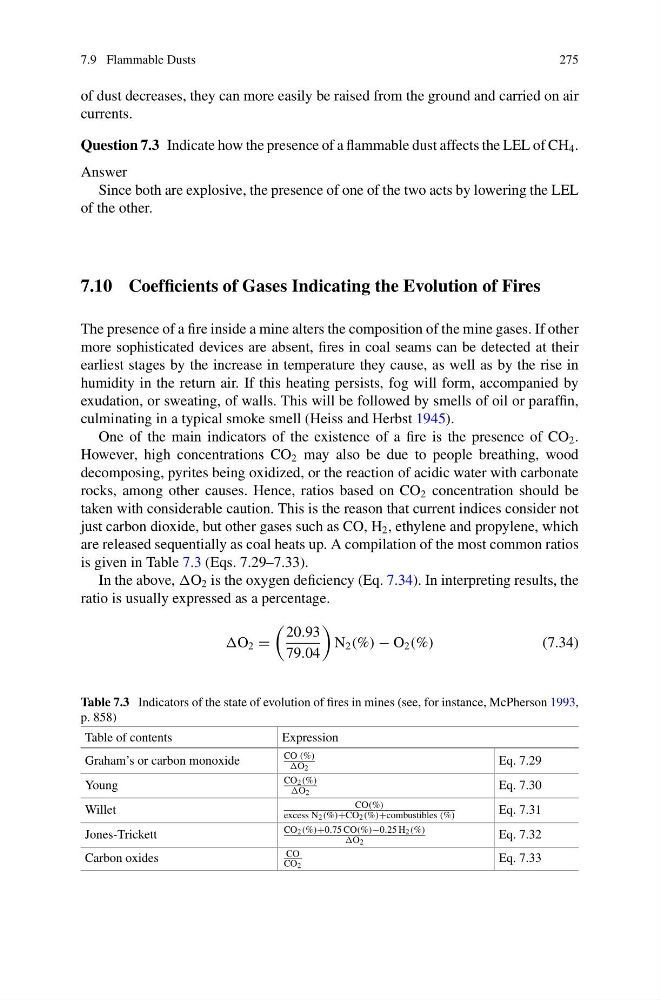
is given in Table 7.3 (Eqs. 7.29–7.33).
In the above, O 2 is the oxygen deficiency (Eq. 7.34). In interpreting results, the
ratio is usually expressed as a percentage.
O 2 =
20.93
79.04
N 2 (%) − O 2 (%)
(7.34)
Table 7.3 Indicators of the state of evolution of fires in mines (see, for instance, McPherson 1993,
p. 858)
Table of contents
Expression
Graham’s or carbon monoxide
CO (%)
O2
Eq. 7.29
Young
CO2(%)
O2
Eq. 7.30
Willet
CO(%)
excess N2(%)+CO2(%)+combustibles (%)
Eq. 7.31
Jones-Trickett
CO2(%)+0.75 CO(%)−0.25 H2(%)
O2
Eq. 7.32
Carbon oxides
CO
CO2
Eq. 7.33
275
of dust decreases, they can more easily be raised from the ground and carried on air
currents.
Question 7.3 Indicate how the presence of a flammable dust affects the LEL of CH 4 .
Answer
Since both are explosive, the presence of one of the two acts by lowering the LEL
of the other.
7.10 Coefficients of Gases Indicating the Evolution of Fires
The presence of a fire inside a mine alters the composition of the mine gases. If other
more sophisticated devices are absent, fires in coal seams can be detected at their
earliest stages by the increase in temperature they cause, as well as by the rise in
humidity in the return air. If this heating persists, fog will form, accompanied by
exudation, or sweating, of walls. This will be followed by smells of oil or paraffin,
culminating in a typical smoke smell (Heiss and Herbst 1945).
One of the main indicators of the existence of a fire is the presence of CO 2 .
However, high concentrations CO 2 may also be due to people breathing, wood
decomposing, pyrites being oxidized, or the reaction of acidic water with carbonate
rocks, among other causes. Hence, ratios based on CO 2 concentration should be
taken with considerable caution. This is the reason that current indices consider not
just carbon dioxide, but other gases such as CO, H 2 , ethylene and propylene, which
are released sequentially as coal heats up. A compilation of the most common ratios
is given in Table 7.3 (Eqs. 7.29–7.33).
In the above, O 2 is the oxygen deficiency (Eq. 7.34). In interpreting results, the
ratio is usually expressed as a percentage.
O 2 =
20.93
79.04
N 2 (%) − O 2 (%)
(7.34)
Table 7.3 Indicators of the state of evolution of fires in mines (see, for instance, McPherson 1993,
p. 858)
Table of contents
Expression
Graham’s or carbon monoxide
CO (%)
O2
Eq. 7.29
Young
CO2(%)
O2
Eq. 7.30
Willet
CO(%)
excess N2(%)+CO2(%)+combustibles (%)
Eq. 7.31
Jones-Trickett
CO2(%)+0.75 CO(%)−0.25 H2(%)
O2
Eq. 7.32
Carbon oxides
CO
CO2
Eq. 7.33