

274
7 The Role of Ventilation in Fires and Explosions
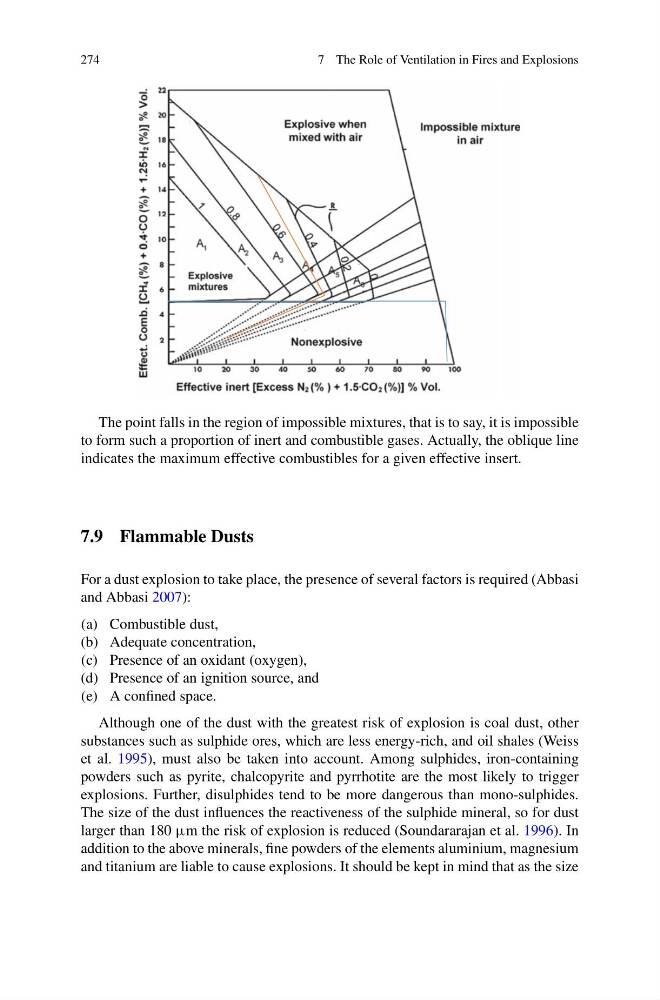
The point falls in the region of impossible mixtures, that is to say, it is impossible
to form such a proportion of inert and combustible gases. Actually, the oblique line
indicates the maximum effective combustibles for a given effective insert.
7.9 Flammable Dusts
For a dust explosion to take place, the presence of several factors is required (Abbasi
and Abbasi 2007):
(a) Combustible dust,
(b) Adequate concentration,
(c) Presence of an oxidant (oxygen),
(d) Presence of an ignition source, and
(e) A confined space.
Although one of the dust with the greatest risk of explosion is coal dust, other
substances such as sulphide ores, which are less energy-rich, and oil shales (Weiss
et al. 1995), must also be taken into account. Among sulphides, iron-containing
powders such as pyrite, chalcopyrite and pyrrhotite are the most likely to trigger
explosions. Further, disulphides tend to be more dangerous than mono-sulphides.
The size of the dust influences the reactiveness of the sulphide mineral, so for dust
larger than 180 μm the risk of explosion is reduced (Soundararajan et al. 1996). In
addition to the above minerals, fine powders of the elements aluminium, magnesium
and titanium are liable to cause explosions. It should be kept in mind that as the size
7 The Role of Ventilation in Fires and Explosions
The point falls in the region of impossible mixtures, that is to say, it is impossible
to form such a proportion of inert and combustible gases. Actually, the oblique line
indicates the maximum effective combustibles for a given effective insert.
7.9 Flammable Dusts
For a dust explosion to take place, the presence of several factors is required (Abbasi
and Abbasi 2007):
(a) Combustible dust,
(b) Adequate concentration,
(c) Presence of an oxidant (oxygen),
(d) Presence of an ignition source, and
(e) A confined space.
Although one of the dust with the greatest risk of explosion is coal dust, other
substances such as sulphide ores, which are less energy-rich, and oil shales (Weiss
et al. 1995), must also be taken into account. Among sulphides, iron-containing
powders such as pyrite, chalcopyrite and pyrrhotite are the most likely to trigger
explosions. Further, disulphides tend to be more dangerous than mono-sulphides.
The size of the dust influences the reactiveness of the sulphide mineral, so for dust
larger than 180 μm the risk of explosion is reduced (Soundararajan et al. 1996). In
addition to the above minerals, fine powders of the elements aluminium, magnesium
and titanium are liable to cause explosions. It should be kept in mind that as the size