

268
7 The Role of Ventilation in Fires and Explosions
Ten iterations were used to calculate V c using the NFPA 502:2017 method. In the
HRR table, we have not performed an interpolation. Our criteria has been to consider
between the two extreme values, the one that provides the most critical speed.
Considering calculations made using the NFPA 502: 2020 method, for values of
HRR up to 15 MW the condition that A ≤ B holds, thus V c was calculated according
to Eq. 7.18, that is to say, V c is a function of Q. From 16 MW the condition A > B
holds and calculations were performed with Eq. 7.19, which does not depend on Q.
In contrast, for calculations made following NFPA 502: 2017, V c is always a function
of Q and the accuracy of the value obtained is determined by the number of iterations
performed.
7.8 Explosiveness of Mine Gases
Of all coal-mine gases, methane (CH 4 ) is perhaps the most feared. However, others
such as carbon monoxide (CO), hydrogen (H 2 ) and hydrogen sulphide (H 2 S) can
also play a major role.
9 The explosibility, explosiveness, or explosive nature of all
of these gases is a function, not only of their concentration, but also of the presence
of other gases with which they interact.
To determine whether a mixture is explosive or not, certain limits can be used for a
first approximation. The Lower Explosive Limit (LEL) is the minimum concentration
of a combustible gas or vapour required for combustion in air to take place. The Upper
Explosive Limit (UEL) is the maximum concentration of a gas or vapour that will
burn in the presence of air. The range between the LEL and the UEL is known as the
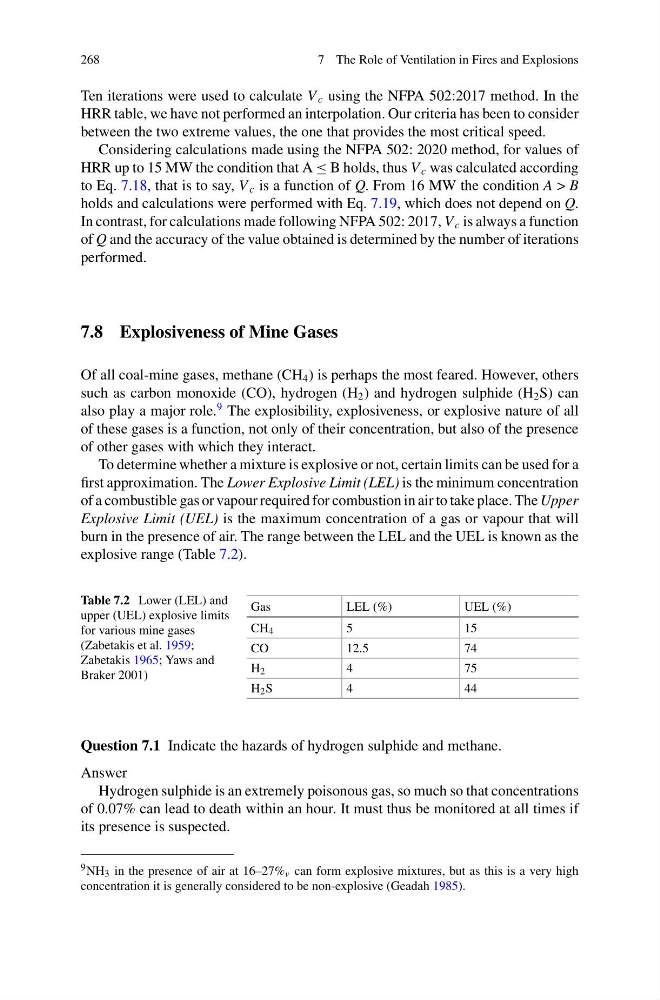
explosive range (Table 7.2).
Table 7.2 Lower (LEL) and
upper (UEL) explosive limits
for various mine gases
(Zabetakis et al. 1959;
Zabetakis 1965; Yaws and
Braker 2001)
Gas
LEL (%)
UEL (%)
CH 4
5
15
CO
12.5
74
H 2
4
75
H 2 S
4
44
Question 7.1 Indicate the hazards of hydrogen sulphide and methane.
Answer
Hydrogen sulphide is an extremely poisonous gas, so much so that concentrations
of 0.07% can lead to death within an hour. It must thus be monitored at all times if
its presence is suspected.
9 NH 3 in the presence of air at 16–27% v can form explosive mixtures, but as this is a very high
concentration it is generally considered to be non-explosive (Geadah 1985).
7 The Role of Ventilation in Fires and Explosions
Ten iterations were used to calculate V c using the NFPA 502:2017 method. In the
HRR table, we have not performed an interpolation. Our criteria has been to consider
between the two extreme values, the one that provides the most critical speed.
Considering calculations made using the NFPA 502: 2020 method, for values of
HRR up to 15 MW the condition that A ≤ B holds, thus V c was calculated according
to Eq. 7.18, that is to say, V c is a function of Q. From 16 MW the condition A > B
holds and calculations were performed with Eq. 7.19, which does not depend on Q.
In contrast, for calculations made following NFPA 502: 2017, V c is always a function
of Q and the accuracy of the value obtained is determined by the number of iterations
performed.
7.8 Explosiveness of Mine Gases
Of all coal-mine gases, methane (CH 4 ) is perhaps the most feared. However, others
such as carbon monoxide (CO), hydrogen (H 2 ) and hydrogen sulphide (H 2 S) can
also play a major role.
9 The explosibility, explosiveness, or explosive nature of all
of these gases is a function, not only of their concentration, but also of the presence
of other gases with which they interact.
To determine whether a mixture is explosive or not, certain limits can be used for a
first approximation. The Lower Explosive Limit (LEL) is the minimum concentration
of a combustible gas or vapour required for combustion in air to take place. The Upper
Explosive Limit (UEL) is the maximum concentration of a gas or vapour that will
burn in the presence of air. The range between the LEL and the UEL is known as the
explosive range (Table 7.2).
Table 7.2 Lower (LEL) and
upper (UEL) explosive limits
for various mine gases
(Zabetakis et al. 1959;
Zabetakis 1965; Yaws and
Braker 2001)
Gas
LEL (%)
UEL (%)
CH 4
5
15
CO
12.5
74
H 2
4
75
H 2 S
4
44
Question 7.1 Indicate the hazards of hydrogen sulphide and methane.
Answer
Hydrogen sulphide is an extremely poisonous gas, so much so that concentrations
of 0.07% can lead to death within an hour. It must thus be monitored at all times if
its presence is suspected.
9 NH 3 in the presence of air at 16–27% v can form explosive mixtures, but as this is a very high
concentration it is generally considered to be non-explosive (Geadah 1985).