

7.5 Cooling Curves
257
These curves give an approximate model for the phenomenon of temperature decay,
as they do not incorporate various phenomena, such as heat released during the
condensation of water at temperatures below 100 °C.
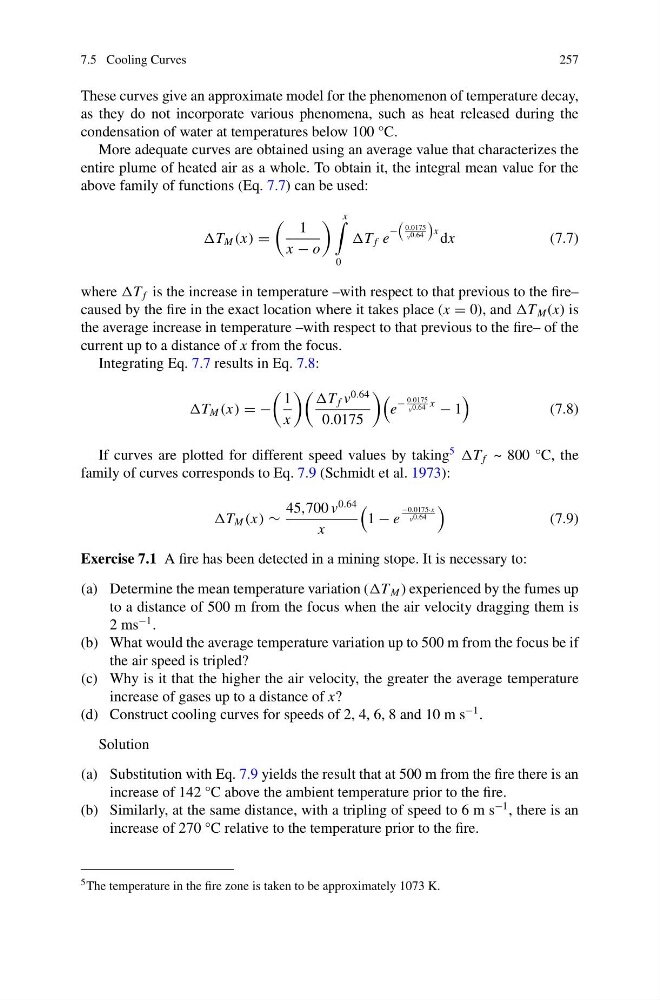
More adequate curves are obtained using an average value that characterizes the
entire plume of heated air as a whole. To obtain it, the integral mean value for the
above family of functions (Eq. 7.7) can be used:
T M (x) =
1
x − o
x
0
T f e
−
0.0175
v 0.64
x dx
(7.7)
where T f is the increase in temperature –with respect to that previous to the fire–
caused by the fire in the exact location where it takes place (x = 0), and T M (x) is
the average increase in temperature –with respect to that previous to the fire– of the
current up to a distance of x from the focus.
Integrating Eq. 7.7 results in Eq. 7.8:
T M (x) = −
1
x
T f v
0.64
0.0175
e
−
0.0175
v 0.64 x − 1
(7.8)
If curves are plotted for different speed values by taking
5
T f ~ 800 °C, the
family of curves corresponds to Eq. 7.9 (Schmidt et al. 1973):
T M (x) ∼
45,700 v
0.64
x
1 − e
−0.0175·x
v 0.64
(7.9)
Exercise 7.1 A fire has been detected in a mining stope. It is necessary to:
(a) Determine the mean temperature variation (T M ) experienced by the fumes up
to a distance of 500 m from the focus when the air velocity dragging them is
2 ms
−1 .
(b) What would the average temperature variation up to 500 m from the focus be if
the air speed is tripled?
(c) Why is it that the higher the air velocity, the greater the average temperature
increase of gases up to a distance of x?
(d) Construct cooling curves for speeds of 2, 4, 6, 8 and 10 m s
−1 .
Solution
(a) Substitution with Eq. 7.9 yields the result that at 500 m from the fire there is an
increase of 142 °C above the ambient temperature prior to the fire.
(b) Similarly, at the same distance, with a tripling of speed to 6 m s
−1 , there is an
increase of 270 °C relative to the temperature prior to the fire.
5 The temperature in the fire zone is taken to be approximately 1073 K.
257
These curves give an approximate model for the phenomenon of temperature decay,
as they do not incorporate various phenomena, such as heat released during the
condensation of water at temperatures below 100 °C.
More adequate curves are obtained using an average value that characterizes the
entire plume of heated air as a whole. To obtain it, the integral mean value for the
above family of functions (Eq. 7.7) can be used:
T M (x) =
1
x − o
x
0
T f e
−
0.0175
v 0.64
x dx
(7.7)
where T f is the increase in temperature –with respect to that previous to the fire–
caused by the fire in the exact location where it takes place (x = 0), and T M (x) is
the average increase in temperature –with respect to that previous to the fire– of the
current up to a distance of x from the focus.
Integrating Eq. 7.7 results in Eq. 7.8:
T M (x) = −
1
x
T f v
0.64
0.0175
e
−
0.0175
v 0.64 x − 1
(7.8)
If curves are plotted for different speed values by taking
5
T f ~ 800 °C, the
family of curves corresponds to Eq. 7.9 (Schmidt et al. 1973):
T M (x) ∼
45,700 v
0.64
x
1 − e
−0.0175·x
v 0.64
(7.9)
Exercise 7.1 A fire has been detected in a mining stope. It is necessary to:
(a) Determine the mean temperature variation (T M ) experienced by the fumes up
to a distance of 500 m from the focus when the air velocity dragging them is
2 ms
−1 .
(b) What would the average temperature variation up to 500 m from the focus be if
the air speed is tripled?
(c) Why is it that the higher the air velocity, the greater the average temperature
increase of gases up to a distance of x?
(d) Construct cooling curves for speeds of 2, 4, 6, 8 and 10 m s
−1 .
Solution
(a) Substitution with Eq. 7.9 yields the result that at 500 m from the fire there is an
increase of 142 °C above the ambient temperature prior to the fire.
(b) Similarly, at the same distance, with a tripling of speed to 6 m s
−1 , there is an
increase of 270 °C relative to the temperature prior to the fire.
5 The temperature in the fire zone is taken to be approximately 1073 K.