

6.3 Airflow Control Devices
235
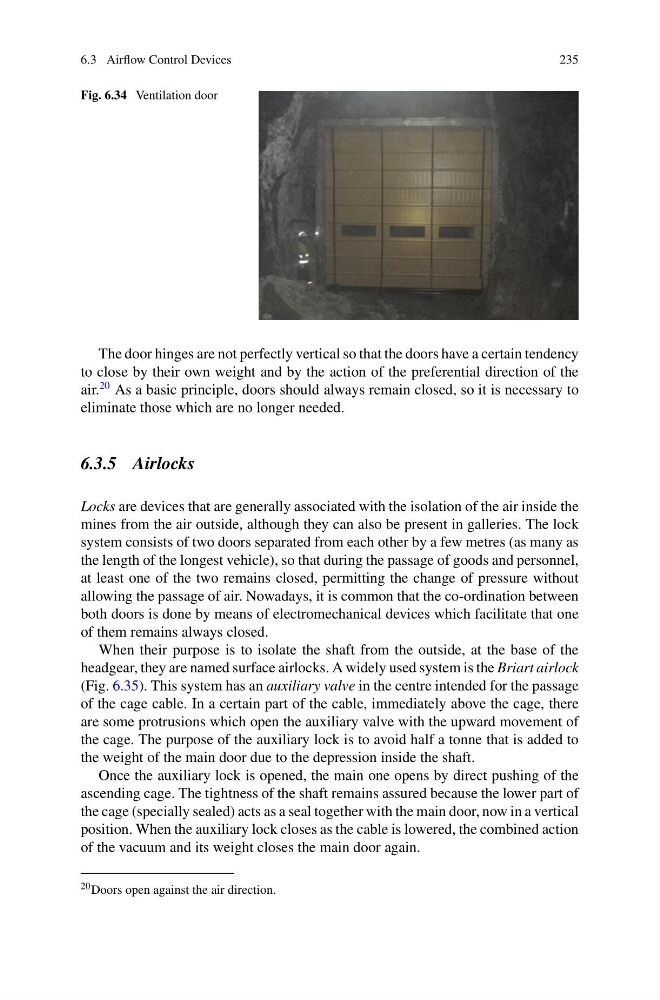
Fig. 6.34 Ventilation door
The door hinges are not perfectly vertical so that the doors have a certain tendency
to close by their own weight and by the action of the preferential direction of the
air.
20 As a basic principle, doors should always remain closed, so it is necessary to
eliminate those which are no longer needed.
6.3.5 Airlocks
Locks are devices that are generally associated with the isolation of the air inside the
mines from the air outside, although they can also be present in galleries. The lock
system consists of two doors separated from each other by a few metres (as many as
the length of the longest vehicle), so that during the passage of goods and personnel,
at least one of the two remains closed, permitting the change of pressure without
allowing the passage of air. Nowadays, it is common that the co-ordination between
both doors is done by means of electromechanical devices which facilitate that one
of them remains always closed.
When their purpose is to isolate the shaft from the outside, at the base of the
headgear, they are named surface airlocks. A widely used system is the Briart airlock
(Fig. 6.35). This system has an auxiliary valve in the centre intended for the passage
of the cage cable. In a certain part of the cable, immediately above the cage, there
are some protrusions which open the auxiliary valve with the upward movement of
the cage. The purpose of the auxiliary lock is to avoid half a tonne that is added to
the weight of the main door due to the depression inside the shaft.
Once the auxiliary lock is opened, the main one opens by direct pushing of the
ascending cage. The tightness of the shaft remains assured because the lower part of
the cage (specially sealed) acts as a seal together with the main door, now in a vertical
position. When the auxiliary lock closes as the cable is lowered, the combined action
of the vacuum and its weight closes the main door again.
20 Doors open against the air direction.
235
Fig. 6.34 Ventilation door
The door hinges are not perfectly vertical so that the doors have a certain tendency
to close by their own weight and by the action of the preferential direction of the
air.
20 As a basic principle, doors should always remain closed, so it is necessary to
eliminate those which are no longer needed.
6.3.5 Airlocks
Locks are devices that are generally associated with the isolation of the air inside the
mines from the air outside, although they can also be present in galleries. The lock
system consists of two doors separated from each other by a few metres (as many as
the length of the longest vehicle), so that during the passage of goods and personnel,
at least one of the two remains closed, permitting the change of pressure without
allowing the passage of air. Nowadays, it is common that the co-ordination between
both doors is done by means of electromechanical devices which facilitate that one
of them remains always closed.
When their purpose is to isolate the shaft from the outside, at the base of the
headgear, they are named surface airlocks. A widely used system is the Briart airlock
(Fig. 6.35). This system has an auxiliary valve in the centre intended for the passage
of the cage cable. In a certain part of the cable, immediately above the cage, there
are some protrusions which open the auxiliary valve with the upward movement of
the cage. The purpose of the auxiliary lock is to avoid half a tonne that is added to
the weight of the main door due to the depression inside the shaft.
Once the auxiliary lock is opened, the main one opens by direct pushing of the
ascending cage. The tightness of the shaft remains assured because the lower part of
the cage (specially sealed) acts as a seal together with the main door, now in a vertical
position. When the auxiliary lock closes as the cable is lowered, the combined action
of the vacuum and its weight closes the main door again.
20 Doors open against the air direction.