

1.3 Fluid Dynamics
9
1.3.3 Energy Conservation: Bernoulli’s Equation
It is assumed that a control volume of an incompressible fluid
4 travels through forced
conduction. The sum of the kinetic (K), potential (U) and due to pressure (W ) energies, must be the same for any point of the fluid under the principle of energy
conservation, which is expressed as:
K 1 + U 1 + W 1 = K 2 + U 2 + W 2
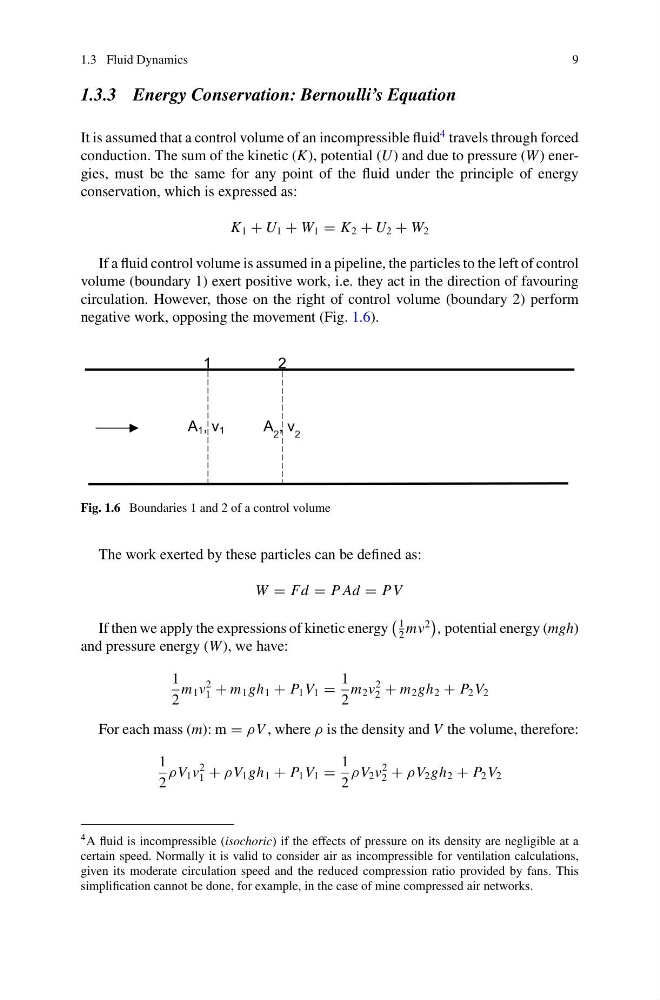
If a fluid control volume is assumed in a pipeline, the particles to the left of control
volume (boundary 1) exert positive work, i.e. they act in the direction of favouring
circulation. However, those on the right of control volume (boundary 2) perform
negative work, opposing the movement (Fig. 1.6).
A 1 , v 1
1
2
A 2 , v 2
Fig. 1.6 Boundaries 1 and 2 of a control volume
The work exerted by these particles can be defined as:
W = Fd = P Ad = PV
If then we apply the expressions of kinetic energy
1
2
mv
2
, potential energy (mgh)
and pressure energy (W ), we have:
1
2
m 1 v
2
1 + m 1 gh 1 + P 1 V 1 =
1
2
m 2 v
2
2 + m 2 gh 2 + P 2 V 2
For each mass (m): m = ρV , where ρ is the density and V the volume, therefore:
1
2
ρV 1 v
2
1 + ρV 1 gh 1 + P 1 V 1 =
1
2
ρV 2 v
2
2 + ρV 2 gh 2 + P 2 V 2
4 A fluid is incompressible (isochoric) if the effects of pressure on its density are negligible at a
certain speed. Normally it is valid to consider air as incompressible for ventilation calculations,
given its moderate circulation speed and the reduced compression ratio provided by fans. This
simplification cannot be done, for example, in the case of mine compressed air networks.
9
1.3.3 Energy Conservation: Bernoulli’s Equation
It is assumed that a control volume of an incompressible fluid
4 travels through forced
conduction. The sum of the kinetic (K), potential (U) and due to pressure (W ) energies, must be the same for any point of the fluid under the principle of energy
conservation, which is expressed as:
K 1 + U 1 + W 1 = K 2 + U 2 + W 2
If a fluid control volume is assumed in a pipeline, the particles to the left of control
volume (boundary 1) exert positive work, i.e. they act in the direction of favouring
circulation. However, those on the right of control volume (boundary 2) perform
negative work, opposing the movement (Fig. 1.6).
A 1 , v 1
1
2
A 2 , v 2
Fig. 1.6 Boundaries 1 and 2 of a control volume
The work exerted by these particles can be defined as:
W = Fd = P Ad = PV
If then we apply the expressions of kinetic energy
1
2
mv
2
, potential energy (mgh)
and pressure energy (W ), we have:
1
2
m 1 v
2
1 + m 1 gh 1 + P 1 V 1 =
1
2
m 2 v
2
2 + m 2 gh 2 + P 2 V 2
For each mass (m): m = ρV , where ρ is the density and V the volume, therefore:
1
2
ρV 1 v
2
1 + ρV 1 gh 1 + P 1 V 1 =
1
2
ρV 2 v
2
2 + ρV 2 gh 2 + P 2 V 2
4 A fluid is incompressible (isochoric) if the effects of pressure on its density are negligible at a
certain speed. Normally it is valid to consider air as incompressible for ventilation calculations,
given its moderate circulation speed and the reduced compression ratio provided by fans. This
simplification cannot be done, for example, in the case of mine compressed air networks.