

8
1 Fundamental Concepts of Fluid Mechanics for Mine Ventilation
P =
W
V
N
m 2 ,
J
m 3
(1.11)
In this way, it is possible to indicate that the ambient pressure is one atmosphere,
101,300 Pa or 101,300 J m
−3 .
Exercise 1.1 A tank contains 1 m 3 of air at 11 atm (absolute pressure).
Approximate, according to what you have learned, the energy stored in it.
Solution
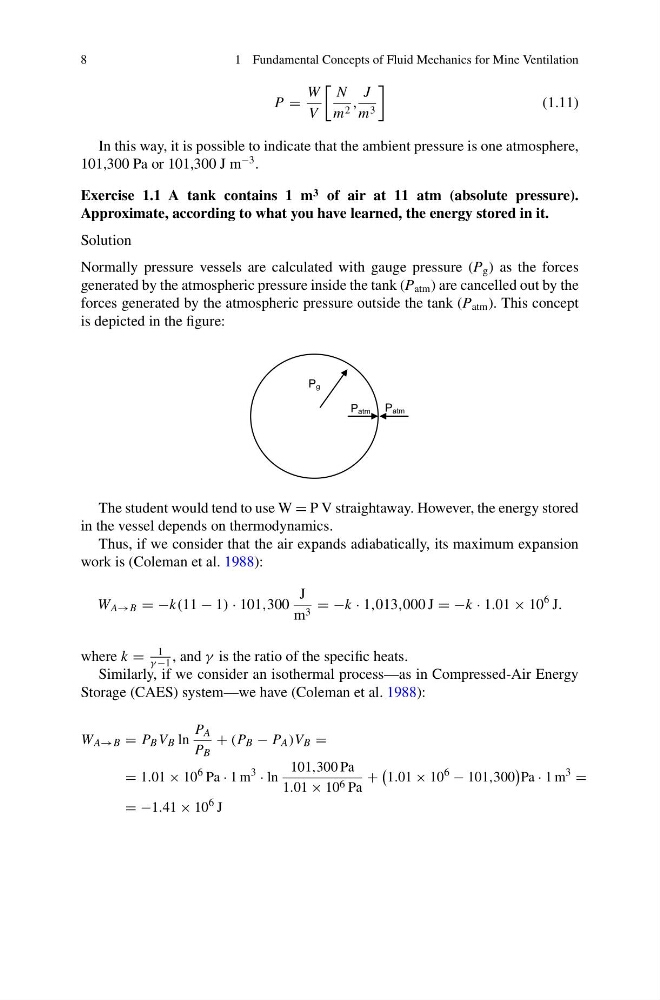
Normally pressure vessels are calculated with gauge pressure (P g ) as the forces
generated by the atmospheric pressure inside the tank (P atm ) are cancelled out by the
forces generated by the atmospheric pressure outside the tank (P atm ). This concept
is depicted in the figure:
P atm
P atm
P g
The student would tend to use W = P V straightaway. However, the energy stored
in the vessel depends on thermodynamics.
Thus, if we consider that the air expands adiabatically, its maximum expansion
work is (Coleman et al. 1988):
W A→B = −k(11 − 1) · 101,300
J
m 3 = −k · 1,013,000 J = −k · 1.01 × 10
6 J.
where k =
1
γ −1
, and γ is the ratio of the specific heats.
Similarly, if we consider an isothermal process—as in Compressed-Air Energy
Storage (CAES) system—we have (Coleman et al. 1988):
W A→B = P B V B ln
P A
P B
+ (P B − P A )V B =
= 1.01 × 10
6 Pa · 1 m
3
· ln
101,300 Pa
1.01 × 10 6 Pa
+
1.01 × 10
6
− 101,300
Pa · 1 m
3
=
= −1.41 × 10
6 J
1 Fundamental Concepts of Fluid Mechanics for Mine Ventilation
P =
W
V
N
m 2 ,
J
m 3
(1.11)
In this way, it is possible to indicate that the ambient pressure is one atmosphere,
101,300 Pa or 101,300 J m
−3 .
Exercise 1.1 A tank contains 1 m 3 of air at 11 atm (absolute pressure).
Approximate, according to what you have learned, the energy stored in it.
Solution
Normally pressure vessels are calculated with gauge pressure (P g ) as the forces
generated by the atmospheric pressure inside the tank (P atm ) are cancelled out by the
forces generated by the atmospheric pressure outside the tank (P atm ). This concept
is depicted in the figure:
P atm
P atm
P g
The student would tend to use W = P V straightaway. However, the energy stored
in the vessel depends on thermodynamics.
Thus, if we consider that the air expands adiabatically, its maximum expansion
work is (Coleman et al. 1988):
W A→B = −k(11 − 1) · 101,300
J
m 3 = −k · 1,013,000 J = −k · 1.01 × 10
6 J.
where k =
1
γ −1
, and γ is the ratio of the specific heats.
Similarly, if we consider an isothermal process—as in Compressed-Air Energy
Storage (CAES) system—we have (Coleman et al. 1988):
W A→B = P B V B ln
P A
P B
+ (P B − P A )V B =
= 1.01 × 10
6 Pa · 1 m
3
· ln
101,300 Pa
1.01 × 10 6 Pa
+
1.01 × 10
6
− 101,300
Pa · 1 m
3
=
= −1.41 × 10
6 J