

5.4 Forced Ventilation
183
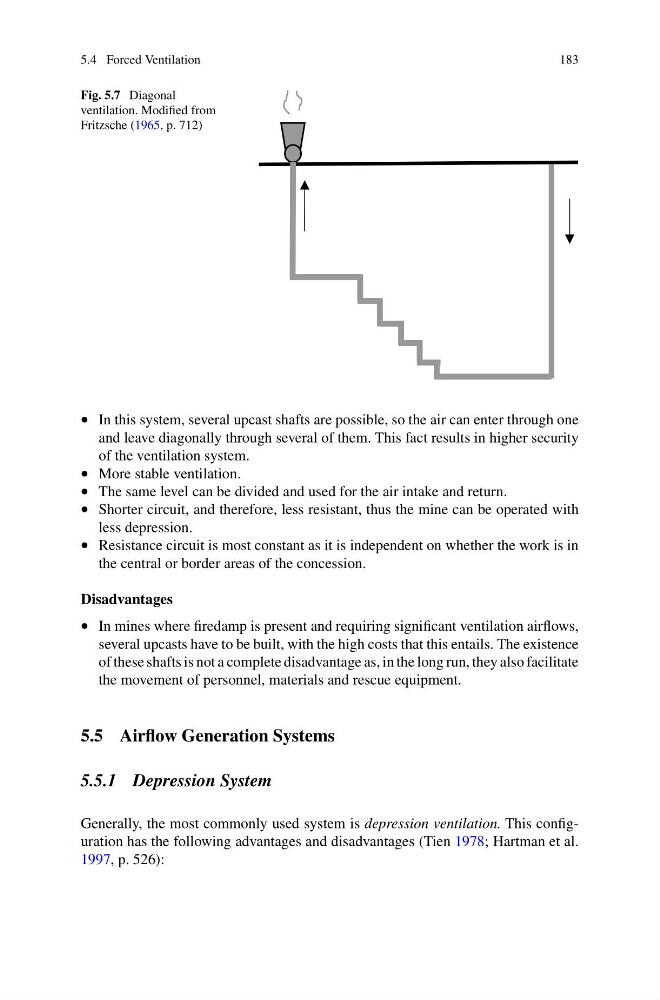
Fig. 5.7 Diagonal
ventilation. Modified from
Fritzsche (1965, p. 712)
• In this system, several upcast shafts are possible, so the air can enter through one
and leave diagonally through several of them. This fact results in higher security
of the ventilation system.
• More stable ventilation.
• The same level can be divided and used for the air intake and return.
• Shorter circuit, and therefore, less resistant, thus the mine can be operated with
less depression.
• Resistance circuit is most constant as it is independent on whether the work is in
the central or border areas of the concession.
Disadvantages
• In mines where firedamp is present and requiring significant ventilation airflows,
several upcasts have to be built, with the high costs that this entails. The existence
of these shafts is not a complete disadvantage as, in the long run, they also facilitate
the movement of personnel, materials and rescue equipment.
5.5 Airflow Generation Systems
5.5.1 Depression System
Generally, the most commonly used system is depression ventilation. This configuration has the following advantages and disadvantages (Tien 1978; Hartman et al.
1997, p. 526):
183
Fig. 5.7 Diagonal
ventilation. Modified from
Fritzsche (1965, p. 712)
• In this system, several upcast shafts are possible, so the air can enter through one
and leave diagonally through several of them. This fact results in higher security
of the ventilation system.
• More stable ventilation.
• The same level can be divided and used for the air intake and return.
• Shorter circuit, and therefore, less resistant, thus the mine can be operated with
less depression.
• Resistance circuit is most constant as it is independent on whether the work is in
the central or border areas of the concession.
Disadvantages
• In mines where firedamp is present and requiring significant ventilation airflows,
several upcasts have to be built, with the high costs that this entails. The existence
of these shafts is not a complete disadvantage as, in the long run, they also facilitate
the movement of personnel, materials and rescue equipment.
5.5 Airflow Generation Systems
5.5.1 Depression System
Generally, the most commonly used system is depression ventilation. This configuration has the following advantages and disadvantages (Tien 1978; Hartman et al.
1997, p. 526):