

172
5 Main Ventilation
Therefore, the Natural Ventilation Pressure (P n ) is (Eq. 5.8):
P n = P 2 − P 3
(5.8)
Note that the same pressure (P 1 ) has been assumed outside both shafts. Note also
that these calculations have been simplified to a static problem while the problem is
actually dynamic due to air movement.
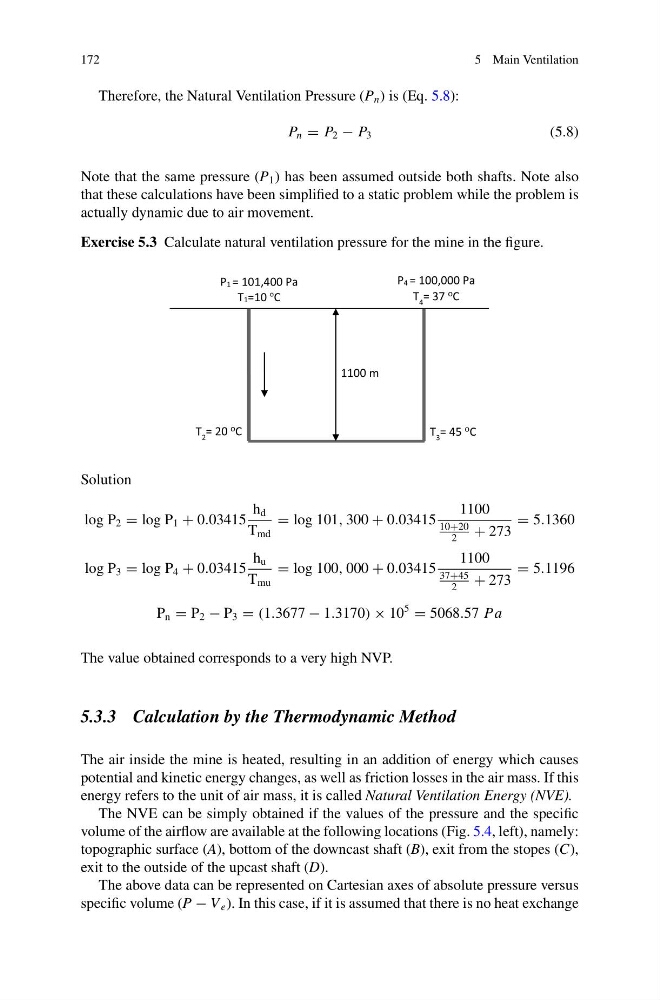
Exercise 5.3 Calculate natural ventilation pressure for the mine in the figure.
P1 = 101,400 Pa
T1=10
o C
T 2 = 20 o C
T 3 = 45 o C
P4 = 100,000 Pa
T 4 = 37 o C
1100 m
Solution
log P 2 = log P 1 + 0.03415
h d
T md
= log 101, 300 + 0.03415
1100
10+20
2
+ 273
= 5.1360
log P 3 = log P 4 + 0.03415
h u
T mu
= log 100, 000 + 0.03415
1100
37+45
2
+ 273
= 5.1196
P n = P 2 − P 3 = (1.3677 − 1.3170) × 10
5
= 5068.57 Pa
The value obtained corresponds to a very high NVP.
5.3.3 Calculation by the Thermodynamic Method
The air inside the mine is heated, resulting in an addition of energy which causes
potential and kinetic energy changes, as well as friction losses in the air mass. If this
energy refers to the unit of air mass, it is called Natural Ventilation Energy (NVE).
The NVE can be simply obtained if the values of the pressure and the specific
volume of the airflow are available at the following locations (Fig. 5.4, left), namely:
topographic surface (A), bottom of the downcast shaft (B), exit from the stopes (C),
exit to the outside of the upcast shaft (D).
The above data can be represented on Cartesian axes of absolute pressure versus
specific volume (P − V e ). In this case, if it is assumed that there is no heat exchange
5 Main Ventilation
Therefore, the Natural Ventilation Pressure (P n ) is (Eq. 5.8):
P n = P 2 − P 3
(5.8)
Note that the same pressure (P 1 ) has been assumed outside both shafts. Note also
that these calculations have been simplified to a static problem while the problem is
actually dynamic due to air movement.
Exercise 5.3 Calculate natural ventilation pressure for the mine in the figure.
P1 = 101,400 Pa
T1=10
o C
T 2 = 20 o C
T 3 = 45 o C
P4 = 100,000 Pa
T 4 = 37 o C
1100 m
Solution
log P 2 = log P 1 + 0.03415
h d
T md
= log 101, 300 + 0.03415
1100
10+20
2
+ 273
= 5.1360
log P 3 = log P 4 + 0.03415
h u
T mu
= log 100, 000 + 0.03415
1100
37+45
2
+ 273
= 5.1196
P n = P 2 − P 3 = (1.3677 − 1.3170) × 10
5
= 5068.57 Pa
The value obtained corresponds to a very high NVP.
5.3.3 Calculation by the Thermodynamic Method
The air inside the mine is heated, resulting in an addition of energy which causes
potential and kinetic energy changes, as well as friction losses in the air mass. If this
energy refers to the unit of air mass, it is called Natural Ventilation Energy (NVE).
The NVE can be simply obtained if the values of the pressure and the specific
volume of the airflow are available at the following locations (Fig. 5.4, left), namely:
topographic surface (A), bottom of the downcast shaft (B), exit from the stopes (C),
exit to the outside of the upcast shaft (D).
The above data can be represented on Cartesian axes of absolute pressure versus
specific volume (P − V e ). In this case, if it is assumed that there is no heat exchange