

5.3 Natural Ventilation
171
5.3.2 Calculation of the Logarithmic Formula Method
Despite the simplifications in the previous section, pressure does increase with depth,
and its increase takes place in a nonlinear manner. In order to consider this fact, the
following expression was developed. A height differential (dL), of a dry air column
of height h, increases the hydrostatic pressure at its base (A) by a value dP. Therefore,
establishing the balance of forces, we have:
A dP = γ A dL
where γ is the specific weight of air. This value can be obtained from the general
gas equation, therefore:
A dP =
P
R w T
A dL
where
R: Constant of gases (per unit mass)
J
K kg
.
Simplified:
dP =
P
R T
dL
Integrating between the pressure at the top of the downcast shaft (P 1 ) and the pressure at the bottom (P 2 ), for a depth of the shaft (h), and considering the temperature
as an integration constant (T md ), we have:
P 2
∫
P 1
dP
P
=
h d
∫
0
dL
R T md
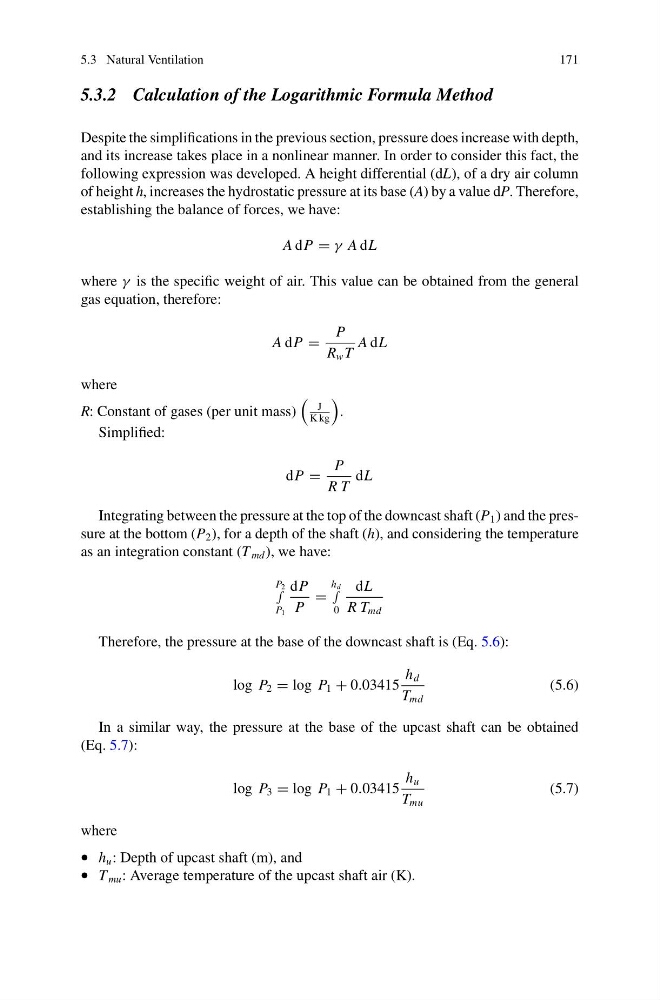
Therefore, the pressure at the base of the downcast shaft is (Eq. 5.6):
log P 2 = log P 1 + 0.03415
h d
T md
(5.6)
In a similar way, the pressure at the base of the upcast shaft can be obtained
(Eq. 5.7):
log P 3 = log P 1 + 0.03415
h u
T mu
(5.7)
where
• h u : Depth of upcast shaft (m), and
• T mu : Average temperature of the upcast shaft air (K).
171
5.3.2 Calculation of the Logarithmic Formula Method
Despite the simplifications in the previous section, pressure does increase with depth,
and its increase takes place in a nonlinear manner. In order to consider this fact, the
following expression was developed. A height differential (dL), of a dry air column
of height h, increases the hydrostatic pressure at its base (A) by a value dP. Therefore,
establishing the balance of forces, we have:
A dP = γ A dL
where γ is the specific weight of air. This value can be obtained from the general
gas equation, therefore:
A dP =
P
R w T
A dL
where
R: Constant of gases (per unit mass)
J
K kg
.
Simplified:
dP =
P
R T
dL
Integrating between the pressure at the top of the downcast shaft (P 1 ) and the pressure at the bottom (P 2 ), for a depth of the shaft (h), and considering the temperature
as an integration constant (T md ), we have:
P 2
∫
P 1
dP
P
=
h d
∫
0
dL
R T md
Therefore, the pressure at the base of the downcast shaft is (Eq. 5.6):
log P 2 = log P 1 + 0.03415
h d
T md
(5.6)
In a similar way, the pressure at the base of the upcast shaft can be obtained
(Eq. 5.7):
log P 3 = log P 1 + 0.03415
h u
T mu
(5.7)
where
• h u : Depth of upcast shaft (m), and
• T mu : Average temperature of the upcast shaft air (K).