

162
5 Main Ventilation
• Reducing the transmission of infectious diseases (flu, COVID-19, tuberculosis,
etc.) among workers, when necessary.
1
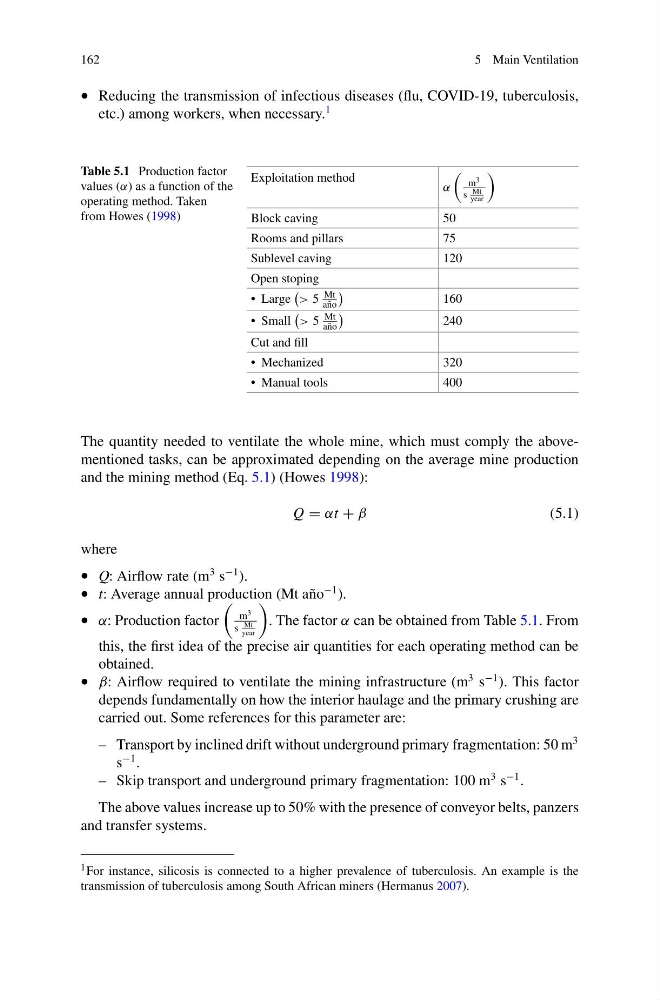
Table 5.1 Production factor
values (α) as a function of the
operating method. Taken
from Howes (1998)
Exploitation method
α
m 3
s
Mt
year
Block caving
50
Rooms and pillars
75
Sublevel caving
120
Open stoping
• Large
> 5
Mt
a˜ no
160
• Small
> 5
Mt
a˜ no
240
Cut and fill
• Mechanized
320
• Manual tools
400
The quantity needed to ventilate the whole mine, which must comply the abovementioned tasks, can be approximated depending on the average mine production
and the mining method (Eq. 5.1) (Howes 1998):
Q = αt + β
(5.1)
where
• Q: Airflow rate (m
3 s
−1 ).
• t: Average annual production (Mt año
−1 ).
• α: Production factor
m
3
s
Mt
year
. The factor α can be obtained from Table 5.1. From
this, the first idea of the precise air quantities for each operating method can be
obtained.
• β: Airflow required to ventilate the mining infrastructure (m
3 s
−1 ). This factor
depends fundamentally on how the interior haulage and the primary crushing are
carried out. Some references for this parameter are:
– Transport by inclined drift without underground primary fragmentation: 50 m
3
s
−1 .
– Skip transport and underground primary fragmentation: 100 m
3 s
−1 .
The above values increase up to 50% with the presence of conveyor belts, panzers
and transfer systems.
1 For instance, silicosis is connected to a higher prevalence of tuberculosis. An example is the
transmission of tuberculosis among South African miners (Hermanus 2007).
5 Main Ventilation
• Reducing the transmission of infectious diseases (flu, COVID-19, tuberculosis,
etc.) among workers, when necessary.
1
Table 5.1 Production factor
values (α) as a function of the
operating method. Taken
from Howes (1998)
Exploitation method
α
m 3
s
Mt
year
Block caving
50
Rooms and pillars
75
Sublevel caving
120
Open stoping
• Large
> 5
Mt
a˜ no
160
• Small
> 5
Mt
a˜ no
240
Cut and fill
• Mechanized
320
• Manual tools
400
The quantity needed to ventilate the whole mine, which must comply the abovementioned tasks, can be approximated depending on the average mine production
and the mining method (Eq. 5.1) (Howes 1998):
Q = αt + β
(5.1)
where
• Q: Airflow rate (m
3 s
−1 ).
• t: Average annual production (Mt año
−1 ).
• α: Production factor
m
3
s
Mt
year
. The factor α can be obtained from Table 5.1. From
this, the first idea of the precise air quantities for each operating method can be
obtained.
• β: Airflow required to ventilate the mining infrastructure (m
3 s
−1 ). This factor
depends fundamentally on how the interior haulage and the primary crushing are
carried out. Some references for this parameter are:
– Transport by inclined drift without underground primary fragmentation: 50 m
3
s
−1 .
– Skip transport and underground primary fragmentation: 100 m
3 s
−1 .
The above values increase up to 50% with the presence of conveyor belts, panzers
and transfer systems.
1 For instance, silicosis is connected to a higher prevalence of tuberculosis. An example is the
transmission of tuberculosis among South African miners (Hermanus 2007).