

140
4 Mine Ventilation Networks
P i = R i Q
2
i
1 + 2
Q
Q i
+
Q
Q i
2
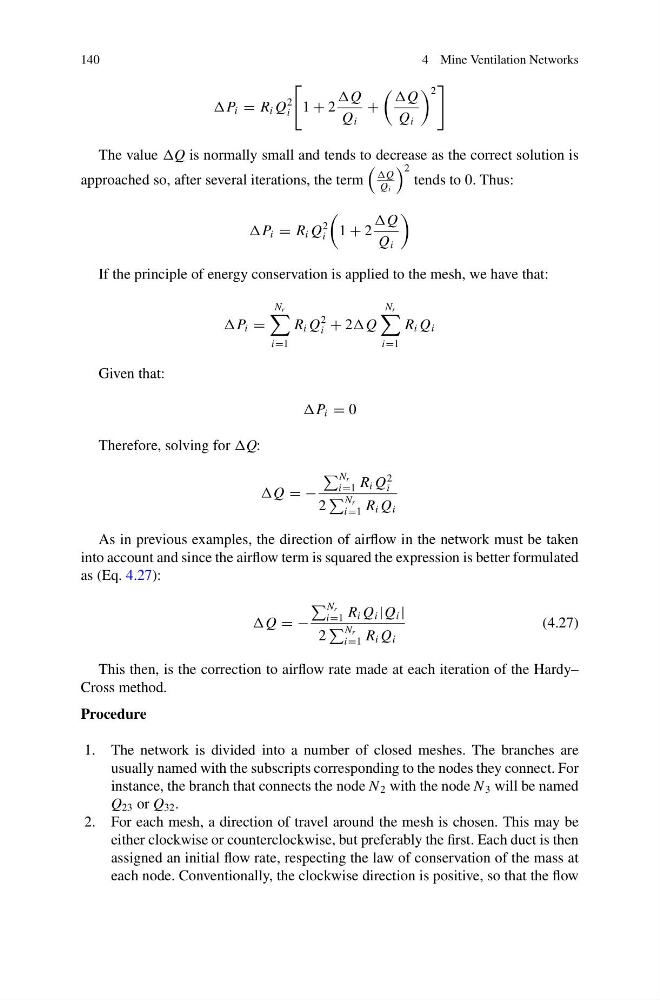
The value Q is normally small and tends to decrease as the correct solution is
approached so, after several iterations, the term
Q
Q i
2
tends to 0. Thus:
P i = R i Q
2
i
1 + 2
Q
Q i
If the principle of energy conservation is applied to the mesh, we have that:
P i =
N r
i=1
R i Q
2
i + 2Q
N r
i=1
R i Q i
Given that:
P i = 0
Therefore, solving for Q:
Q = −
N r
i=1 R i Q
2
i
2
N r
i=1 R i Q i
As in previous examples, the direction of airflow in the network must be taken
into account and since the airflow term is squared the expression is better formulated
as (Eq. 4.27):
Q = −
N r
i=1 R i Q i |Q i |
2
N r
i=1 R i Q i
(4.27)
This then, is the correction to airflow rate made at each iteration of the Hardy–
Cross method.
Procedure
1. The network is divided into a number of closed meshes. The branches are
usually named with the subscripts corresponding to the nodes they connect. For
instance, the branch that connects the node N 2 with the node N 3 will be named
Q 23 or Q 32 .
2. For each mesh, a direction of travel around the mesh is chosen. This may be
either clockwise or counterclockwise, but preferably the first. Each duct is then
assigned an initial flow rate, respecting the law of conservation of the mass at
each node. Conventionally, the clockwise direction is positive, so that the flow
4 Mine Ventilation Networks
P i = R i Q
2
i
1 + 2
Q
Q i
+
Q
Q i
2
The value Q is normally small and tends to decrease as the correct solution is
approached so, after several iterations, the term
Q
Q i
2
tends to 0. Thus:
P i = R i Q
2
i
1 + 2
Q
Q i
If the principle of energy conservation is applied to the mesh, we have that:
P i =
N r
i=1
R i Q
2
i + 2Q
N r
i=1
R i Q i
Given that:
P i = 0
Therefore, solving for Q:
Q = −
N r
i=1 R i Q
2
i
2
N r
i=1 R i Q i
As in previous examples, the direction of airflow in the network must be taken
into account and since the airflow term is squared the expression is better formulated
as (Eq. 4.27):
Q = −
N r
i=1 R i Q i |Q i |
2
N r
i=1 R i Q i
(4.27)
This then, is the correction to airflow rate made at each iteration of the Hardy–
Cross method.
Procedure
1. The network is divided into a number of closed meshes. The branches are
usually named with the subscripts corresponding to the nodes they connect. For
instance, the branch that connects the node N 2 with the node N 3 will be named
Q 23 or Q 32 .
2. For each mesh, a direction of travel around the mesh is chosen. This may be
either clockwise or counterclockwise, but preferably the first. Each duct is then
assigned an initial flow rate, respecting the law of conservation of the mass at
each node. Conventionally, the clockwise direction is positive, so that the flow