

136
4 Mine Ventilation Networks
4.10.2 Newton’s Method
The Newton–Raphson method, widely used for the solution of fluid network problems, is an iterative method of calculation used to find the roots of a real non-linear
function or a system of non-linear functions. It is often found under the method
names of Newton, Newton–Raphson, and Newton–Fourier, after the scientists and
mathematicians associated with its development.
The method can be applied to any continuous, differentiable function, f (x) that
intersects the x-axis at least once. The method allows us to approach the value of x
for which f (x) = 0 through a series of calculations of the tangent to f (x).
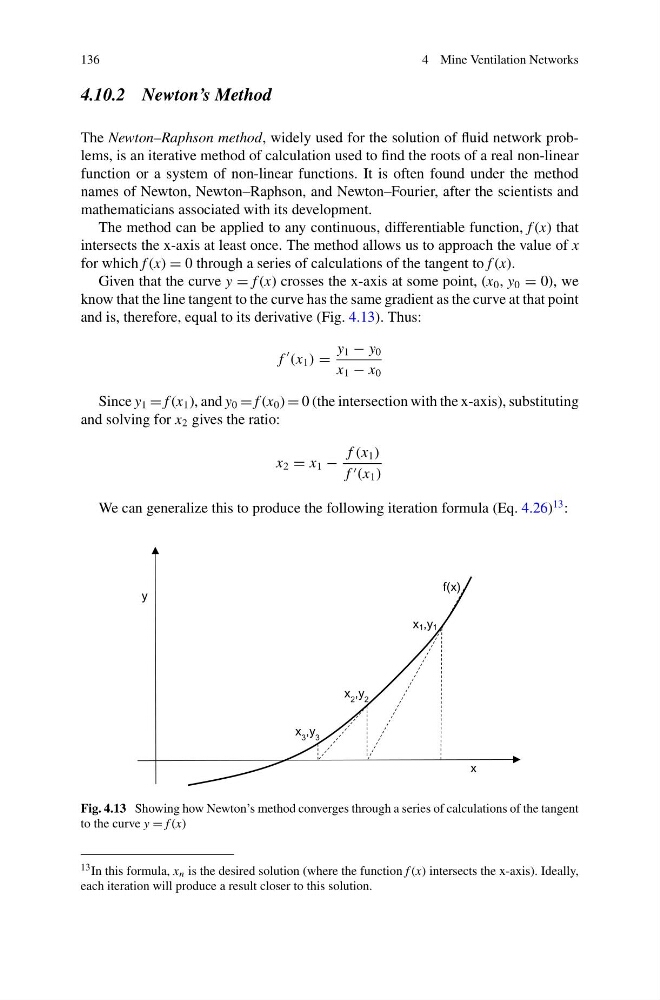
Given that the curve y = f (x) crosses the x-axis at some point, (x 0 , y 0 = 0), we
know that the line tangent to the curve has the same gradient as the curve at that point
and is, therefore, equal to its derivative (Fig. 4.13). Thus:
f
(x 1 ) =
y 1 − y 0
x 1 − x 0
Since y 1 = f (x 1 ), and y 0 = f (x 0 ) = 0 (the intersection with the x-axis), substituting
and solving for x 2 gives the ratio:
x 2 = x 1 −
f (x 1 )
f (x 1 )
We can generalize this to produce the following iteration formula (Eq. 4.26)
13 :
x 1 ,y 1
x 2 ,y 2
x 3 ,y 3
y
x
f(x)
Fig. 4.13 Showing how Newton’s method converges through a series of calculations of the tangent
to the curve y = f (x)
13 In this formula, x n is the desired solution (where the function f (x) intersects the x-axis). Ideally,
each iteration will produce a result closer to this solution.
4 Mine Ventilation Networks
4.10.2 Newton’s Method
The Newton–Raphson method, widely used for the solution of fluid network problems, is an iterative method of calculation used to find the roots of a real non-linear
function or a system of non-linear functions. It is often found under the method
names of Newton, Newton–Raphson, and Newton–Fourier, after the scientists and
mathematicians associated with its development.
The method can be applied to any continuous, differentiable function, f (x) that
intersects the x-axis at least once. The method allows us to approach the value of x
for which f (x) = 0 through a series of calculations of the tangent to f (x).
Given that the curve y = f (x) crosses the x-axis at some point, (x 0 , y 0 = 0), we
know that the line tangent to the curve has the same gradient as the curve at that point
and is, therefore, equal to its derivative (Fig. 4.13). Thus:
f
(x 1 ) =
y 1 − y 0
x 1 − x 0
Since y 1 = f (x 1 ), and y 0 = f (x 0 ) = 0 (the intersection with the x-axis), substituting
and solving for x 2 gives the ratio:
x 2 = x 1 −
f (x 1 )
f (x 1 )
We can generalize this to produce the following iteration formula (Eq. 4.26)
13 :
x 1 ,y 1
x 2 ,y 2
x 3 ,y 3
y
x
f(x)
Fig. 4.13 Showing how Newton’s method converges through a series of calculations of the tangent
to the curve y = f (x)
13 In this formula, x n is the desired solution (where the function f (x) intersects the x-axis). Ideally,
each iteration will produce a result closer to this solution.