

1.2 Fluid Statics
3
P1V1=P2V2
T= cte
1
1
=
2
2
V=cte
1
1
=
2
2
P= cte
a)
b)
c)
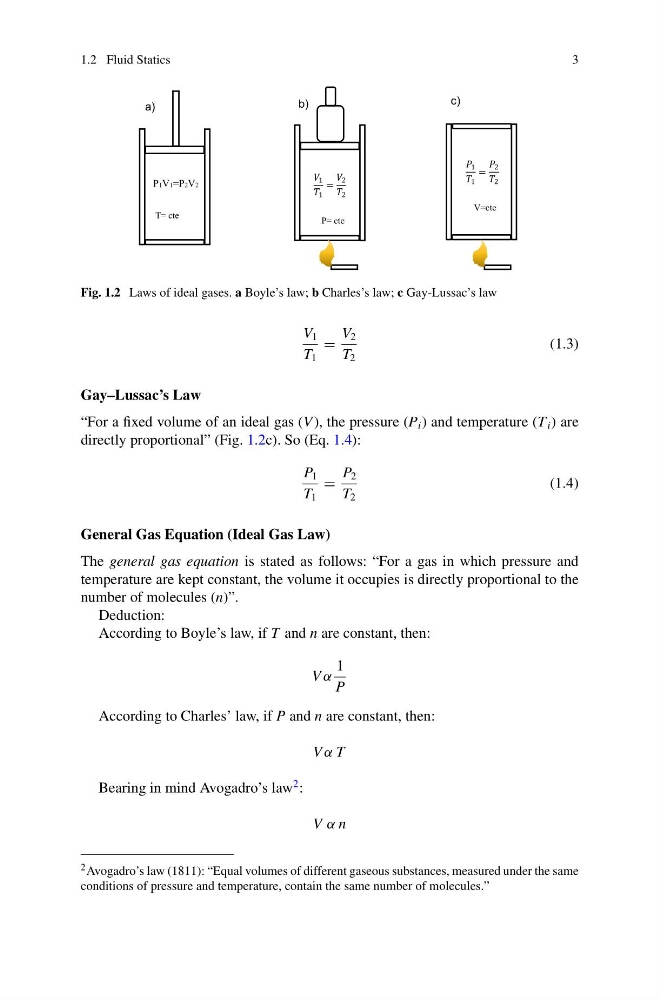
Fig. 1.2 Laws of ideal gases. a Boyle’s law; b Charles’s law; c Gay-Lussac’s law
V 1
T 1
=
V 2
T 2
(1.3)
Gay–Lussac’s Law
“For a fixed volume of an ideal gas (V ), the pressure (P i ) and temperature (T i ) are
directly proportional” (Fig. 1.2c). So (Eq. 1.4):
P 1
T 1
=
P 2
T 2
(1.4)
General Gas Equation (Ideal Gas Law)
The general gas equation is stated as follows: “For a gas in which pressure and
temperature are kept constant, the volume it occupies is directly proportional to the
number of molecules (n)”.
Deduction:
According to Boyle’s law, if T and n are constant, then:
V α
1
P
According to Charles’ law, if P and n are constant, then:
V α T
Bearing in mind Avogadro’s law
2 :
V α n
2 Avogadro’s law (1811): “Equal volumes of different gaseous substances, measured under the same
conditions of pressure and temperature, contain the same number of molecules.”
3
P1V1=P2V2
T= cte
1
1
=
2
2
V=cte
1
1
=
2
2
P= cte
a)
b)
c)
Fig. 1.2 Laws of ideal gases. a Boyle’s law; b Charles’s law; c Gay-Lussac’s law
V 1
T 1
=
V 2
T 2
(1.3)
Gay–Lussac’s Law
“For a fixed volume of an ideal gas (V ), the pressure (P i ) and temperature (T i ) are
directly proportional” (Fig. 1.2c). So (Eq. 1.4):
P 1
T 1
=
P 2
T 2
(1.4)
General Gas Equation (Ideal Gas Law)
The general gas equation is stated as follows: “For a gas in which pressure and
temperature are kept constant, the volume it occupies is directly proportional to the
number of molecules (n)”.
Deduction:
According to Boyle’s law, if T and n are constant, then:
V α
1
P
According to Charles’ law, if P and n are constant, then:
V α T
Bearing in mind Avogadro’s law
2 :
V α n
2 Avogadro’s law (1811): “Equal volumes of different gaseous substances, measured under the same
conditions of pressure and temperature, contain the same number of molecules.”