

2
1 Fundamental Concepts of Fluid Mechanics for Mine Ventilation
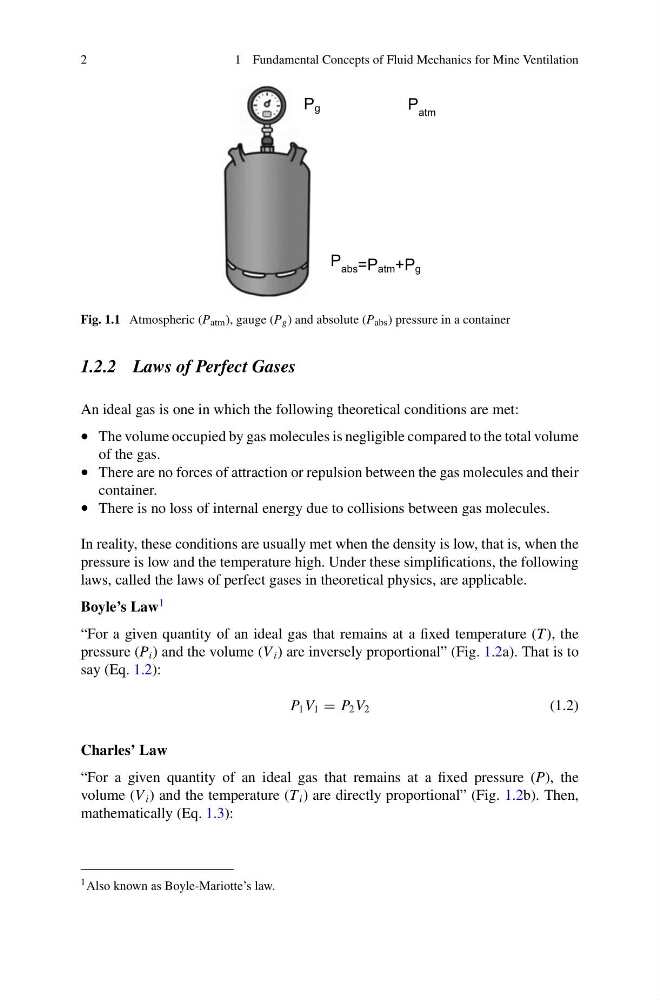
P g
P atm
P abs =P atm +P g
Fig. 1.1 Atmospheric (P atm ), gauge (P g ) and absolute (P abs ) pressure in a container
1.2.2 Laws of Perfect Gases
An ideal gas is one in which the following theoretical conditions are met:
• The volume occupied by gas molecules is negligible compared to the total volume
of the gas.
• There are no forces of attraction or repulsion between the gas molecules and their
container.
• There is no loss of internal energy due to collisions between gas molecules.
In reality, these conditions are usually met when the density is low, that is, when the
pressure is low and the temperature high. Under these simplifications, the following
laws, called the laws of perfect gases in theoretical physics, are applicable.
Boyle’s Law
1
“For a given quantity of an ideal gas that remains at a fixed temperature (T ), the
pressure (P i ) and the volume (V i ) are inversely proportional” (Fig. 1.2a). That is to
say (Eq. 1.2):
P 1 V 1 = P 2 V 2
(1.2)
Charles’ Law
“For a given quantity of an ideal gas that remains at a fixed pressure (P), the
volume (V i ) and the temperature (T i ) are directly proportional” (Fig. 1.2b). Then,
mathematically (Eq. 1.3):
1 Also known as Boyle-Mariotte’s law.
1 Fundamental Concepts of Fluid Mechanics for Mine Ventilation
P g
P atm
P abs =P atm +P g
Fig. 1.1 Atmospheric (P atm ), gauge (P g ) and absolute (P abs ) pressure in a container
1.2.2 Laws of Perfect Gases
An ideal gas is one in which the following theoretical conditions are met:
• The volume occupied by gas molecules is negligible compared to the total volume
of the gas.
• There are no forces of attraction or repulsion between the gas molecules and their
container.
• There is no loss of internal energy due to collisions between gas molecules.
In reality, these conditions are usually met when the density is low, that is, when the
pressure is low and the temperature high. Under these simplifications, the following
laws, called the laws of perfect gases in theoretical physics, are applicable.
Boyle’s Law
1
“For a given quantity of an ideal gas that remains at a fixed temperature (T ), the
pressure (P i ) and the volume (V i ) are inversely proportional” (Fig. 1.2a). That is to
say (Eq. 1.2):
P 1 V 1 = P 2 V 2
(1.2)
Charles’ Law
“For a given quantity of an ideal gas that remains at a fixed pressure (P), the
volume (V i ) and the temperature (T i ) are directly proportional” (Fig. 1.2b). Then,
mathematically (Eq. 1.3):
1 Also known as Boyle-Mariotte’s law.