

59
2.1 Aerofoils
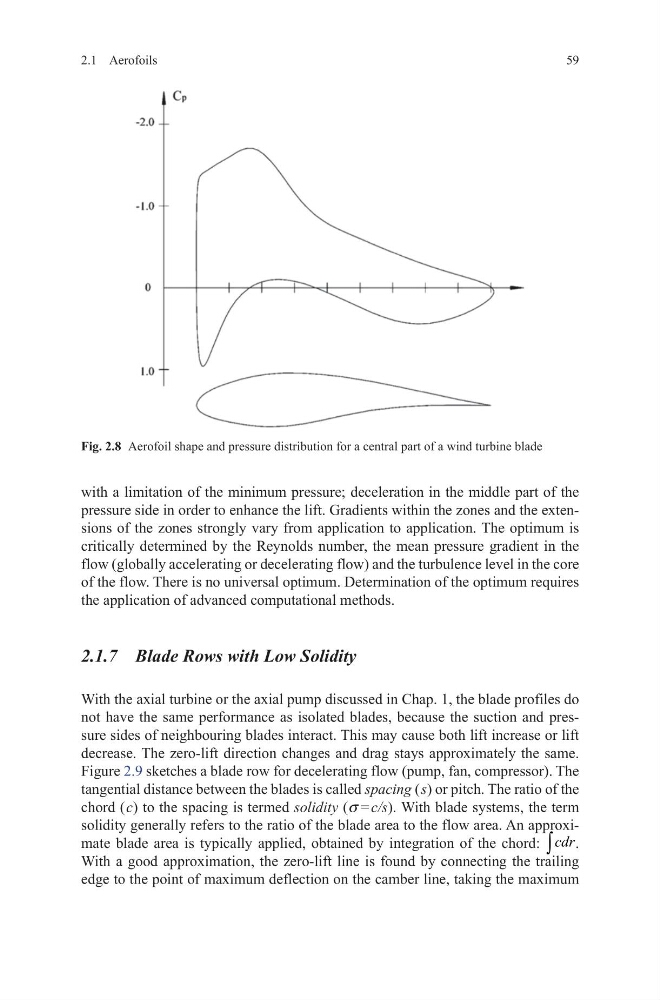
with a limitation of the minimum pressure; deceleration in the middle part of the
pressure side in order to enhance the lift. Gradients within the zones and the extensions of the zones strongly vary from application to application. The optimum is
critically determined by the Reynolds number, the mean pressure gradient in the
flow (globally accelerating or decelerating flow) and the turbulence level in the core
of the flow. There is no universal optimum. Determination of the optimum requires
the application of advanced computational methods.
2.1.7 Blade Rows with Low Solidity
With the axial turbine or the axial pump discussed in Chap. 1, the blade profiles do
not have the same performance as isolated blades, because the suction and pressure sides of neighbouring blades interact. This may cause both lift increase or lift
decrease. The zero-lift direction changes and drag stays approximately the same.
Figure 2.9 sketches a blade row for decelerating flow (pump, fan, compressor). The
tangential distance between the blades is called spacing ( s) or pitch. The ratio of the
chord ( c) to the spacing is termed solidity (s = c/s). With blade systems, the term
solidity generally refers to the ratio of the blade area to the flow area. An approximate blade area is typically applied, obtained by integration of the chord: cdr
∫ .
With a good approximation, the zero-lift line is found by connecting the trailing
edge to the point of maximum deflection on the camber line, taking the maximum
Fig. 2.8 Aerofoil shape and pressure distribution for a central part of a wind turbine blade
2.1 Aerofoils
with a limitation of the minimum pressure; deceleration in the middle part of the
pressure side in order to enhance the lift. Gradients within the zones and the extensions of the zones strongly vary from application to application. The optimum is
critically determined by the Reynolds number, the mean pressure gradient in the
flow (globally accelerating or decelerating flow) and the turbulence level in the core
of the flow. There is no universal optimum. Determination of the optimum requires
the application of advanced computational methods.
2.1.7 Blade Rows with Low Solidity
With the axial turbine or the axial pump discussed in Chap. 1, the blade profiles do
not have the same performance as isolated blades, because the suction and pressure sides of neighbouring blades interact. This may cause both lift increase or lift
decrease. The zero-lift direction changes and drag stays approximately the same.
Figure 2.9 sketches a blade row for decelerating flow (pump, fan, compressor). The
tangential distance between the blades is called spacing ( s) or pitch. The ratio of the
chord ( c) to the spacing is termed solidity (s = c/s). With blade systems, the term
solidity generally refers to the ratio of the blade area to the flow area. An approximate blade area is typically applied, obtained by integration of the chord: cdr
∫ .
With a good approximation, the zero-lift line is found by connecting the trailing
edge to the point of maximum deflection on the camber line, taking the maximum
Fig. 2.8 Aerofoil shape and pressure distribution for a central part of a wind turbine blade