

42
1 Working Principles
A: P
k W P
kW P
k W
shaft
p ropulsion
residual
= =
=
513
395
118
,
,
.
1.9.5 Consider the Pelton turbine of Exercise 1.9.1 once more. Determine the
force exerted on the blade in the jet direction, if the blade runs with velocity v/2
and velocity v with respect to the nozzle. Derive the dependence of the force on the
speed. Determine the power exchanged as a function of the speed. At which speed
does the power attain its maximum? Explain why the power does not equal the
energy flux of the water jet.
A: F x is linearly decreasing with the blade speed, going from the force at stand
still to zero for speed equal to the jet velocity. Power is at maximum at blade speed
equal to half the jet velocity. The difference between the energy flux of the jet and
the output power is the power associated with the kinetic energy dissipated into the
atmosphere.
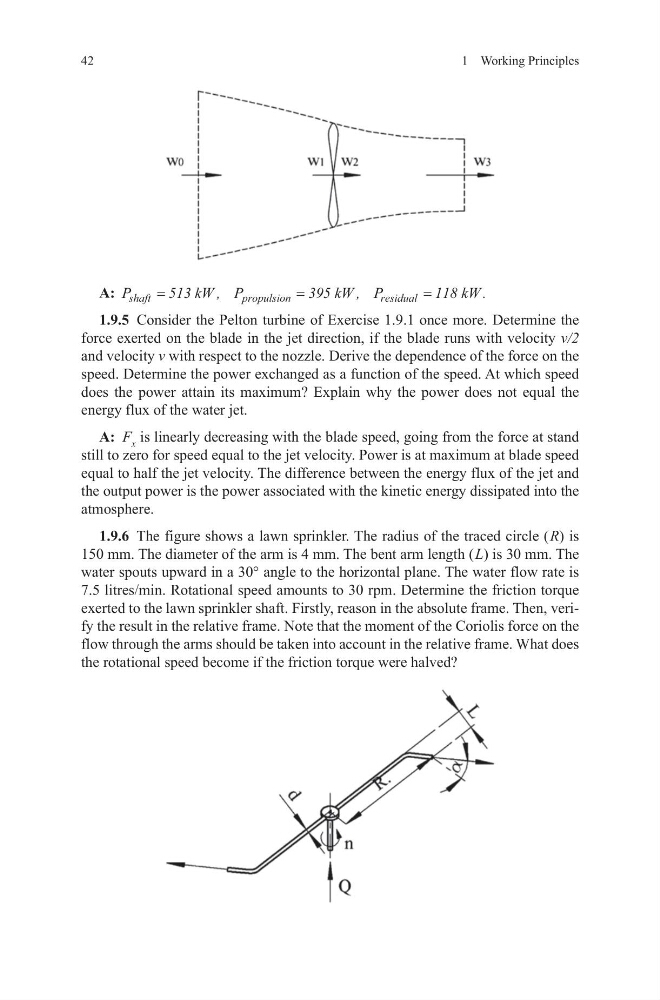
1.9.6 The figure shows a lawn sprinkler. The radius of the traced circle ( R) is
150 mm. The diameter of the arm is 4 mm. The bent arm length ( L) is 30 mm. The
water spouts upward in a 30° angle to the horizontal plane. The water flow rate is
7.5 litres/min. Rotational speed amounts to 30 rpm. Determine the friction torque
exerted to the lawn sprinkler shaft. Firstly, reason in the absolute frame. Then, verify the result in the relative frame. Note that the moment of the Coriolis force on the
flow through the arms should be taken into account in the relative frame. What does
the rotational speed become if the friction torque were halved?
1 Working Principles
A: P
k W P
kW P
k W
shaft
p ropulsion
residual
= =
=
513
395
118
,
,
.
1.9.5 Consider the Pelton turbine of Exercise 1.9.1 once more. Determine the
force exerted on the blade in the jet direction, if the blade runs with velocity v/2
and velocity v with respect to the nozzle. Derive the dependence of the force on the
speed. Determine the power exchanged as a function of the speed. At which speed
does the power attain its maximum? Explain why the power does not equal the
energy flux of the water jet.
A: F x is linearly decreasing with the blade speed, going from the force at stand
still to zero for speed equal to the jet velocity. Power is at maximum at blade speed
equal to half the jet velocity. The difference between the energy flux of the jet and
the output power is the power associated with the kinetic energy dissipated into the
atmosphere.
1.9.6 The figure shows a lawn sprinkler. The radius of the traced circle ( R) is
150 mm. The diameter of the arm is 4 mm. The bent arm length ( L) is 30 mm. The
water spouts upward in a 30° angle to the horizontal plane. The water flow rate is
7.5 litres/min. Rotational speed amounts to 30 rpm. Determine the friction torque
exerted to the lawn sprinkler shaft. Firstly, reason in the absolute frame. Then, verify the result in the relative frame. Note that the moment of the Coriolis force on the
flow through the arms should be taken into account in the relative frame. What does
the rotational speed become if the friction torque were halved?