

41
1.9 Exercises
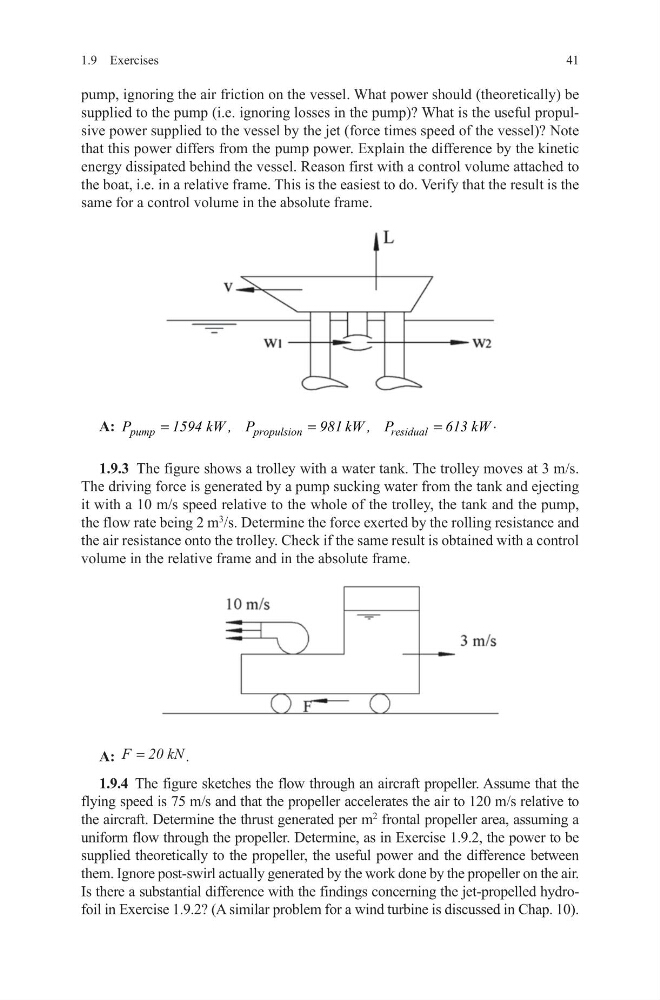
pump, ignoring the air friction on the vessel. What power should (theoretically) be
supplied to the pump (i.e. ignoring losses in the pump)? What is the useful propulsive power supplied to the vessel by the jet (force times speed of the vessel)? Note
that this power differs from the pump power. Explain the difference by the kinetic
energy dissipated behind the vessel. Reason first with a control volume attached to
the boat, i.e. in a relative frame. This is the easiest to do. Verify that the result is the
same for a control volume in the absolute frame.
A: pump
propulsion
residual
P
1594 kW , P
981 kW , P
613 kW
=
=
=
.
1.9.3 The figure shows a trolley with a water tank. The trolley moves at 3 m/s.
The driving force is generated by a pump sucking water from the tank and ejecting
it with a 10 m/s speed relative to the whole of the trolley, the tank and the pump,
the flow rate being 2 m
3
/s. Determine the force exerted by the rolling resistance and
the air resistance onto the trolley. Check if the same result is obtained with a control
volume in the relative frame and in the absolute frame.
A: F
kN
= 20 .
1.9.4 The figure sketches the flow through an aircraft propeller. Assume that the
flying speed is 75 m/s and that the propeller accelerates the air to 120 m/s relative to
the aircraft. Determine the thrust generated per m
2
frontal propeller area, assuming a
uniform flow through the propeller. Determine, as in Exercise 1.9.2, the power to be
supplied theoretically to the propeller, the useful power and the difference between
them. Ignore post-swirl actually generated by the work done by the propeller on the air.
Is there a substantial difference with the findings concerning the jet-propelled hydrofoil in Exercise 1.9.2? (A similar problem for a wind turbine is discussed in Chap. 10).
1.9 Exercises
pump, ignoring the air friction on the vessel. What power should (theoretically) be
supplied to the pump (i.e. ignoring losses in the pump)? What is the useful propulsive power supplied to the vessel by the jet (force times speed of the vessel)? Note
that this power differs from the pump power. Explain the difference by the kinetic
energy dissipated behind the vessel. Reason first with a control volume attached to
the boat, i.e. in a relative frame. This is the easiest to do. Verify that the result is the
same for a control volume in the absolute frame.
A: pump
propulsion
residual
P
1594 kW , P
981 kW , P
613 kW
=
=
=
.
1.9.3 The figure shows a trolley with a water tank. The trolley moves at 3 m/s.
The driving force is generated by a pump sucking water from the tank and ejecting
it with a 10 m/s speed relative to the whole of the trolley, the tank and the pump,
the flow rate being 2 m
3
/s. Determine the force exerted by the rolling resistance and
the air resistance onto the trolley. Check if the same result is obtained with a control
volume in the relative frame and in the absolute frame.
A: F
kN
= 20 .
1.9.4 The figure sketches the flow through an aircraft propeller. Assume that the
flying speed is 75 m/s and that the propeller accelerates the air to 120 m/s relative to
the aircraft. Determine the thrust generated per m
2
frontal propeller area, assuming a
uniform flow through the propeller. Determine, as in Exercise 1.9.2, the power to be
supplied theoretically to the propeller, the useful power and the difference between
them. Ignore post-swirl actually generated by the work done by the propeller on the air.
Is there a substantial difference with the findings concerning the jet-propelled hydrofoil in Exercise 1.9.2? (A similar problem for a wind turbine is discussed in Chap. 10).