

38
1 Working Principles
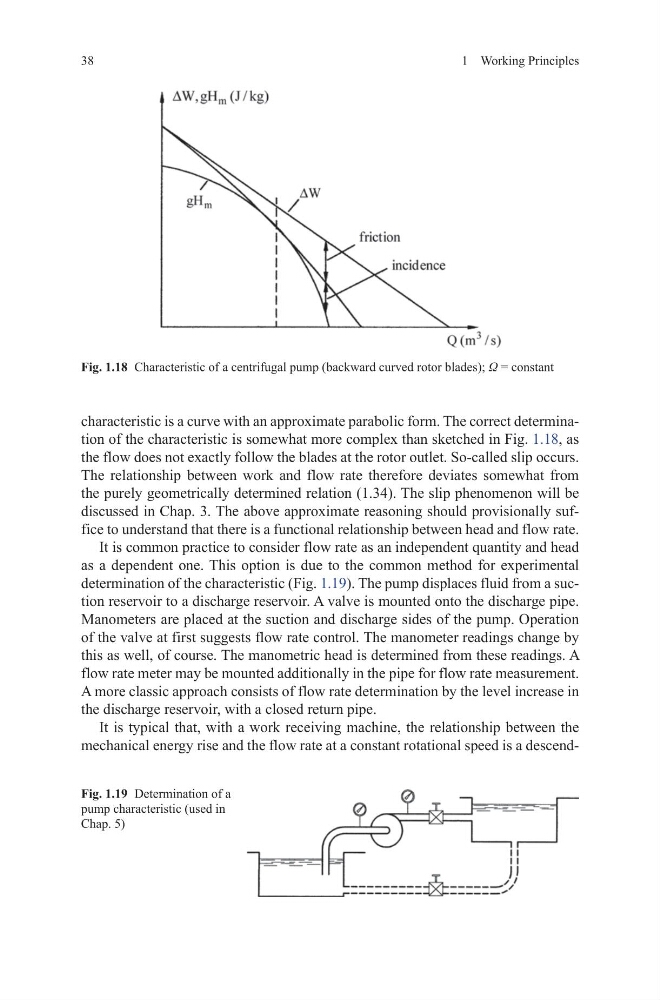
characteristic is a curve with an approximate parabolic form. The correct determination of the characteristic is somewhat more complex than sketched in Fig. 1.18, as
the flow does not exactly follow the blades at the rotor outlet. So-called slip occurs.
The relationship between work and flow rate therefore deviates somewhat from
the purely geometrically determined relation (1.34). The slip phenomenon will be
discussed in Chap. 3. The above approximate reasoning should provisionally suffice to understand that there is a functional relationship between head and flow rate.
It is common practice to consider flow rate as an independent quantity and head
as a dependent one. This option is due to the common method for experimental
determination of the characteristic (Fig. 1.19). The pump displaces fluid from a suction reservoir to a discharge reservoir. A valve is mounted onto the discharge pipe.
Manometers are placed at the suction and discharge sides of the pump. Operation
of the valve at first suggests flow rate control. The manometer readings change by
this as well, of course. The manometric head is determined from these readings. A
flow rate meter may be mounted additionally in the pipe for flow rate measurement.
A more classic approach consists of flow rate determination by the level increase in
the discharge reservoir, with a closed return pipe.
It is typical that, with a work receiving machine, the relationship between the
mechanical energy rise and the flow rate at a constant rotational speed is a descendFig. 1.18 Characteristic of a centrifugal pump (backward curved rotor blades); Ω = constant
Fig. 1.19 Determination of a
pump characteristic (used in
Chap. 5)
1 Working Principles
characteristic is a curve with an approximate parabolic form. The correct determination of the characteristic is somewhat more complex than sketched in Fig. 1.18, as
the flow does not exactly follow the blades at the rotor outlet. So-called slip occurs.
The relationship between work and flow rate therefore deviates somewhat from
the purely geometrically determined relation (1.34). The slip phenomenon will be
discussed in Chap. 3. The above approximate reasoning should provisionally suffice to understand that there is a functional relationship between head and flow rate.
It is common practice to consider flow rate as an independent quantity and head
as a dependent one. This option is due to the common method for experimental
determination of the characteristic (Fig. 1.19). The pump displaces fluid from a suction reservoir to a discharge reservoir. A valve is mounted onto the discharge pipe.
Manometers are placed at the suction and discharge sides of the pump. Operation
of the valve at first suggests flow rate control. The manometer readings change by
this as well, of course. The manometric head is determined from these readings. A
flow rate meter may be mounted additionally in the pipe for flow rate measurement.
A more classic approach consists of flow rate determination by the level increase in
the discharge reservoir, with a closed return pipe.
It is typical that, with a work receiving machine, the relationship between the
mechanical energy rise and the flow rate at a constant rotational speed is a descendFig. 1.18 Characteristic of a centrifugal pump (backward curved rotor blades); Ω = constant
Fig. 1.19 Determination of a
pump characteristic (used in
Chap. 5)