

31
1.6 Energy Analysis of Turbomachines
So
or
As with the turbine, the gravitational potential energy consumed is converted into
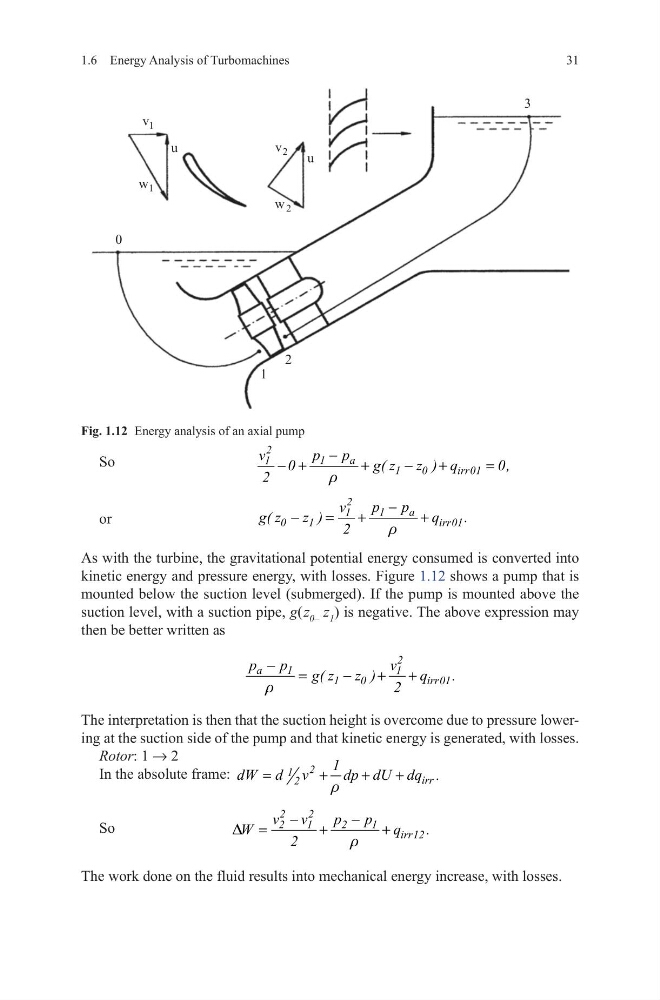
kinetic energy and pressure energy, with losses. Figure 1.12 shows a pump that is
mounted below the suction level (submerged). If the pump is mounted above the
suction level, with a suction pipe, g( z 0– z 1 ) is negative. The above expression may
then be better written as
2
a
1
1
1
0
irr01
p
p
v
g( z z )
q
.
2
r
−
=
−
+
+
The interpretation is then that the suction height is overcome due to pressure lowering at the suction side of the pump and that kinetic energy is generated, with losses.
Rotor: 1 → 2
In the absolute frame:
2
1
irr
2
1
dW d v
dp dU dq .
r
=
+
+
+
So
The work done on the fluid results into mechanical energy increase, with losses.
2
1
a
1
1
0
irr01
p p
v
0
g( z z ) q
0,
2
r
−
− +
+
−
+
=
2
1
a
1
0
1
irr01
p p
v
g( z z )
q
.
2
r
−
−
=
+
+
2
2
2
1
2
1
irr12
v v
p
p
W
q
.
2
D
r
−
−
=
+
+
1
2
0
3
u
u
1
v
2
v
1
w
2
w
Fig. 1.12 Energy analysis of an axial pump
1.6 Energy Analysis of Turbomachines
So
or
As with the turbine, the gravitational potential energy consumed is converted into
kinetic energy and pressure energy, with losses. Figure 1.12 shows a pump that is
mounted below the suction level (submerged). If the pump is mounted above the
suction level, with a suction pipe, g( z 0– z 1 ) is negative. The above expression may
then be better written as
2
a
1
1
1
0
irr01
p
p
v
g( z z )
q
.
2
r
−
=
−
+
+
The interpretation is then that the suction height is overcome due to pressure lowering at the suction side of the pump and that kinetic energy is generated, with losses.
Rotor: 1 → 2
In the absolute frame:
2
1
irr
2
1
dW d v
dp dU dq .
r
=
+
+
+
So
The work done on the fluid results into mechanical energy increase, with losses.
2
1
a
1
1
0
irr01
p p
v
0
g( z z ) q
0,
2
r
−
− +
+
−
+
=
2
1
a
1
0
1
irr01
p p
v
g( z z )
q
.
2
r
−
−
=
+
+
2
2
2
1
2
1
irr12
v v
p
p
W
q
.
2
D
r
−
−
=
+
+
1
2
0
3
u
u
1
v
2
v
1
w
2
w
Fig. 1.12 Energy analysis of an axial pump