

538
15 Axial and Radial Turbines for Gases
The coefficients s
x and r
x are the enthalpy loss coefficients of stator and rotor.
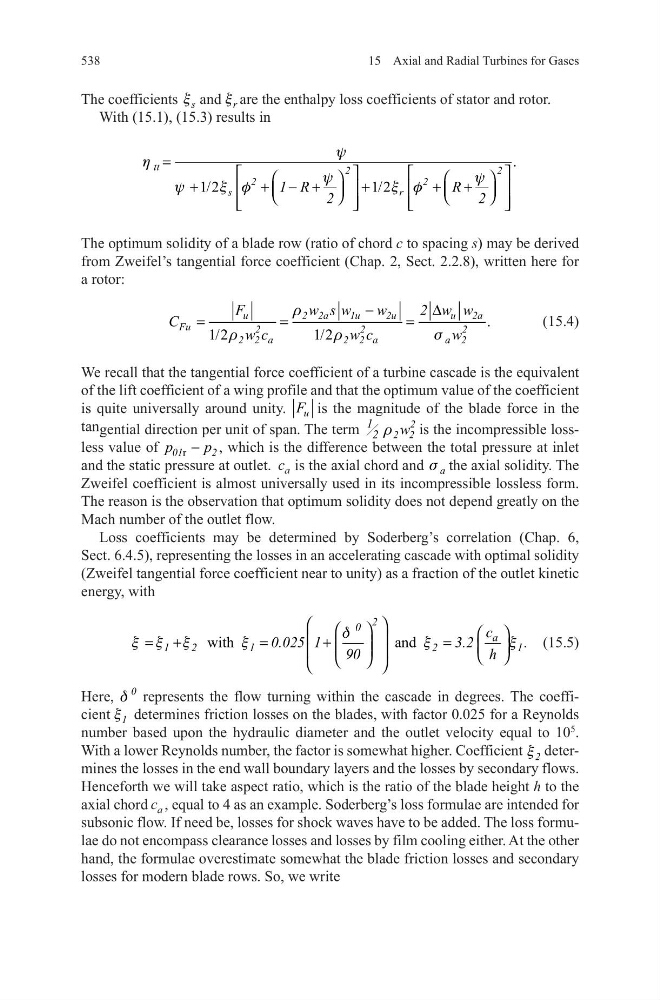
With (15.1), (15.3) results in
The optimum solidity of a blade row (ratio of chord c to spacing s) may be derived
from Zweifel’s tangential force coefficient (Chap. 2, Sect. 2.2.8), written here for
a rotor:
(15.4)
We recall that the tangential force coefficient of a turbine cascade is the equivalent
of the lift coefficient of a wing profile and that the optimum value of the coefficient
is quite universally around unity. u
F is the magnitude of the blade force in the
tan gential direction per unit of span. The term
2
2 2
1
2
w
r
is the incompressible lossless value of
r
01
2
p
p
− , which is the difference between the total pressure at inlet
and the static pressure at outlet. c a is the axial chord and a
s the axial solidity. The
Zweifel coefficient is almost universally used in its incompressible lossless form.
The reason is the observation that optimum solidity does not depend greatly on the
Mach number of the outlet flow.
Loss coefficients may be determined by Soderberg’s correlation (Chap. 6,
Sect. 6.4.5), representing the losses in an accelerating cascade with optimal solidity
(Zweifel tangential force coefficient near to unity) as a fraction of the outlet kinetic
energy, with
(15.5)
Here,
0
d represents the flow turning within the cascade in degrees. The coefficient 1
x determines friction losses on the blades, with factor 0.025 for a Reynolds
number based upon the hydraulic diameter and the outlet velocity equal to 10
5
.
With a lower Reynolds number, the factor is somewhat higher. Coefficient 2
x determines the losses in the end wall boundary layers and the losses by secondary flows.
Henceforth we will take aspect ratio, which is the ratio of the blade height h to the
axial chord c a , equal to 4 as an example. Soderberg’s loss formulae are intended for
subsonic flow. If need be, losses for shock waves have to be added. The loss formulae do not encompass clearance losses and losses by film cooling either. At the other
hand, the formulae overestimate somewhat the blade friction losses and secondary
losses for modern blade rows. So, we write
.
1/2
1/2
tt
2
2
2
2
s
r
1 R
R
2
2
y
h
y
y
y
x f
x f
=
+
+ − +
+
+
+
1/2
.
1/2
u
2 2a
1u
2u
u
2a
Fu
2
2
2
2 2 a
2 2 a
a 2
F
w s w
w
2 w w
C
w c
w c
w
r
r
r
s
−
∆
=
=
=
with
and
2
0
a
1
2
1
2
1
c
0.025 1
3.2
.
90
h
d
x x x
x
x
x
= +
=
+
=
15 Axial and Radial Turbines for Gases
The coefficients s
x and r
x are the enthalpy loss coefficients of stator and rotor.
With (15.1), (15.3) results in
The optimum solidity of a blade row (ratio of chord c to spacing s) may be derived
from Zweifel’s tangential force coefficient (Chap. 2, Sect. 2.2.8), written here for
a rotor:
(15.4)
We recall that the tangential force coefficient of a turbine cascade is the equivalent
of the lift coefficient of a wing profile and that the optimum value of the coefficient
is quite universally around unity. u
F is the magnitude of the blade force in the
tan gential direction per unit of span. The term
2
2 2
1
2
w
r
is the incompressible lossless value of
r
01
2
p
p
− , which is the difference between the total pressure at inlet
and the static pressure at outlet. c a is the axial chord and a
s the axial solidity. The
Zweifel coefficient is almost universally used in its incompressible lossless form.
The reason is the observation that optimum solidity does not depend greatly on the
Mach number of the outlet flow.
Loss coefficients may be determined by Soderberg’s correlation (Chap. 6,
Sect. 6.4.5), representing the losses in an accelerating cascade with optimal solidity
(Zweifel tangential force coefficient near to unity) as a fraction of the outlet kinetic
energy, with
(15.5)
Here,
0
d represents the flow turning within the cascade in degrees. The coefficient 1
x determines friction losses on the blades, with factor 0.025 for a Reynolds
number based upon the hydraulic diameter and the outlet velocity equal to 10
5
.
With a lower Reynolds number, the factor is somewhat higher. Coefficient 2
x determines the losses in the end wall boundary layers and the losses by secondary flows.
Henceforth we will take aspect ratio, which is the ratio of the blade height h to the
axial chord c a , equal to 4 as an example. Soderberg’s loss formulae are intended for
subsonic flow. If need be, losses for shock waves have to be added. The loss formulae do not encompass clearance losses and losses by film cooling either. At the other
hand, the formulae overestimate somewhat the blade friction losses and secondary
losses for modern blade rows. So, we write
.
1/2
1/2
tt
2
2
2
2
s
r
1 R
R
2
2
y
h
y
y
y
x f
x f
=
+
+ − +
+
+
+
1/2
.
1/2
u
2 2a
1u
2u
u
2a
Fu
2
2
2
2 2 a
2 2 a
a 2
F
w s w
w
2 w w
C
w c
w c
w
r
r
r
s
−
∆
=
=
=
with
and
2
0
a
1
2
1
2
1
c
0.025 1
3.2
.
90
h
d
x x x
x
x
x
= +
=
+
=