

536
15 Axial and Radial Turbines for Gases
(15.1)
Figure 15.2 sketches some examples of velocity triangles for ϕ = 2/3. The conventions
are as for axial turbines in Chap. 6. The vertical direction is the axial direction ( x)
with the through-flow from top to bottom. The running direction ( y) is horizontal
with the running sense from left to right and the radial direction ( z) is perpendicular to the drawing, upward. The xyz frame is right-handed, but the machine
is left-running. There is symmetry in the relations: replacing R by 1 − R causes a
change of 1
w by 2
v
− and� w 2 by −v 1 . For
(
)
2 1 R
y =
− , the cascade inlet and outlet
velocities lie in the meridional plane. For a larger value of ѱ, there is outlet swirl
in the contra-rotation sense 2
(
0)
u
v < . With a higher degree of reaction this already
occurs with a moderately high work coefficient.
Figure 15.3 sketches an h-s diagram.
Using stage repetition, the total-to-total isentropic efficiency is
(15.2)
Ignoring the divergence of the isobars, it follows
(15.3)
1u
2u
1u
2u
w
w
v
v
R
,
R
,
1 R
,
1 R
.
u
2 u
2 u
2 u
2
y
y
y
y
= − +
= − −
= − +
= − −
0
2
tt
00
02s
0
2ss
h h
W
.
h
h
h h
D
h
−
=
=
−
−
2
2
1
2
0
2ss
0
2
1
1s
2
2s
s
r
v
w
h h
h h ( h h ) ( h h )
W
,
2
2
D
x
x
−
= − +
−
+
−
=
+
+
so that
tt
2
2
1
2
s
r
W
.
v
w
W
2
2
D
h
D
x
x
=
+
+
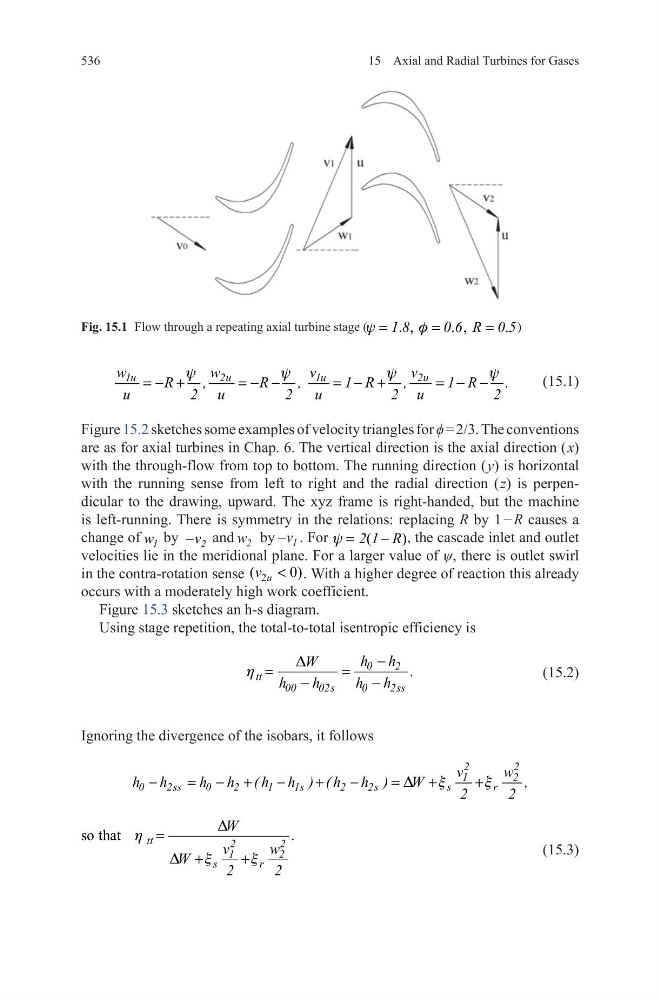
Fig. 15.1 Flow through a repeating axial turbine stage (
. ,
. ,
.
1 8
0 6 R 0 5
y
f
=
=
=
)
15 Axial and Radial Turbines for Gases
(15.1)
Figure 15.2 sketches some examples of velocity triangles for ϕ = 2/3. The conventions
are as for axial turbines in Chap. 6. The vertical direction is the axial direction ( x)
with the through-flow from top to bottom. The running direction ( y) is horizontal
with the running sense from left to right and the radial direction ( z) is perpendicular to the drawing, upward. The xyz frame is right-handed, but the machine
is left-running. There is symmetry in the relations: replacing R by 1 − R causes a
change of 1
w by 2
v
− and� w 2 by −v 1 . For
(
)
2 1 R
y =
− , the cascade inlet and outlet
velocities lie in the meridional plane. For a larger value of ѱ, there is outlet swirl
in the contra-rotation sense 2
(
0)
u
v < . With a higher degree of reaction this already
occurs with a moderately high work coefficient.
Figure 15.3 sketches an h-s diagram.
Using stage repetition, the total-to-total isentropic efficiency is
(15.2)
Ignoring the divergence of the isobars, it follows
(15.3)
1u
2u
1u
2u
w
w
v
v
R
,
R
,
1 R
,
1 R
.
u
2 u
2 u
2 u
2
y
y
y
y
= − +
= − −
= − +
= − −
0
2
tt
00
02s
0
2ss
h h
W
.
h
h
h h
D
h
−
=
=
−
−
2
2
1
2
0
2ss
0
2
1
1s
2
2s
s
r
v
w
h h
h h ( h h ) ( h h )
W
,
2
2
D
x
x
−
= − +
−
+
−
=
+
+
so that
tt
2
2
1
2
s
r
W
.
v
w
W
2
2
D
h
D
x
x
=
+
+
Fig. 15.1 Flow through a repeating axial turbine stage (
. ,
. ,
.
1 8
0 6 R 0 5
y
f
=
=
=
)