

535
Chapter 15
Axial and Radial Turbines for Gases
© Springer Science+Business Media Dordrecht 2015
E. Dick, Fundamentals of Turbomachines, Fluid Mechanics and Its Applications 109,
DOI 10.1007/978-94-017-9627-9_15
Abstract Fundamentals of axial turbines were discussed in the chapter on steam turbines (Chap. 6). Design of turbine parts in gas turbines follows the same principles.
When analysing the performance of axial turbines, we assumed, by way of a simplification, a given stator outlet angle ( α 1 = 72° and 75°). The analysis is generalised
here and completed with a discussion of blade design and operating characteristics.
The fundamental theory of radial turbines was treated in the chapter on hydraulic
turbines (Chap. 9). The specific aspects for a compressible fluid are discussed in the
present chapter. In particular, the rotor has an exducer part. Operating characteristics
of radial turbines are derived. The chapter concludes with the non-dimensional form
of the operating characteristics of turbomachines with a compressible fluid.
15.1 Axial Turbines
15.1.1 Kinematic Parameters
Figure 15.1 sketches the flow through a repeating stage of an axial turbine. As with
the analysis of axial compressors, flow angles are measured with respect to the axial
direction, positive in the rotation sense ( α for stator, β for rotor). Constant axial
velocity through the cascade is assumed. The fundamental relations are similar to
these with compressors.
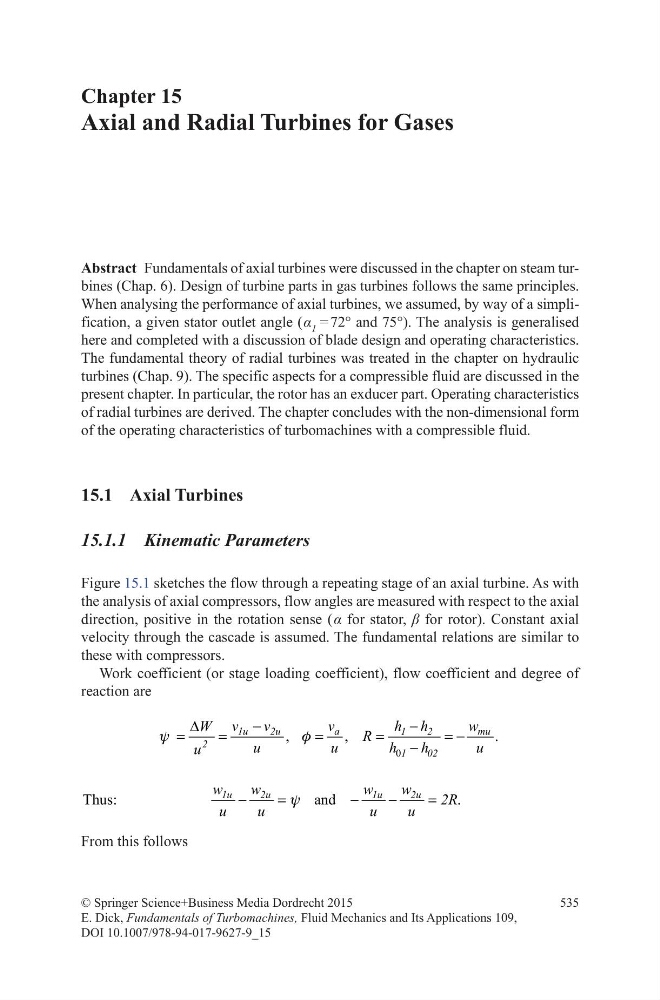
Work coefficient (or stage loading coefficient), flow coefficient and degree of
reaction are
From this follows
0
,
,
.
1u
2u
a
mu
1
2
2
1
02
v
v
v
w
h h
W
R
u
u
h
h
u
u
y
f
−
−
∆
=
=
=
=
= −
−
Thus:
and
.
1u
2u
1u
2u
w
w
w
w
2R
u
u
u
u
y
−
=
−
−
=
Chapter 15
Axial and Radial Turbines for Gases
© Springer Science+Business Media Dordrecht 2015
E. Dick, Fundamentals of Turbomachines, Fluid Mechanics and Its Applications 109,
DOI 10.1007/978-94-017-9627-9_15
Abstract Fundamentals of axial turbines were discussed in the chapter on steam turbines (Chap. 6). Design of turbine parts in gas turbines follows the same principles.
When analysing the performance of axial turbines, we assumed, by way of a simplification, a given stator outlet angle ( α 1 = 72° and 75°). The analysis is generalised
here and completed with a discussion of blade design and operating characteristics.
The fundamental theory of radial turbines was treated in the chapter on hydraulic
turbines (Chap. 9). The specific aspects for a compressible fluid are discussed in the
present chapter. In particular, the rotor has an exducer part. Operating characteristics
of radial turbines are derived. The chapter concludes with the non-dimensional form
of the operating characteristics of turbomachines with a compressible fluid.
15.1 Axial Turbines
15.1.1 Kinematic Parameters
Figure 15.1 sketches the flow through a repeating stage of an axial turbine. As with
the analysis of axial compressors, flow angles are measured with respect to the axial
direction, positive in the rotation sense ( α for stator, β for rotor). Constant axial
velocity through the cascade is assumed. The fundamental relations are similar to
these with compressors.
Work coefficient (or stage loading coefficient), flow coefficient and degree of
reaction are
From this follows
0
,
,
.
1u
2u
a
mu
1
2
2
1
02
v
v
v
w
h h
W
R
u
u
h
h
u
u
y
f
−
−
∆
=
=
=
=
= −
−
Thus:
and
.
1u
2u
1u
2u
w
w
w
w
2R
u
u
u
u
y
−
=
−
−
=