

526
14 Radial Compressors
of migration within the turbulent motion is not fully understood yet. The concept
of turbulence segregation, used here, is actually more a description than an explanation. For a more detailed discussion, but again without a full explanation, we
refer Cumpsty [2], where a description is given in terms of stabilisation (tendency
towards laminar flow) at the suction side and destabilisation (tendency to increased
turbulence) at the pressure side.
14.5.2 Mixing Zone
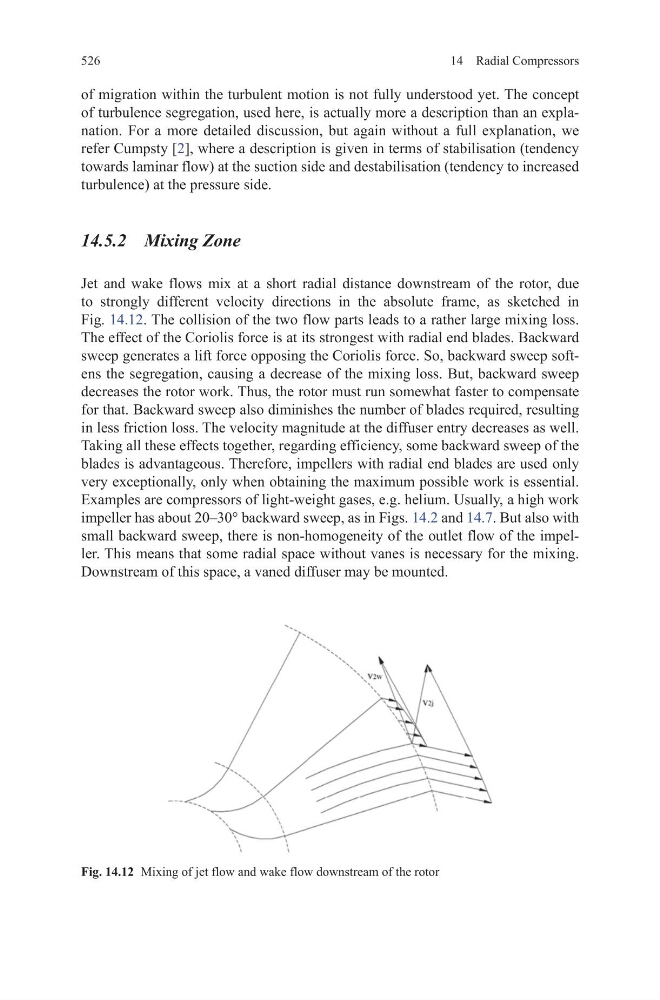
Jet and wake flows mix at a short radial distance downstream of the rotor, due
to strongly different velocity directions in the absolute frame, as sketched in
Fig. 14.12. The collision of the two flow parts leads to a rather large mixing loss.
The effect of the Coriolis force is at its strongest with radial end blades. Backward
sweep generates a lift force opposing the Coriolis force. So, backward sweep softens the segregation, causing a decrease of the mixing loss. But, backward sweep
decreases the rotor work. Thus, the rotor must run somewhat faster to compensate
for that. Backward sweep also diminishes the number of blades required, resulting
in less friction loss. The velocity magnitude at the diffuser entry decreases as well.
Taking all these effects together, regarding efficiency, some backward sweep of the
blades is advantageous. Therefore, impellers with radial end blades are used only
very exceptionally, only when obtaining the maximum possible work is essential.
Examples are compressors of light-weight gases, e.g. helium. Usually, a high work
impeller has about 20–30° backward sweep, as in Figs. 14.2 and 14.7. But also with
small backward sweep, there is non-homogeneity of the outlet flow of the impeller. This means that some radial space without vanes is necessary for the mixing.
Downstream of this space, a vaned diffuser may be mounted.
Fig. 14.12 Mixing of jet flow and wake flow downstream of the rotor
14 Radial Compressors
of migration within the turbulent motion is not fully understood yet. The concept
of turbulence segregation, used here, is actually more a description than an explanation. For a more detailed discussion, but again without a full explanation, we
refer Cumpsty [2], where a description is given in terms of stabilisation (tendency
towards laminar flow) at the suction side and destabilisation (tendency to increased
turbulence) at the pressure side.
14.5.2 Mixing Zone
Jet and wake flows mix at a short radial distance downstream of the rotor, due
to strongly different velocity directions in the absolute frame, as sketched in
Fig. 14.12. The collision of the two flow parts leads to a rather large mixing loss.
The effect of the Coriolis force is at its strongest with radial end blades. Backward
sweep generates a lift force opposing the Coriolis force. So, backward sweep softens the segregation, causing a decrease of the mixing loss. But, backward sweep
decreases the rotor work. Thus, the rotor must run somewhat faster to compensate
for that. Backward sweep also diminishes the number of blades required, resulting
in less friction loss. The velocity magnitude at the diffuser entry decreases as well.
Taking all these effects together, regarding efficiency, some backward sweep of the
blades is advantageous. Therefore, impellers with radial end blades are used only
very exceptionally, only when obtaining the maximum possible work is essential.
Examples are compressors of light-weight gases, e.g. helium. Usually, a high work
impeller has about 20–30° backward sweep, as in Figs. 14.2 and 14.7. But also with
small backward sweep, there is non-homogeneity of the outlet flow of the impeller. This means that some radial space without vanes is necessary for the mixing.
Downstream of this space, a vaned diffuser may be mounted.
Fig. 14.12 Mixing of jet flow and wake flow downstream of the rotor