

501
13.5 Performance Characteristics and Operating Range
choking. Moreover, the through-flow area in the rotor is smaller than in the stator,
as the rotor velocity is more tangential than the stator velocity. This means that the
rotor is typically the most critical with respect to choking. One may also derive this
from the observation that for the design flow rate, the Mach number level is the
largest in the rotor.
The above derivation is intended to illustrate that the choking mass flow rate
depends on the rotational speed. The obtained expressions are approximate, as onedimensional flow is assumed. Another approximation is that the stage inlet is assumed in the axial direction. The above reasoning for subsonic cascades applies,
in principle, to supercritical cascades as well. The choking condition for transonic
cascades is different, as explained before.
13.5.4 Surge
The term surge refers to flow varying in time between attached flow and separated
flow. This periodic type of stall is caused by a dynamically unstable interaction
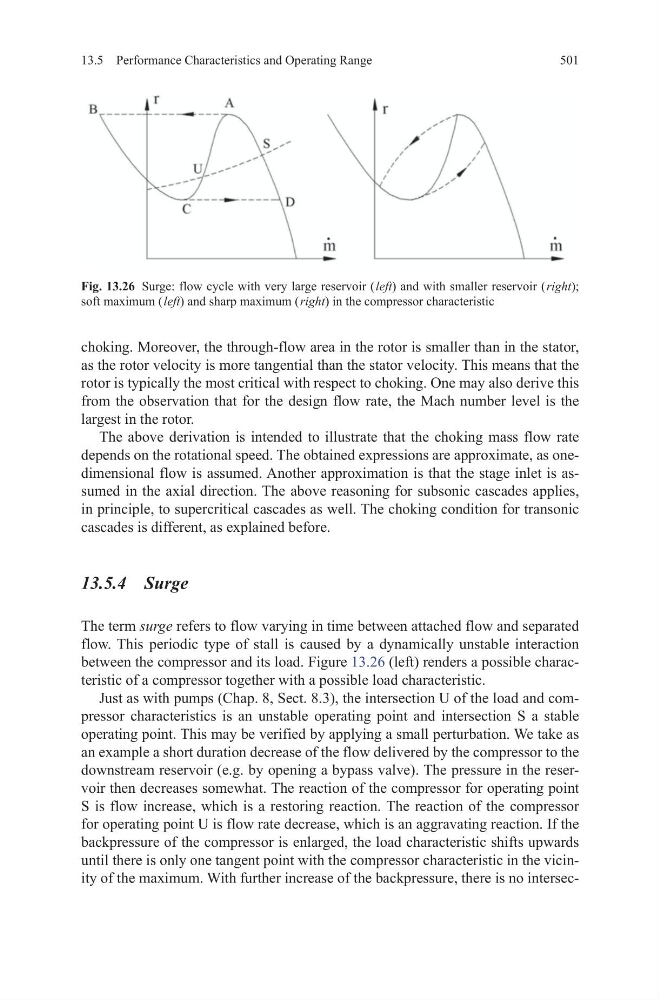
between the compressor and its load. Figure 13.26 (left) renders a possible characteristic of a compressor together with a possible load characteristic.
Just as with pumps (Chap. 8, Sect. 8.3), the intersection U of the load and compressor characteristics is an unstable operating point and intersection S a stable
operating point. This may be verified by applying a small perturbation. We take as
an example a short duration decrease of the flow delivered by the compressor to the
downstream reservoir (e.g. by opening a bypass valve). The pressure in the reservoir then decreases somewhat. The reaction of the compressor for operating point
S is flow increase, which is a restoring reaction. The reaction of the compressor
for operating point U is flow rate decrease, which is an aggravating reaction. If the
backpressure of the compressor is enlarged, the load characteristic shifts upwards
until there is only one tangent point with the compressor characteristic in the vicinity of the maximum. With further increase of the backpressure, there is no intersecFig. 13.26 Surge: flow cycle with very large reservoir ( left) and with smaller reservoir ( right);
soft maximum ( left) and sharp maximum ( right) in the compressor characteristic
13.5 Performance Characteristics and Operating Range
choking. Moreover, the through-flow area in the rotor is smaller than in the stator,
as the rotor velocity is more tangential than the stator velocity. This means that the
rotor is typically the most critical with respect to choking. One may also derive this
from the observation that for the design flow rate, the Mach number level is the
largest in the rotor.
The above derivation is intended to illustrate that the choking mass flow rate
depends on the rotational speed. The obtained expressions are approximate, as onedimensional flow is assumed. Another approximation is that the stage inlet is assumed in the axial direction. The above reasoning for subsonic cascades applies,
in principle, to supercritical cascades as well. The choking condition for transonic
cascades is different, as explained before.
13.5.4 Surge
The term surge refers to flow varying in time between attached flow and separated
flow. This periodic type of stall is caused by a dynamically unstable interaction
between the compressor and its load. Figure 13.26 (left) renders a possible characteristic of a compressor together with a possible load characteristic.
Just as with pumps (Chap. 8, Sect. 8.3), the intersection U of the load and compressor characteristics is an unstable operating point and intersection S a stable
operating point. This may be verified by applying a small perturbation. We take as
an example a short duration decrease of the flow delivered by the compressor to the
downstream reservoir (e.g. by opening a bypass valve). The pressure in the reservoir then decreases somewhat. The reaction of the compressor for operating point
S is flow increase, which is a restoring reaction. The reaction of the compressor
for operating point U is flow rate decrease, which is an aggravating reaction. If the
backpressure of the compressor is enlarged, the load characteristic shifts upwards
until there is only one tangent point with the compressor characteristic in the vicinity of the maximum. With further increase of the backpressure, there is no intersecFig. 13.26 Surge: flow cycle with very large reservoir ( left) and with smaller reservoir ( right);
soft maximum ( left) and sharp maximum ( right) in the compressor characteristic