

500
13 Axial Compressors
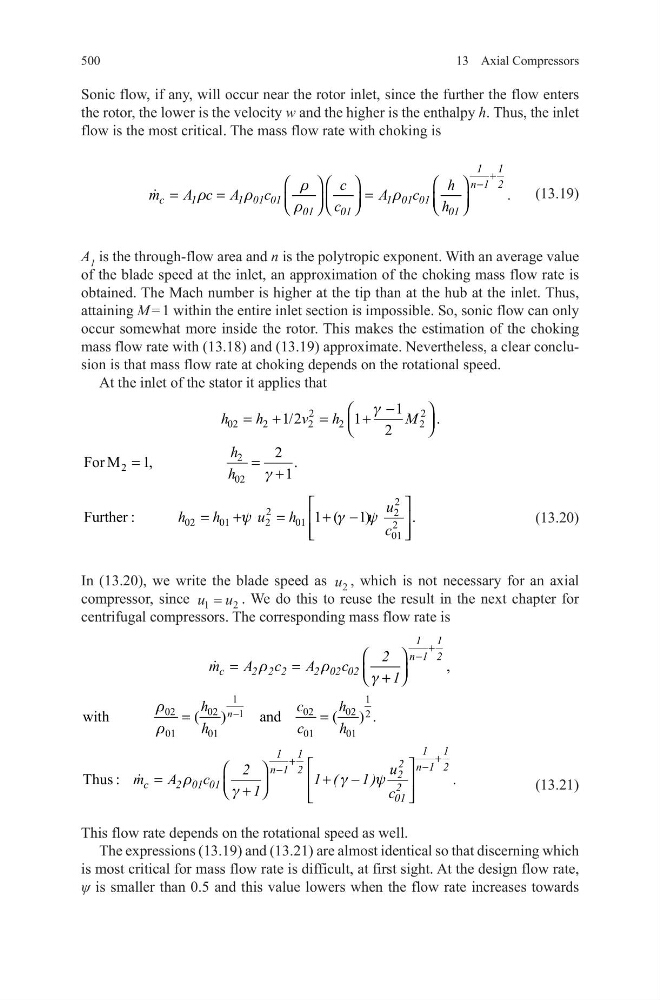
Sonic flow, if any, will occur near the rotor inlet, since the further the flow enters
the rotor, the lower is the velocity w and the higher is the enthalpy h. Thus, the inlet
flow is the most critical. The mass flow rate with choking is
(13.19)
A 1 is the through-flow area and n is the polytropic exponent. With an average value
of the blade speed at the inlet, an approximation of the choking mass flow rate is
obtained. The Mach number is higher at the tip than at the hub at the inlet. Thus,
attaining M = 1 within the entire inlet section is impossible. So, sonic flow can only
occur somewhat more inside the rotor. This makes the estimation of the choking
mass flow rate with (13.18) and (13.19) approximate. Nevertheless, a clear conclusion is that mass flow rate at choking depends on the rotational speed.
At the inlet of the stator it applies that
(13.20)
In (13.20), we write the blade speed as u 2 , which is not necessary for an axial
compressor, since u u
1
2
= . We do this to reuse the result in the next chapter for
centrifugal compressors. The corresponding mass flow rate is
(13.21)
This flow rate depends on the rotational speed as well.
The expressions (13.19) and (13.21) are almost identical so that discerning which
is most critical for mass flow rate is difficult, at first sight. At the design flow rate,
ψ is smaller than 0.5 and this value lowers when the flow rate increases towards
1 1
n 1 2
c
1
1 01 01
1 01 01
01
01
01
c
h
m
A c A
c
A
c
.
c
h
+
−
=
=
=
r
r
r
r
r
2
2
02
2
2
2
2
1
1/2
1
.
2
h
h
v
h
M
g −
= +
=
+
2
2
02
2
For M 1,
.
1
=
= +
h
h
g
2
2
2
02
01
2
01
2
01
Further :
1 ( 1)
.
y
g
y
=
+
=
+ −
u
h
h
u
h
c
,
1 1
n 1 2
c
2 2 2
2 02 02
2
m
A c
A
c
1
+
−
=
=
+
r
r
g
1
1
02
02
02
02
1
2
01
01
01
01
with
( )
and
( ) .
−
=
=
n
h
c
h
h
c
h
r
r
Thus :
1 1
1 1
2 n 1 2
n 1 2
2
c
2 01 01
2
01
u
2
m
A
c
1 (
1)
.
1
c
+
+
−
−
=
+ −
+
r
g
y
g
13 Axial Compressors
Sonic flow, if any, will occur near the rotor inlet, since the further the flow enters
the rotor, the lower is the velocity w and the higher is the enthalpy h. Thus, the inlet
flow is the most critical. The mass flow rate with choking is
(13.19)
A 1 is the through-flow area and n is the polytropic exponent. With an average value
of the blade speed at the inlet, an approximation of the choking mass flow rate is
obtained. The Mach number is higher at the tip than at the hub at the inlet. Thus,
attaining M = 1 within the entire inlet section is impossible. So, sonic flow can only
occur somewhat more inside the rotor. This makes the estimation of the choking
mass flow rate with (13.18) and (13.19) approximate. Nevertheless, a clear conclusion is that mass flow rate at choking depends on the rotational speed.
At the inlet of the stator it applies that
(13.20)
In (13.20), we write the blade speed as u 2 , which is not necessary for an axial
compressor, since u u
1
2
= . We do this to reuse the result in the next chapter for
centrifugal compressors. The corresponding mass flow rate is
(13.21)
This flow rate depends on the rotational speed as well.
The expressions (13.19) and (13.21) are almost identical so that discerning which
is most critical for mass flow rate is difficult, at first sight. At the design flow rate,
ψ is smaller than 0.5 and this value lowers when the flow rate increases towards
1 1
n 1 2
c
1
1 01 01
1 01 01
01
01
01
c
h
m
A c A
c
A
c
.
c
h
+
−
=
=
=
r
r
r
r
r
2
2
02
2
2
2
2
1
1/2
1
.
2
h
h
v
h
M
g −
= +
=
+
2
2
02
2
For M 1,
.
1
=
= +
h
h
g
2
2
2
02
01
2
01
2
01
Further :
1 ( 1)
.
y
g
y
=
+
=
+ −
u
h
h
u
h
c
,
1 1
n 1 2
c
2 2 2
2 02 02
2
m
A c
A
c
1
+
−
=
=
+
r
r
g
1
1
02
02
02
02
1
2
01
01
01
01
with
( )
and
( ) .
−
=
=
n
h
c
h
h
c
h
r
r
Thus :
1 1
1 1
2 n 1 2
n 1 2
2
c
2 01 01
2
01
u
2
m
A
c
1 (
1)
.
1
c
+
+
−
−
=
+ −
+
r
g
y
g