

498
13 Axial Compressors
boundary layer separation occurs below a certain flow rate. The flow is then said
to be stalled, meaning that the compressor does not function properly anymore. In
stalled flow, the tangential force of the blade drops. This causes a maximum in the
characteristic curve for pressure ratio as a function of flow rate. This maximum may
be very sharp.
13.5.2 Rotating Stall
Stall never occurs in a compressor simultaneously on all blades over their full span.
First, the incidence margin with respect to stall changes from stage to stage within
a multistage compressor, with bigger incidence margin with the first stages (see
below). Second, in order to decrease blade torsion, rotor blades are given greater
incidence at the tip than at the hub (see Fig. 13.9). So, the incidence margin at the
tip is smaller than at the hub. With decreasing flow rate, the flow thus first goes
into stall at the tip of a rotor blade. With longer blades, as in the first stages of a
compressor, stall zones therefore form at the casing, unless the flow rate reduction
with respect to non-stalled flow is extreme. In the last stages of a compressor, where
blade height is smaller, full span stall is reached faster. Whether stall is part-span
or full-span, it is always organised in cells, rotating in the rotation sense of the
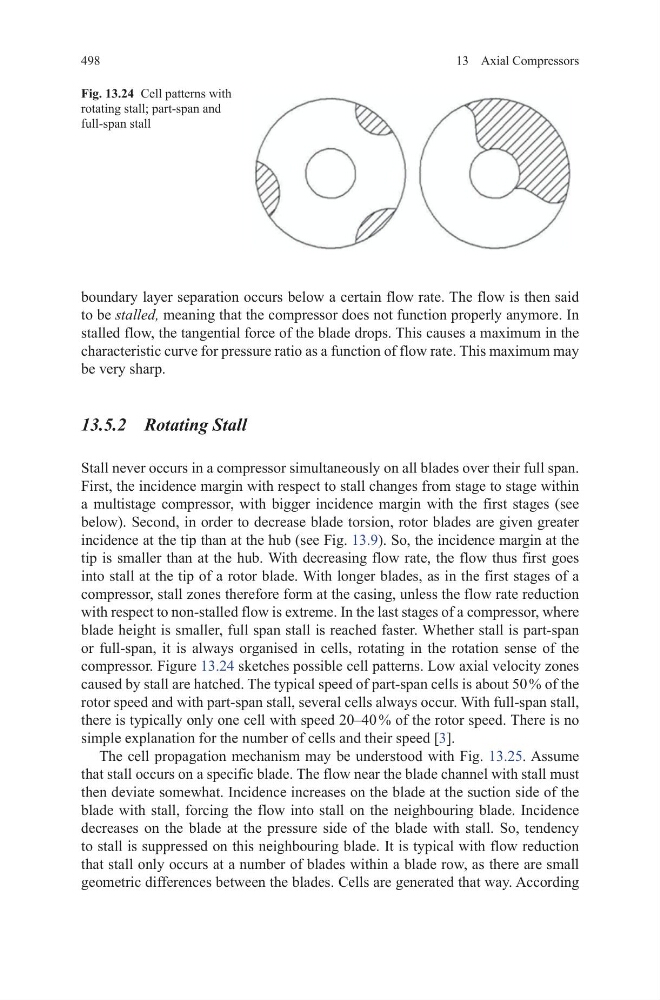
compressor. Figure 13.24 sketches possible cell patterns. Low axial velocity zones
caused by stall are hatched. The typical speed of part-span cells is about 50 % of the
rotor speed and with part-span stall, several cells always occur. With full-span stall,
there is typically only one cell with speed 20–40 % of the rotor speed. There is no
simple explanation for the number of cells and their speed [3].
The cell propagation mechanism may be understood with Fig. 13.25. Assume
that stall occurs on a specific blade. The flow near the blade channel with stall must
then deviate somewhat. Incidence increases on the blade at the suction side of the
blade with stall, forcing the flow into stall on the neighbouring blade. Incidence
decreases on the blade at the pressure side of the blade with stall. So, tendency
to stall is suppressed on this neighbouring blade. It is typical with flow reduction
that stall only occurs at a number of blades within a blade row, as there are small
geometric differences between the blades. Cells are generated that way. According
Fig. 13.24 Cell patterns with
rotating stall; part-span and
full-span stall
13 Axial Compressors
boundary layer separation occurs below a certain flow rate. The flow is then said
to be stalled, meaning that the compressor does not function properly anymore. In
stalled flow, the tangential force of the blade drops. This causes a maximum in the
characteristic curve for pressure ratio as a function of flow rate. This maximum may
be very sharp.
13.5.2 Rotating Stall
Stall never occurs in a compressor simultaneously on all blades over their full span.
First, the incidence margin with respect to stall changes from stage to stage within
a multistage compressor, with bigger incidence margin with the first stages (see
below). Second, in order to decrease blade torsion, rotor blades are given greater
incidence at the tip than at the hub (see Fig. 13.9). So, the incidence margin at the
tip is smaller than at the hub. With decreasing flow rate, the flow thus first goes
into stall at the tip of a rotor blade. With longer blades, as in the first stages of a
compressor, stall zones therefore form at the casing, unless the flow rate reduction
with respect to non-stalled flow is extreme. In the last stages of a compressor, where
blade height is smaller, full span stall is reached faster. Whether stall is part-span
or full-span, it is always organised in cells, rotating in the rotation sense of the
compressor. Figure 13.24 sketches possible cell patterns. Low axial velocity zones
caused by stall are hatched. The typical speed of part-span cells is about 50 % of the
rotor speed and with part-span stall, several cells always occur. With full-span stall,
there is typically only one cell with speed 20–40 % of the rotor speed. There is no
simple explanation for the number of cells and their speed [3].
The cell propagation mechanism may be understood with Fig. 13.25. Assume
that stall occurs on a specific blade. The flow near the blade channel with stall must
then deviate somewhat. Incidence increases on the blade at the suction side of the
blade with stall, forcing the flow into stall on the neighbouring blade. Incidence
decreases on the blade at the pressure side of the blade with stall. So, tendency
to stall is suppressed on this neighbouring blade. It is typical with flow reduction
that stall only occurs at a number of blades within a blade row, as there are small
geometric differences between the blades. Cells are generated that way. According
Fig. 13.24 Cell patterns with
rotating stall; part-span and
full-span stall