

479
13.2.2 Passage Vortex and Trailing Vortices
The passage vortex was already discussed in Sect. 13.1.8. It results from the turning
of the primary flow and the centrifugal force associated with it, being stronger in
the flow core than in the end boundary layers. Figure 13.10 represents the passage
vortex within a linear cascade with added end walls. In a real compressor, the passage vortex is distorted compared to the sketch, because the blade spacing increases
with the radius. A significant effect of the passage vortex is a change in the outlet
direction of the flow. The flow turning by the blades is increased in the boundary
layers at the hub and the casing and reduced some distance away from the end walls.
Another passage vortex effect is trailing vortex generation within the wake flow
of the blades, as sketched in Fig. 13.10. The trailing vortices may be weak since
the passage vortices typically do not come as close to each other as suggested in
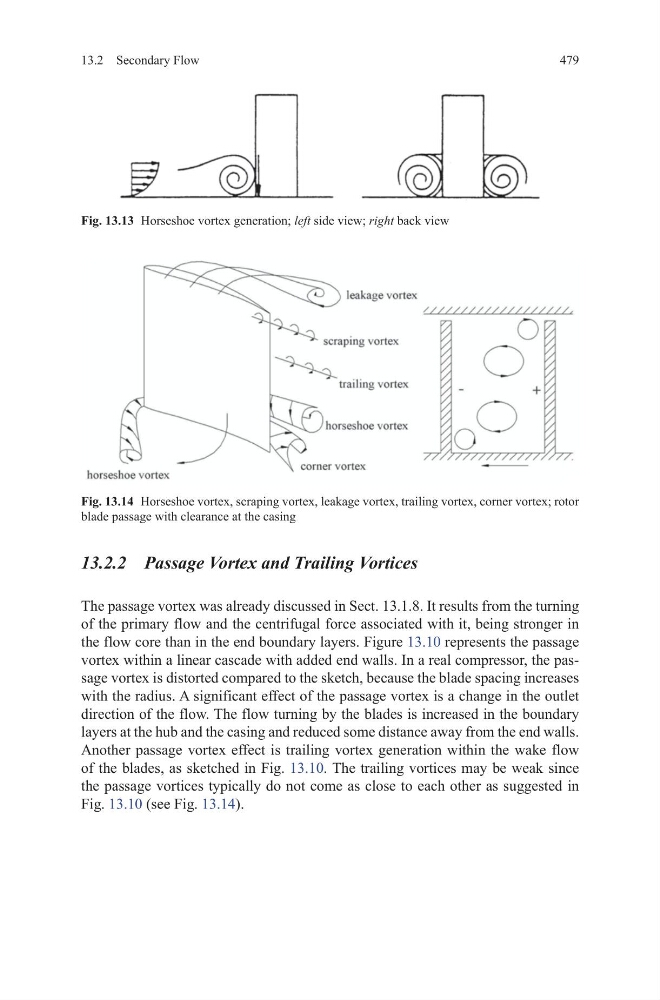
Fig. 13.10 (see Fig. 13.14).
13.2 Secondary Flow
Fig. 13.13 Horseshoe vortex generation; left side view; right back view
Fig. 13.14 Horseshoe vortex, scraping vortex, leakage vortex, trailing vortex, corner vortex; rotor
blade passage with clearance at the casing
13.2.2 Passage Vortex and Trailing Vortices
The passage vortex was already discussed in Sect. 13.1.8. It results from the turning
of the primary flow and the centrifugal force associated with it, being stronger in
the flow core than in the end boundary layers. Figure 13.10 represents the passage
vortex within a linear cascade with added end walls. In a real compressor, the passage vortex is distorted compared to the sketch, because the blade spacing increases
with the radius. A significant effect of the passage vortex is a change in the outlet
direction of the flow. The flow turning by the blades is increased in the boundary
layers at the hub and the casing and reduced some distance away from the end walls.
Another passage vortex effect is trailing vortex generation within the wake flow
of the blades, as sketched in Fig. 13.10. The trailing vortices may be weak since
the passage vortices typically do not come as close to each other as suggested in
Fig. 13.10 (see Fig. 13.14).
13.2 Secondary Flow
Fig. 13.13 Horseshoe vortex generation; left side view; right back view
Fig. 13.14 Horseshoe vortex, scraping vortex, leakage vortex, trailing vortex, corner vortex; rotor
blade passage with clearance at the casing