

24
1 Working Principles
(1.30)
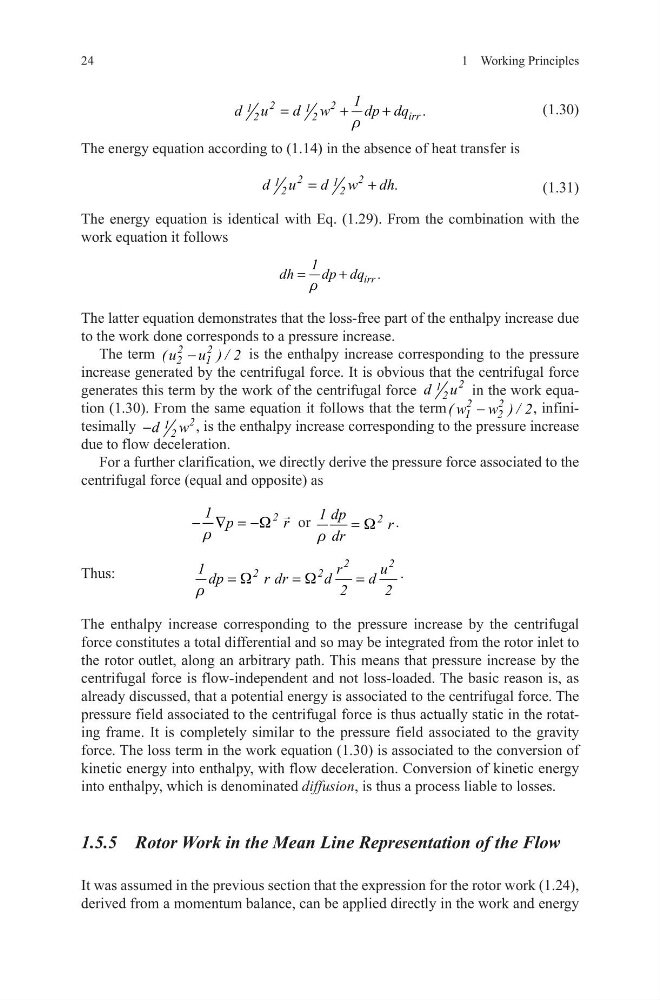
The energy equation according to (1.14) in the absence of heat transfer is
(1.31)
The energy equation is identical with Eq. (1.29). From the combination with the
work equation it follows
The latter equation demonstrates that the loss-free part of the enthalpy increase due
to the work done corresponds to a pressure increase.
The term
2
2
2
1
( u u ) / 2
−
is the enthalpy increase corresponding to the pressure
increase generated by the centrifugal force. It is obvious that the centrifugal force
generates this term by the work of the centrifugal force
2
1 2
d u in the work equation (1.30). From the same equation it follows that the term
2
2
1
2
( w w ) / 2
−
, infinitesimally
2
1 2
d w
−
, is the enthalpy increase corresponding to the pressure increase
due to flow deceleration.
For a further clarification, we directly derive the pressure force associated to the
centrifugal force (equal and opposite) as
2
1 p
r
W
r
− ∇ = −
or
2
1 dp
r
dr
W
r
=
.
Thus:
2
2
2
2
1
r
u
dp
r dr
d
d
2
2
W
W
r
=
=
=
.
The enthalpy increase corresponding to the pressure increase by the centrifugal
force constitutes a total differential and so may be integrated from the rotor inlet to
the rotor outlet, along an arbitrary path. This means that pressure increase by the
centrifugal force is flow-independent and not loss-loaded. The basic reason is, as
already discussed, that a potential energy is associated to the centrifugal force. The
pressure field associated to the centrifugal force is thus actually static in the rotating frame. It is completely similar to the pressure field associated to the gravity
force. The loss term in the work equation (1.30) is associated to the conversion of
kinetic energy into enthalpy, with flow deceleration. Conversion of kinetic energy
into enthalpy, which is denominated diffusion, is thus a process liable to losses.
1.5.5 Rotor Work in the Mean Line Representation of the Flow
It was assumed in the previous section that the expression for the rotor work (1.24),
derived from a momentum balance, can be applied directly in the work and energy
2
2
1
1
irr
2
2
1
d u
d w
dp dq .
r
=
+
+
2
2
1
1
2
2
d u
d w dh.
=
+
irr
1
dh
dp dq .
r
=
+
1 Working Principles
(1.30)
The energy equation according to (1.14) in the absence of heat transfer is
(1.31)
The energy equation is identical with Eq. (1.29). From the combination with the
work equation it follows
The latter equation demonstrates that the loss-free part of the enthalpy increase due
to the work done corresponds to a pressure increase.
The term
2
2
2
1
( u u ) / 2
−
is the enthalpy increase corresponding to the pressure
increase generated by the centrifugal force. It is obvious that the centrifugal force
generates this term by the work of the centrifugal force
2
1 2
d u in the work equation (1.30). From the same equation it follows that the term
2
2
1
2
( w w ) / 2
−
, infinitesimally
2
1 2
d w
−
, is the enthalpy increase corresponding to the pressure increase
due to flow deceleration.
For a further clarification, we directly derive the pressure force associated to the
centrifugal force (equal and opposite) as
2
1 p
r
W
r
− ∇ = −
or
2
1 dp
r
dr
W
r
=
.
Thus:
2
2
2
2
1
r
u
dp
r dr
d
d
2
2
W
W
r
=
=
=
.
The enthalpy increase corresponding to the pressure increase by the centrifugal
force constitutes a total differential and so may be integrated from the rotor inlet to
the rotor outlet, along an arbitrary path. This means that pressure increase by the
centrifugal force is flow-independent and not loss-loaded. The basic reason is, as
already discussed, that a potential energy is associated to the centrifugal force. The
pressure field associated to the centrifugal force is thus actually static in the rotating frame. It is completely similar to the pressure field associated to the gravity
force. The loss term in the work equation (1.30) is associated to the conversion of
kinetic energy into enthalpy, with flow deceleration. Conversion of kinetic energy
into enthalpy, which is denominated diffusion, is thus a process liable to losses.
1.5.5 Rotor Work in the Mean Line Representation of the Flow
It was assumed in the previous section that the expression for the rotor work (1.24),
derived from a momentum balance, can be applied directly in the work and energy
2
2
1
1
irr
2
2
1
d u
d w
dp dq .
r
=
+
+
2
2
1
1
2
2
d u
d w dh.
=
+
irr
1
dh
dp dq .
r
=
+