

23
1.5 Basic Laws for Rotating Duct Parts
the pressure change (pressure-associated energy) in the flow. The centrifugal force
influences the distribution of the energy forms within the rotor flow. A potential
energy is associated to the centrifugal force. A change in this potential energy due
to a change in radius must be compensated by a change in another energy component. Distribution of energy forms, internally within the flow, has to be distinguished from energy exchange between the flow and the rotating machine parts.
The effect of the centrifugal force on the energy distribution will be discussed in
the next section.
1.5.4 Energy Component Changes Caused By the Rotor Work
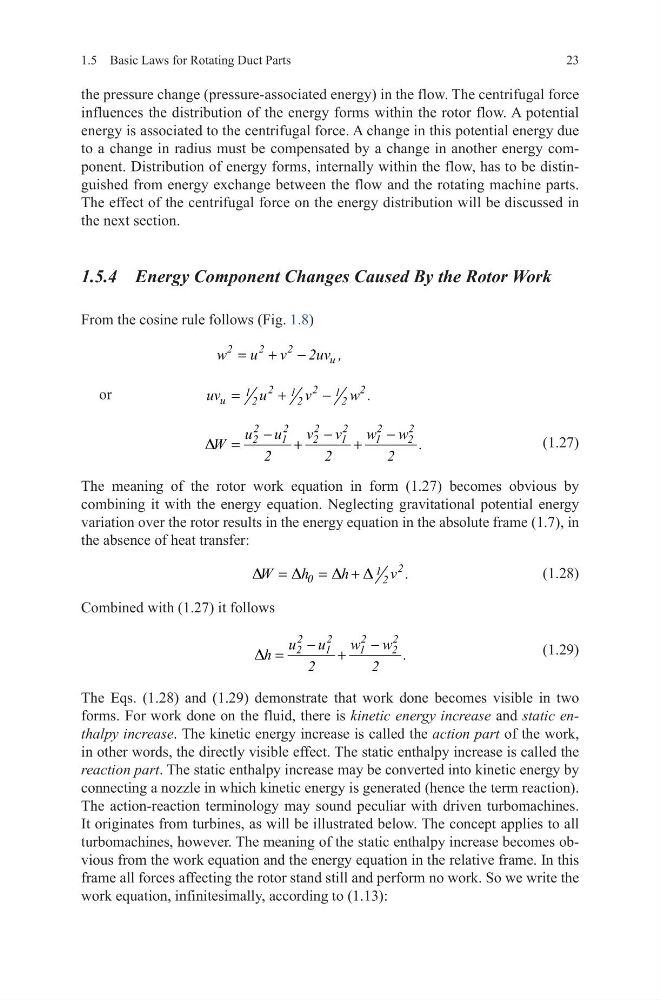
From the cosine rule follows (Fig. 1.8)
or
(1.27)
The meaning of the rotor work equation in form (1.27) becomes obvious by
combining it with the energy equation. Neglecting gravitational potential energy
variation over the rotor results in the energy equation in the absolute frame (1.7), in
the absence of heat transfer:
(1.28)
Combined with (1.27) it follows
(1.29)
The Eqs. (1.28) and (1.29) demonstrate that work done becomes visible in two
forms. For work done on the fluid, there is kinetic energy increase and static enthalpy increase. The kinetic energy increase is called the action part of the work,
in other words, the directly visible effect. The static enthalpy increase is called the
reaction part. The static enthalpy increase may be converted into kinetic energy by
connecting a nozzle in which kinetic energy is generated (hence the term reaction).
The action-reaction terminology may sound peculiar with driven turbomachines.
It originates from turbines, as will be illustrated below. The concept applies to all
turbomachines, however. The meaning of the static enthalpy increase becomes obvious from the work equation and the energy equation in the relative frame. In this
frame all forces affecting the rotor stand still and perform no work. So we write the
work equation, infinitesimally, according to (1.13):
2
2
2
u
w
u v 2uv ,
= + −
2
2
2
1
1
1
u
2
2
2
uv
u
v
w .
=
+
−
2
2
2
2
2
2
2
1
2
1
1
2
u u
v v
w w
W
.
2
2
2
D
−
−
−
=
+
+
2
1
0
2
W
h
h
v .
D
D
D D
=
=
+
2
2
2
2
2
1
1
2
u u
w w
h
.
2
2
D
−
−
=
+
1.5 Basic Laws for Rotating Duct Parts
the pressure change (pressure-associated energy) in the flow. The centrifugal force
influences the distribution of the energy forms within the rotor flow. A potential
energy is associated to the centrifugal force. A change in this potential energy due
to a change in radius must be compensated by a change in another energy component. Distribution of energy forms, internally within the flow, has to be distinguished from energy exchange between the flow and the rotating machine parts.
The effect of the centrifugal force on the energy distribution will be discussed in
the next section.
1.5.4 Energy Component Changes Caused By the Rotor Work
From the cosine rule follows (Fig. 1.8)
or
(1.27)
The meaning of the rotor work equation in form (1.27) becomes obvious by
combining it with the energy equation. Neglecting gravitational potential energy
variation over the rotor results in the energy equation in the absolute frame (1.7), in
the absence of heat transfer:
(1.28)
Combined with (1.27) it follows
(1.29)
The Eqs. (1.28) and (1.29) demonstrate that work done becomes visible in two
forms. For work done on the fluid, there is kinetic energy increase and static enthalpy increase. The kinetic energy increase is called the action part of the work,
in other words, the directly visible effect. The static enthalpy increase is called the
reaction part. The static enthalpy increase may be converted into kinetic energy by
connecting a nozzle in which kinetic energy is generated (hence the term reaction).
The action-reaction terminology may sound peculiar with driven turbomachines.
It originates from turbines, as will be illustrated below. The concept applies to all
turbomachines, however. The meaning of the static enthalpy increase becomes obvious from the work equation and the energy equation in the relative frame. In this
frame all forces affecting the rotor stand still and perform no work. So we write the
work equation, infinitesimally, according to (1.13):
2
2
2
u
w
u v 2uv ,
= + −
2
2
2
1
1
1
u
2
2
2
uv
u
v
w .
=
+
−
2
2
2
2
2
2
2
1
2
1
1
2
u u
v v
w w
W
.
2
2
2
D
−
−
−
=
+
+
2
1
0
2
W
h
h
v .
D
D
D D
=
=
+
2
2
2
2
2
1
1
2
u u
w w
h
.
2
2
D
−
−
=
+