

20
1 Working Principles
The term –M c Ω is always positive and thus has the same nature as the term –M d Ω.
After division by the mass flow rate we obtain
where M
m W
W
D
=
and
o
c
d
irr
M
M
mq .
W
W
−
−
=
The result for
shaft
W
D
is then the same as (1.19).
Interpretation of the moment balance (1.22) is quite simple. For a driven machine, it means that the shaft moment M shaft is divided into two parts: the M b part
reaches the blades (the rotating machine parts) and the -M d part is absorbed by disc
friction. Further, the blade moment M b is divided into two parts: the M part reaches
the flows and the –M c part is absorbed by friction on the casing.
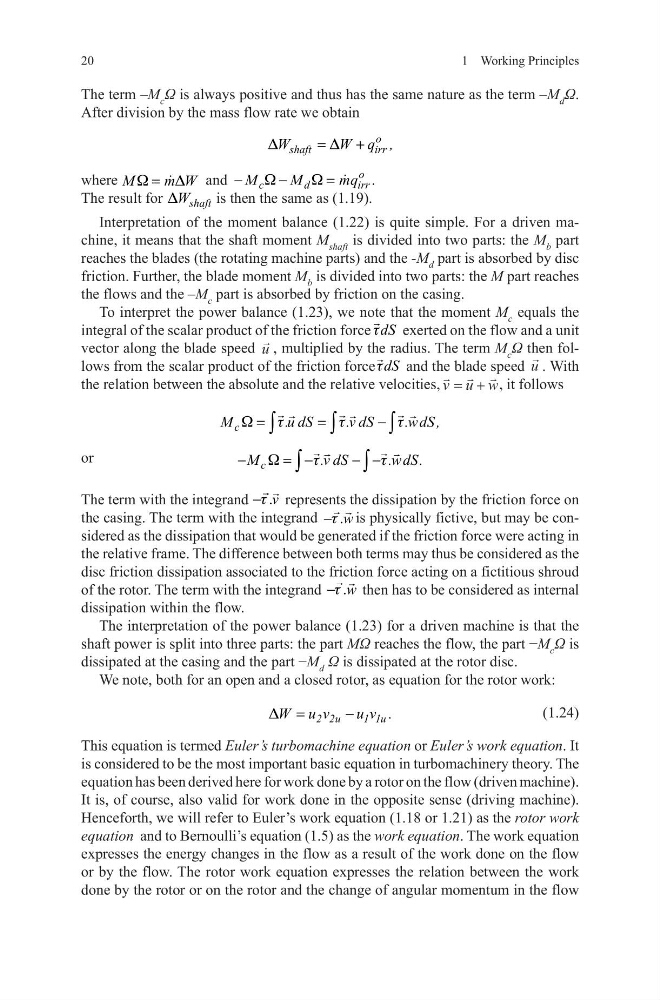
To interpret the power balance (1.23), we note that the moment M c equals the
integral of the scalar product of the friction force dS
t
exerted on the flow and a unit
vector along the blade speed
u , multiplied by the radius. The term M c Ω then follows from the scalar product of the friction force dS
t
and the blade speed
u . With
the relation between the absolute and the relative velocities,
v u w
= + , it follows
or
The term with the integrand .v
t
−
represents the dissipation by the friction force on
the casing. The term with the integrand .w
t
−
is physically fictive, but may be considered as the dissipation that would be generated if the friction force were acting in
the relative frame. The difference between both terms may thus be considered as the
disc friction dissipation associated to the friction force acting on a fictitious shroud
of the rotor. The term with the integrand .w
t
−
then has to be considered as internal
dissipation within the flow.
The interpretation of the power balance (1.23) for a driven machine is that the
shaft power is split into three parts: the part MΩ reaches the flow, the part −M c Ω is
dissipated at the casing and the part −M d Ω is dissipated at the rotor disc.
We note, both for an open and a closed rotor, as equation for the rotor work:
(1.24)
This equation is termed Euler’s turbomachine equation or Euler’s work equation. It
is considered to be the most important basic equation in turbomachinery theory. The
equation has been derived here for work done by a rotor on the flow (driven machine).
It is, of course, also valid for work done in the opposite sense (driving machine).
Henceforth, we will refer to Euler’s work equation (1.18 or 1.21) as the rotor work
equation and to Bernoulli’s equation (1.5) as the work equation. The work equation
expresses the energy changes in the flow as a result of the work done on the flow
or by the flow. The rotor work equation expresses the relation between the work
done by the rotor or on the rotor and the change of angular momentum in the flow
o
shaft
irr
W
W q ,
D
D
=
+
c
M
.u dS
.v dS
.w dS ,
W
t
t
t
=
=
−
∫
∫
∫
c
M
.v dS
.w dS.
W
t
t
−
= −
− −
∫
∫
2 2u
1 1u
W u v
u v .
D =
−
1 Working Principles
The term –M c Ω is always positive and thus has the same nature as the term –M d Ω.
After division by the mass flow rate we obtain
where M
m W
W
D
=
and
o
c
d
irr
M
M
mq .
W
W
−
−
=
The result for
shaft
W
D
is then the same as (1.19).
Interpretation of the moment balance (1.22) is quite simple. For a driven machine, it means that the shaft moment M shaft is divided into two parts: the M b part
reaches the blades (the rotating machine parts) and the -M d part is absorbed by disc
friction. Further, the blade moment M b is divided into two parts: the M part reaches
the flows and the –M c part is absorbed by friction on the casing.
To interpret the power balance (1.23), we note that the moment M c equals the
integral of the scalar product of the friction force dS
t
exerted on the flow and a unit
vector along the blade speed
u , multiplied by the radius. The term M c Ω then follows from the scalar product of the friction force dS
t
and the blade speed
u . With
the relation between the absolute and the relative velocities,
v u w
= + , it follows
or
The term with the integrand .v
t
−
represents the dissipation by the friction force on
the casing. The term with the integrand .w
t
−
is physically fictive, but may be considered as the dissipation that would be generated if the friction force were acting in
the relative frame. The difference between both terms may thus be considered as the
disc friction dissipation associated to the friction force acting on a fictitious shroud
of the rotor. The term with the integrand .w
t
−
then has to be considered as internal
dissipation within the flow.
The interpretation of the power balance (1.23) for a driven machine is that the
shaft power is split into three parts: the part MΩ reaches the flow, the part −M c Ω is
dissipated at the casing and the part −M d Ω is dissipated at the rotor disc.
We note, both for an open and a closed rotor, as equation for the rotor work:
(1.24)
This equation is termed Euler’s turbomachine equation or Euler’s work equation. It
is considered to be the most important basic equation in turbomachinery theory. The
equation has been derived here for work done by a rotor on the flow (driven machine).
It is, of course, also valid for work done in the opposite sense (driving machine).
Henceforth, we will refer to Euler’s work equation (1.18 or 1.21) as the rotor work
equation and to Bernoulli’s equation (1.5) as the work equation. The work equation
expresses the energy changes in the flow as a result of the work done on the flow
or by the flow. The rotor work equation expresses the relation between the work
done by the rotor or on the rotor and the change of angular momentum in the flow
o
shaft
irr
W
W q ,
D
D
=
+
c
M
.u dS
.v dS
.w dS ,
W
t
t
t
=
=
−
∫
∫
∫
c
M
.v dS
.w dS.
W
t
t
−
= −
− −
∫
∫
2 2u
1 1u
W u v
u v .
D =
−