

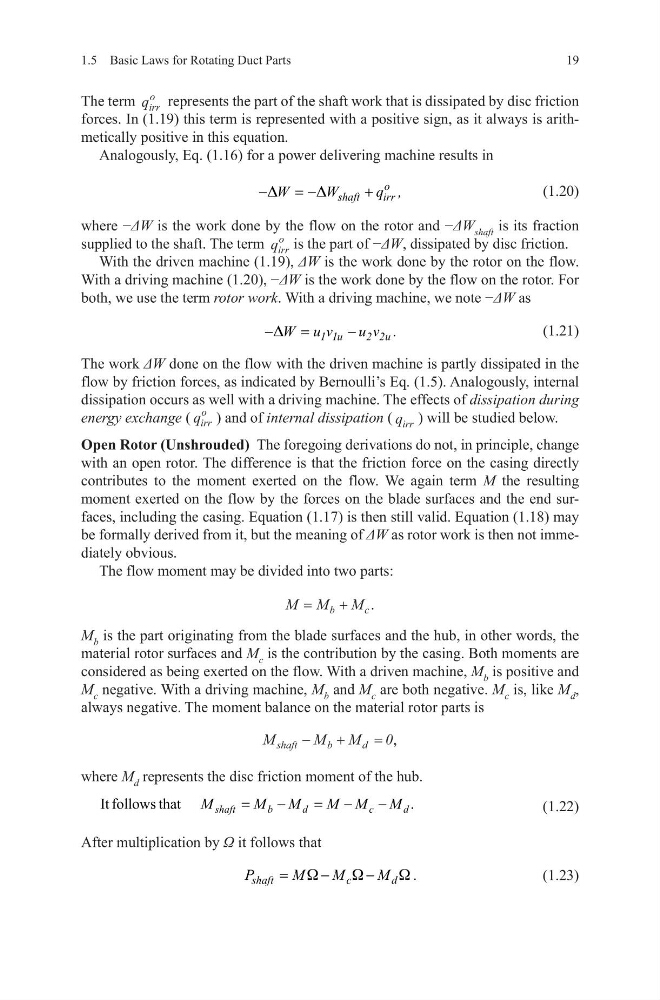
19
1.5 Basic Laws for Rotating Duct Parts
The term q irr
o
represents the part of the shaft work that is dissipated by disc friction
forces. In (1.19) this term is represented with a positive sign, as it always is arithmetically positive in this equation.
Analogously, Eq. (1.16) for a power delivering machine results in
(1.20)
where −ΔW is the work done by the flow on the rotor and −ΔW shaft is its fraction
supplied to the shaft. The term q irr
o
is the part of −ΔW, dissipated by disc friction.
With the driven machine (1.19), ΔW is the work done by the rotor on the flow.
With a driving machine (1.20), −ΔW is the work done by the flow on the rotor. For
both, we use the term rotor work. With a driving machine, we note −ΔW as
(1.21)
The work ΔW done on the flow with the driven machine is partly dissipated in the
flow by friction forces, as indicated by Bernoulli’s Eq. (1.5). Analogously, internal
dissipation occurs as well with a driving machine. The effects of dissipation during
energy exchange ( q irr
o
) and of internal dissipation ( q irr ) will be studied below.
Open Rotor (Unshrouded) The foregoing derivations do not, in principle, change
with an open rotor. The difference is that the friction force on the casing directly
contributes to the moment exerted on the flow. We again term M the resulting
moment exerted on the flow by the forces on the blade surfaces and the end surfaces, including the casing. Equation (1.17) is then still valid. Equation (1.18) may
be formally derived from it, but the meaning of ΔW as rotor work is then not immediately obvious.
The flow moment may be divided into two parts:
M b is the part originating from the blade surfaces and the hub, in other words, the
material rotor surfaces and M c is the contribution by the casing. Both moments are
considered as being exerted on the flow. With a driven machine, M b is positive and
M c negative. With a driving machine, M b and M c are both negative. M c is, like M d ,
always negative. The moment balance on the material rotor parts is
where M d represents the disc friction moment of the hub.
(1.22)
After multiplication by Ω it follows that
(1.23)
o
shaft
irr
W
W
q ,
D
D
−
= −
+
1 1u
2 2u
W u v
u v .
D
−
=
−
M M M
b
c
=
+
.
M
M M
0
shaft
b
d
−
+
= ,
It follows that
.
shaft
b
d
c
d
M
M M
M M M
=
−
= −
−
shaft
c
d
P
M
M
M
.
W
W
W
=
−
−
1.5 Basic Laws for Rotating Duct Parts
The term q irr
o
represents the part of the shaft work that is dissipated by disc friction
forces. In (1.19) this term is represented with a positive sign, as it always is arithmetically positive in this equation.
Analogously, Eq. (1.16) for a power delivering machine results in
(1.20)
where −ΔW is the work done by the flow on the rotor and −ΔW shaft is its fraction
supplied to the shaft. The term q irr
o
is the part of −ΔW, dissipated by disc friction.
With the driven machine (1.19), ΔW is the work done by the rotor on the flow.
With a driving machine (1.20), −ΔW is the work done by the flow on the rotor. For
both, we use the term rotor work. With a driving machine, we note −ΔW as
(1.21)
The work ΔW done on the flow with the driven machine is partly dissipated in the
flow by friction forces, as indicated by Bernoulli’s Eq. (1.5). Analogously, internal
dissipation occurs as well with a driving machine. The effects of dissipation during
energy exchange ( q irr
o
) and of internal dissipation ( q irr ) will be studied below.
Open Rotor (Unshrouded) The foregoing derivations do not, in principle, change
with an open rotor. The difference is that the friction force on the casing directly
contributes to the moment exerted on the flow. We again term M the resulting
moment exerted on the flow by the forces on the blade surfaces and the end surfaces, including the casing. Equation (1.17) is then still valid. Equation (1.18) may
be formally derived from it, but the meaning of ΔW as rotor work is then not immediately obvious.
The flow moment may be divided into two parts:
M b is the part originating from the blade surfaces and the hub, in other words, the
material rotor surfaces and M c is the contribution by the casing. Both moments are
considered as being exerted on the flow. With a driven machine, M b is positive and
M c negative. With a driving machine, M b and M c are both negative. M c is, like M d ,
always negative. The moment balance on the material rotor parts is
where M d represents the disc friction moment of the hub.
(1.22)
After multiplication by Ω it follows that
(1.23)
o
shaft
irr
W
W
q ,
D
D
−
= −
+
1 1u
2 2u
W u v
u v .
D
−
=
−
M M M
b
c
=
+
.
M
M M
0
shaft
b
d
−
+
= ,
It follows that
.
shaft
b
d
c
d
M
M M
M M M
=
−
= −
−
shaft
c
d
P
M
M
M
.
W
W
W
=
−
−