

435
12.3 Performance Parameters of Aircraft Propulsion Systems
12.3.7 Rocket
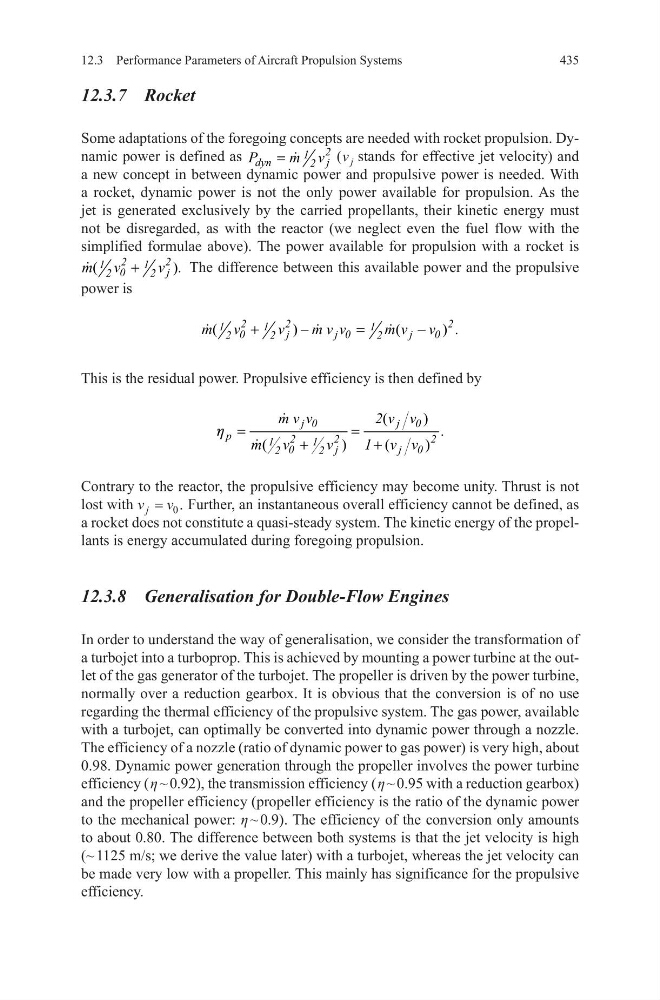
Some adaptations of the foregoing concepts are needed with rocket propulsion. Dynamic power is defined as
2
1
dyn
j
2
P
m v
=
(v j stands for effective jet velocity) and
a new concept in between dynamic power and propulsive power is needed. With
a rocket, dynamic power is not the only power available for propulsion. As the
jet is generated exclusively by the carried propellants, their kinetic energy must
not be disregarded, as with the reactor (we neglect even the fuel flow with the
simplified formulae above). The power available for propulsion with a rocket is
(
)
+
2
2
1
1
0
j
2
2
m v
v . The difference between this available power and the propulsive
power is
This is the residual power. Propulsive efficiency is then defined by
Contrary to the reactor, the propulsive efficiency may become unity. Thrust is not
lost with v v
j = 0 . Further, an instantaneous overall efficiency cannot be defined, as
a rocket does not constitute a quasi-steady system. The kinetic energy of the propellants is energy accumulated during foregoing propulsion.
12.3.8 Generalisation for Double-Flow Engines
In order to understand the way of generalisation, we consider the transformation of
a turbojet into a turboprop. This is achieved by mounting a power turbine at the outlet of the gas generator of the turbojet. The propeller is driven by the power turbine,
normally over a reduction gearbox. It is obvious that the conversion is of no use
regarding the thermal efficiency of the propulsive system. The gas power, available
with a turbojet, can optimally be converted into dynamic power through a nozzle.
The efficiency of a nozzle (ratio of dynamic power to gas power) is very high, about
0.98. Dynamic power generation through the propeller involves the power turbine
efficiency ( η ~ 0.92), the transmission efficiency ( η ~ 0.95 with a reduction gearbox)
and the propeller efficiency (propeller efficiency is the ratio of the dynamic power
to the mechanical power: η ~ 0.9). The efficiency of the conversion only amounts
to about 0.80. The difference between both systems is that the jet velocity is high
(~ 1125 m/s; we derive the value later) with a turbojet, whereas the jet velocity can
be made very low with a propeller. This mainly has significance for the propulsive
efficiency.
(
)
(
)
+
−
=
−
2
2
2
1
1
1
0
j
j 0
j
0
2
2
2
m v
v
m v v
m v v .
(
)
(
)
(
)
=
=
+
+
j 0
j 0
p
2
2
2
1
1
0
j
j 0
2
2
m v v
2 v v
.
m v
v
1 v v
h
12.3 Performance Parameters of Aircraft Propulsion Systems
12.3.7 Rocket
Some adaptations of the foregoing concepts are needed with rocket propulsion. Dynamic power is defined as
2
1
dyn
j
2
P
m v
=
(v j stands for effective jet velocity) and
a new concept in between dynamic power and propulsive power is needed. With
a rocket, dynamic power is not the only power available for propulsion. As the
jet is generated exclusively by the carried propellants, their kinetic energy must
not be disregarded, as with the reactor (we neglect even the fuel flow with the
simplified formulae above). The power available for propulsion with a rocket is
(
)
+
2
2
1
1
0
j
2
2
m v
v . The difference between this available power and the propulsive
power is
This is the residual power. Propulsive efficiency is then defined by
Contrary to the reactor, the propulsive efficiency may become unity. Thrust is not
lost with v v
j = 0 . Further, an instantaneous overall efficiency cannot be defined, as
a rocket does not constitute a quasi-steady system. The kinetic energy of the propellants is energy accumulated during foregoing propulsion.
12.3.8 Generalisation for Double-Flow Engines
In order to understand the way of generalisation, we consider the transformation of
a turbojet into a turboprop. This is achieved by mounting a power turbine at the outlet of the gas generator of the turbojet. The propeller is driven by the power turbine,
normally over a reduction gearbox. It is obvious that the conversion is of no use
regarding the thermal efficiency of the propulsive system. The gas power, available
with a turbojet, can optimally be converted into dynamic power through a nozzle.
The efficiency of a nozzle (ratio of dynamic power to gas power) is very high, about
0.98. Dynamic power generation through the propeller involves the power turbine
efficiency ( η ~ 0.92), the transmission efficiency ( η ~ 0.95 with a reduction gearbox)
and the propeller efficiency (propeller efficiency is the ratio of the dynamic power
to the mechanical power: η ~ 0.9). The efficiency of the conversion only amounts
to about 0.80. The difference between both systems is that the jet velocity is high
(~ 1125 m/s; we derive the value later) with a turbojet, whereas the jet velocity can
be made very low with a propeller. This mainly has significance for the propulsive
efficiency.
(
)
(
)
+
−
=
−
2
2
2
1
1
1
0
j
j 0
j
0
2
2
2
m v
v
m v v
m v v .
(
)
(
)
(
)
=
=
+
+
j 0
j 0
p
2
2
2
1
1
0
j
j 0
2
2
m v v
2 v v
.
m v
v
1 v v
h