

434
12 Thrust Gas Turbines
12.3.5 Propulsive Power and Propulsive Efficiency
Propulsive power or thrust power is the power consumed by the aircraft for its
propulsion:
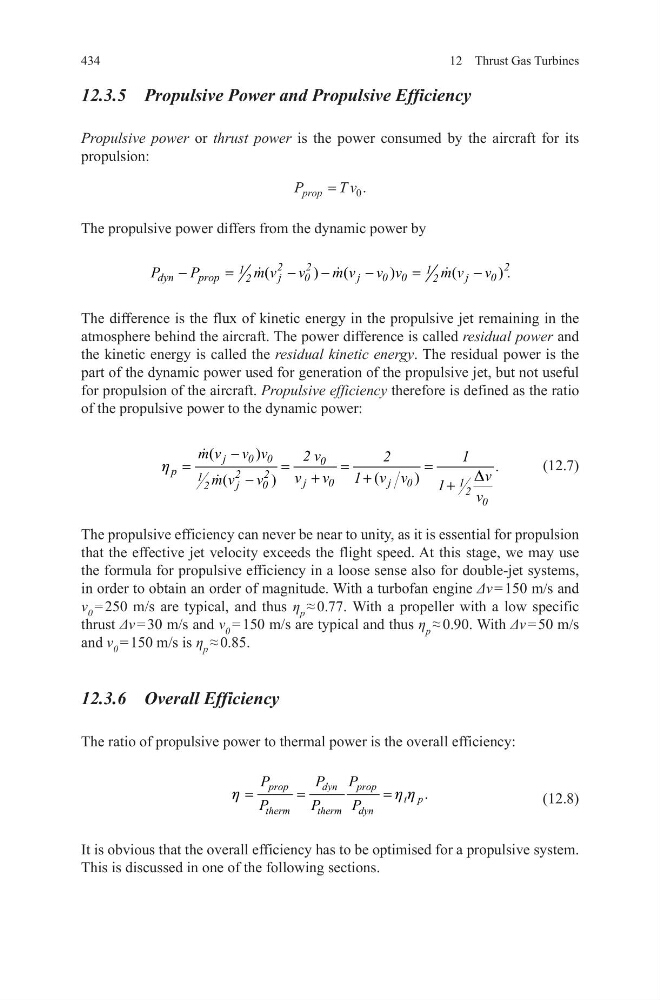
The propulsive power differs from the dynamic power by
The difference is the flux of kinetic energy in the propulsive jet remaining in the
atmosphere behind the aircraft. The power difference is called residual power and
the kinetic energy is called the residual kinetic energy. The residual power is the
part of the dynamic power used for generation of the propulsive jet, but not useful
for propulsion of the aircraft. Propulsive efficiency therefore is defined as the ratio
of the propulsive power to the dynamic power:
(12.7)
The propulsive efficiency can never be near to unity, as it is essential for propulsion
that the effective jet velocity exceeds the flight speed. At this stage, we may use
the formula for propulsive efficiency in a loose sense also for double-jet systems,
in order to obtain an order of magnitude. With a turbofan engine Δv = 150 m/s and
v 0 = 250 m/s are typical, and thus η p ≈ 0.77. With a propeller with a low specific
thrust Δv = 30 m/s and v 0 = 150 m/s are typical and thus η p ≈ 0.90. With Δv = 50 m/s
and v 0 = 150 m/s is η p ≈ 0.85.
12.3.6 Overall Efficiency
The ratio of propulsive power to thermal power is the overall efficiency:
(12.8)
It is obvious that the overall efficiency has to be optimised for a propulsive system.
This is discussed in one of the following sections.
P
Tv
prop = 0 .
(
)
(
)
(
)
−
=
−
−
−
=
−
2
2
2
1
1
dyn
prop
j
0
j
0 0
j
0
2
2
P
P
m v v
m v v v
m v v .
(
)
(
)
(
)
−
=
=
=
=
+
+
−
+
j
0 0
0
p
2
2
1
1
j
0
j 0
j
0
2
2 0
m v v v
2 v
2
1
.
v
v v
1 v v
m v v
1
v
h
D
.
prop
dyn
prop
t p
therm
therm
dyn
P
P
P
P
P
P
h
h h
=
=
=
12 Thrust Gas Turbines
12.3.5 Propulsive Power and Propulsive Efficiency
Propulsive power or thrust power is the power consumed by the aircraft for its
propulsion:
The propulsive power differs from the dynamic power by
The difference is the flux of kinetic energy in the propulsive jet remaining in the
atmosphere behind the aircraft. The power difference is called residual power and
the kinetic energy is called the residual kinetic energy. The residual power is the
part of the dynamic power used for generation of the propulsive jet, but not useful
for propulsion of the aircraft. Propulsive efficiency therefore is defined as the ratio
of the propulsive power to the dynamic power:
(12.7)
The propulsive efficiency can never be near to unity, as it is essential for propulsion
that the effective jet velocity exceeds the flight speed. At this stage, we may use
the formula for propulsive efficiency in a loose sense also for double-jet systems,
in order to obtain an order of magnitude. With a turbofan engine Δv = 150 m/s and
v 0 = 250 m/s are typical, and thus η p ≈ 0.77. With a propeller with a low specific
thrust Δv = 30 m/s and v 0 = 150 m/s are typical and thus η p ≈ 0.90. With Δv = 50 m/s
and v 0 = 150 m/s is η p ≈ 0.85.
12.3.6 Overall Efficiency
The ratio of propulsive power to thermal power is the overall efficiency:
(12.8)
It is obvious that the overall efficiency has to be optimised for a propulsive system.
This is discussed in one of the following sections.
P
Tv
prop = 0 .
(
)
(
)
(
)
−
=
−
−
−
=
−
2
2
2
1
1
dyn
prop
j
0
j
0 0
j
0
2
2
P
P
m v v
m v v v
m v v .
(
)
(
)
(
)
−
=
=
=
=
+
+
−
+
j
0 0
0
p
2
2
1
1
j
0
j 0
j
0
2
2 0
m v v v
2 v
2
1
.
v
v v
1 v v
m v v
1
v
h
D
.
prop
dyn
prop
t p
therm
therm
dyn
P
P
P
P
P
P
h
h h
=
=
=