

431
12.2 Overview of Aircraft Gas Turbine Engines
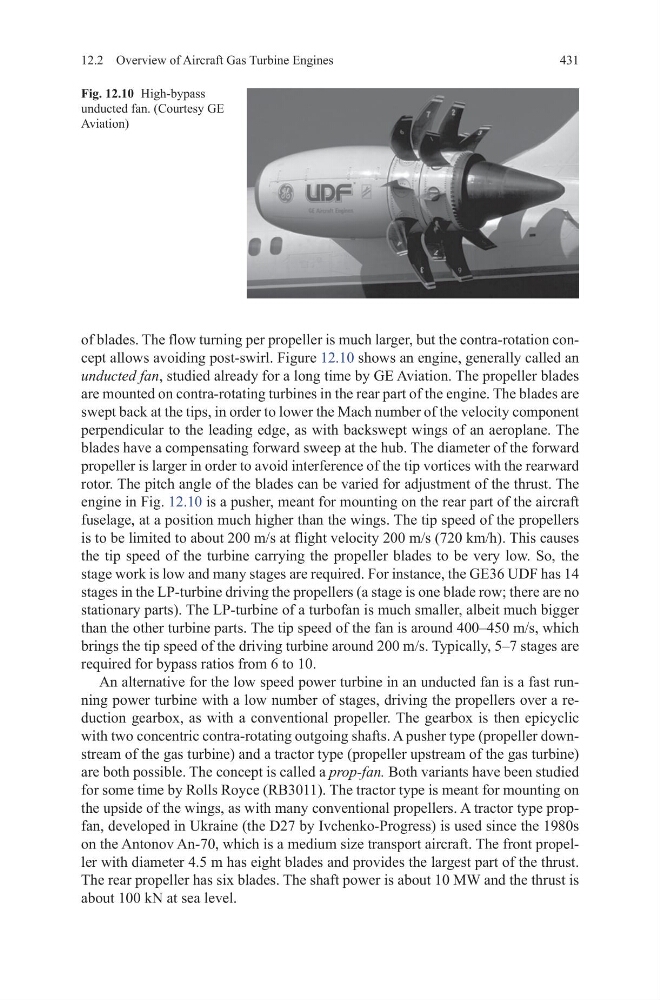
of blades. The flow turning per propeller is much larger, but the contra-rotation concept allows avoiding post-swirl. Figure 12.10 shows an engine, generally called an
unducted fan, studied already for a long time by GE Aviation. The propeller blades
are mounted on contra-rotating turbines in the rear part of the engine. The blades are
swept back at the tips, in order to lower the Mach number of the velocity component
perpendicular to the leading edge, as with backswept wings of an aeroplane. The
blades have a compensating forward sweep at the hub. The diameter of the forward
propeller is larger in order to avoid interference of the tip vortices with the rearward
rotor. The pitch angle of the blades can be varied for adjustment of the thrust. The
engine in Fig. 12.10 is a pusher, meant for mounting on the rear part of the aircraft
fuselage, at a position much higher than the wings. The tip speed of the propellers
is to be limited to about 200 m/s at flight velocity 200 m/s (720 km/h). This causes
the tip speed of the turbine carrying the propeller blades to be very low. So, the
stage work is low and many stages are required. For instance, the GE36 UDF has 14
stages in the LP-turbine driving the propellers (a stage is one blade row; there are no
stationary parts). The LP-turbine of a turbofan is much smaller, albeit much bigger
than the other turbine parts. The tip speed of the fan is around 400–450 m/s, which
brings the tip speed of the driving turbine around 200 m/s. Typically, 5–7 stages are
required for bypass ratios from 6 to 10.
An alternative for the low speed power turbine in an unducted fan is a fast running power turbine with a low number of stages, driving the propellers over a reduction gearbox, as with a conventional propeller. The gearbox is then epicyclic
with two concentric contra-rotating outgoing shafts. A pusher type (propeller downstream of the gas turbine) and a tractor type (propeller upstream of the gas turbine)
are both possible. The concept is called a prop-fan. Both variants have been studied
for some time by Rolls Royce (RB3011). The tractor type is meant for mounting on
the upside of the wings, as with many conventional propellers. A tractor type propfan, developed in Ukraine (the D27 by Ivchenko-Progress) is used since the 1980s
on the Antonov An-70, which is a medium size transport aircraft. The front propeller with diameter 4.5 m has eight blades and provides the largest part of the thrust.
The rear propeller has six blades. The shaft power is about 10 MW and the thrust is
about 100 kN at sea level.
Fig. 12.10 High-bypass
unducted fan. (Courtesy GE
Aviation)
12.2 Overview of Aircraft Gas Turbine Engines
of blades. The flow turning per propeller is much larger, but the contra-rotation concept allows avoiding post-swirl. Figure 12.10 shows an engine, generally called an
unducted fan, studied already for a long time by GE Aviation. The propeller blades
are mounted on contra-rotating turbines in the rear part of the engine. The blades are
swept back at the tips, in order to lower the Mach number of the velocity component
perpendicular to the leading edge, as with backswept wings of an aeroplane. The
blades have a compensating forward sweep at the hub. The diameter of the forward
propeller is larger in order to avoid interference of the tip vortices with the rearward
rotor. The pitch angle of the blades can be varied for adjustment of the thrust. The
engine in Fig. 12.10 is a pusher, meant for mounting on the rear part of the aircraft
fuselage, at a position much higher than the wings. The tip speed of the propellers
is to be limited to about 200 m/s at flight velocity 200 m/s (720 km/h). This causes
the tip speed of the turbine carrying the propeller blades to be very low. So, the
stage work is low and many stages are required. For instance, the GE36 UDF has 14
stages in the LP-turbine driving the propellers (a stage is one blade row; there are no
stationary parts). The LP-turbine of a turbofan is much smaller, albeit much bigger
than the other turbine parts. The tip speed of the fan is around 400–450 m/s, which
brings the tip speed of the driving turbine around 200 m/s. Typically, 5–7 stages are
required for bypass ratios from 6 to 10.
An alternative for the low speed power turbine in an unducted fan is a fast running power turbine with a low number of stages, driving the propellers over a reduction gearbox, as with a conventional propeller. The gearbox is then epicyclic
with two concentric contra-rotating outgoing shafts. A pusher type (propeller downstream of the gas turbine) and a tractor type (propeller upstream of the gas turbine)
are both possible. The concept is called a prop-fan. Both variants have been studied
for some time by Rolls Royce (RB3011). The tractor type is meant for mounting on
the upside of the wings, as with many conventional propellers. A tractor type propfan, developed in Ukraine (the D27 by Ivchenko-Progress) is used since the 1980s
on the Antonov An-70, which is a medium size transport aircraft. The front propeller with diameter 4.5 m has eight blades and provides the largest part of the thrust.
The rear propeller has six blades. The shaft power is about 10 MW and the thrust is
about 100 kN at sea level.
Fig. 12.10 High-bypass
unducted fan. (Courtesy GE
Aviation)