

410
11 Power Gas Turbines
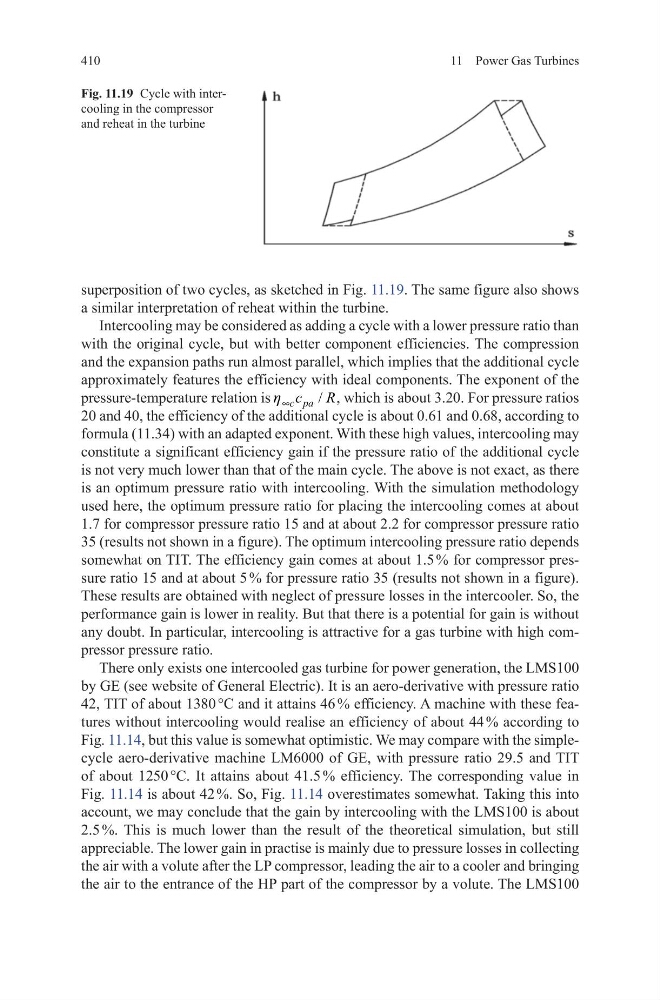
superposition of two cycles, as sketched in Fig. 11.19. The same figure also shows
a similar interpretation of reheat within the turbine.
Intercooling may be considered as adding a cycle with a lower pressure ratio than
with the original cycle, but with better component efficiencies. The compression
and the expansion paths run almost parallel, which implies that the additional cycle
approximately features the efficiency with ideal components. The exponent of the
pressure-temperature relation is
/
c pa
c
R
h ∞
, which is about 3.20. For pressure ratios
20 and 40, the efficiency of the additional cycle is about 0.61 and 0.68, according to
formula (11.34) with an adapted exponent. With these high values, intercooling may
constitute a significant efficiency gain if the pressure ratio of the additional cycle
is not very much lower than that of the main cycle. The above is not exact, as there
is an optimum pressure ratio with intercooling. With the simulation methodology
used here, the optimum pressure ratio for placing the intercooling comes at about
1.7 for compressor pressure ratio 15 and at about 2.2 for compressor pressure ratio
35 (results not shown in a figure). The optimum intercooling pressure ratio depends
somewhat on TIT. The efficiency gain comes at about 1.5 % for compressor pressure ratio 15 and at about 5 % for pressure ratio 35 (results not shown in a figure).
These results are obtained with neglect of pressure losses in the intercooler. So, the
performance gain is lower in reality. But that there is a potential for gain is without
any doubt. In particular, intercooling is attractive for a gas turbine with high compressor pressure ratio.
There only exists one intercooled gas turbine for power generation, the LMS100
by GE (see website of General Electric). It is an aero-derivative with pressure ratio
42, TIT of about 1380 °C and it attains 46 % efficiency. A machine with these features without intercooling would realise an efficiency of about 44 % according to
Fig. 11.14, but this value is somewhat optimistic. We may compare with the simplecycle aero-derivative machine LM6000 of GE, with pressure ratio 29.5 and TIT
of about 1250 °C. It attains about 41.5 % efficiency. The corresponding value in
Fig. 11.14 is about 42 %. So, Fig. 11.14 overestimates somewhat. Taking this into
account, we may conclude that the gain by intercooling with the LMS100 is about
2.5 %. This is much lower than the result of the theoretical simulation, but still
appreciable. The lower gain in practise is mainly due to pressure losses in collecting
the air with a volute after the LP compressor, leading the air to a cooler and bringing
the air to the entrance of the HP part of the compressor by a volute. The LMS100
Fig. 11.19 Cycle with intercooling in the compressor
and reheat in the turbine
11 Power Gas Turbines
superposition of two cycles, as sketched in Fig. 11.19. The same figure also shows
a similar interpretation of reheat within the turbine.
Intercooling may be considered as adding a cycle with a lower pressure ratio than
with the original cycle, but with better component efficiencies. The compression
and the expansion paths run almost parallel, which implies that the additional cycle
approximately features the efficiency with ideal components. The exponent of the
pressure-temperature relation is
/
c pa
c
R
h ∞
, which is about 3.20. For pressure ratios
20 and 40, the efficiency of the additional cycle is about 0.61 and 0.68, according to
formula (11.34) with an adapted exponent. With these high values, intercooling may
constitute a significant efficiency gain if the pressure ratio of the additional cycle
is not very much lower than that of the main cycle. The above is not exact, as there
is an optimum pressure ratio with intercooling. With the simulation methodology
used here, the optimum pressure ratio for placing the intercooling comes at about
1.7 for compressor pressure ratio 15 and at about 2.2 for compressor pressure ratio
35 (results not shown in a figure). The optimum intercooling pressure ratio depends
somewhat on TIT. The efficiency gain comes at about 1.5 % for compressor pressure ratio 15 and at about 5 % for pressure ratio 35 (results not shown in a figure).
These results are obtained with neglect of pressure losses in the intercooler. So, the
performance gain is lower in reality. But that there is a potential for gain is without
any doubt. In particular, intercooling is attractive for a gas turbine with high compressor pressure ratio.
There only exists one intercooled gas turbine for power generation, the LMS100
by GE (see website of General Electric). It is an aero-derivative with pressure ratio
42, TIT of about 1380 °C and it attains 46 % efficiency. A machine with these features without intercooling would realise an efficiency of about 44 % according to
Fig. 11.14, but this value is somewhat optimistic. We may compare with the simplecycle aero-derivative machine LM6000 of GE, with pressure ratio 29.5 and TIT
of about 1250 °C. It attains about 41.5 % efficiency. The corresponding value in
Fig. 11.14 is about 42 %. So, Fig. 11.14 overestimates somewhat. Taking this into
account, we may conclude that the gain by intercooling with the LMS100 is about
2.5 %. This is much lower than the result of the theoretical simulation, but still
appreciable. The lower gain in practise is mainly due to pressure losses in collecting
the air with a volute after the LP compressor, leading the air to a cooler and bringing
the air to the entrance of the HP part of the compressor by a volute. The LMS100
Fig. 11.19 Cycle with intercooling in the compressor
and reheat in the turbine