

406
11 Power Gas Turbines
lower heating value. The heat exchange coefficient in the turbine is set to κ = 0.15 J/
kJK. Film cooling is assumed with heat exchanger effectiveness ε = 1. This means
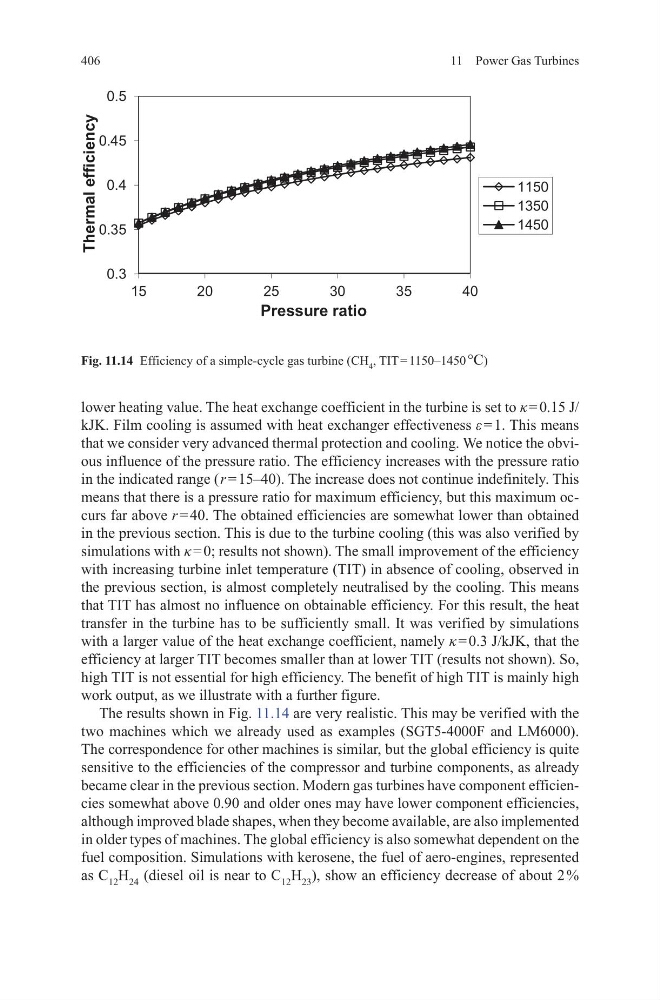
that we consider very advanced thermal protection and cooling. We notice the obvious influence of the pressure ratio. The efficiency increases with the pressure ratio
in the indicated range ( r = 15–40). The increase does not continue indefinitely. This
means that there is a pressure ratio for maximum efficiency, but this maximum occurs far above r = 40. The obtained efficiencies are somewhat lower than obtained
in the previous section. This is due to the turbine cooling (this was also verified by
simulations with κ = 0; results not shown). The small improvement of the efficiency
with increasing turbine inlet temperature (TIT) in absence of cooling, observed in
the previous section, is almost completely neutralised by the cooling. This means
that TIT has almost no influence on obtainable efficiency. For this result, the heat
transfer in the turbine has to be sufficiently small. It was verified by simulations
with a larger value of the heat exchange coefficient, namely κ = 0.3 J/kJK, that the
efficiency at larger TIT becomes smaller than at lower TIT (results not shown). So,
high TIT is not essential for high efficiency. The benefit of high TIT is mainly high
work output, as we illustrate with a further figure.
The results shown in Fig. 11.14 are very realistic. This may be verified with the
two machines which we already used as examples (SGT5-4000F and LM6000).
The correspondence for other machines is similar, but the global efficiency is quite
sensitive to the efficiencies of the compressor and turbine components, as already
became clear in the previous section. Modern gas turbines have component efficiencies somewhat above 0.90 and older ones may have lower component efficiencies,
although improved blade shapes, when they become available, are also implemented
in older types of machines. The global efficiency is also somewhat dependent on the
fuel composition. Simulations with kerosene, the fuel of aero-engines, represented
as C 12 H 24 (diesel oil is near to C 12 H 23 ), show an efficiency decrease of about 2 %
7KHUPDOHIILFLHQF\
3UHVVXUHUDWLR
Fig. 11.14 Efficiency of a simple-cycle gas turbine (CH 4 , TIT = 1150–1450 °C)
11 Power Gas Turbines
lower heating value. The heat exchange coefficient in the turbine is set to κ = 0.15 J/
kJK. Film cooling is assumed with heat exchanger effectiveness ε = 1. This means
that we consider very advanced thermal protection and cooling. We notice the obvious influence of the pressure ratio. The efficiency increases with the pressure ratio
in the indicated range ( r = 15–40). The increase does not continue indefinitely. This
means that there is a pressure ratio for maximum efficiency, but this maximum occurs far above r = 40. The obtained efficiencies are somewhat lower than obtained
in the previous section. This is due to the turbine cooling (this was also verified by
simulations with κ = 0; results not shown). The small improvement of the efficiency
with increasing turbine inlet temperature (TIT) in absence of cooling, observed in
the previous section, is almost completely neutralised by the cooling. This means
that TIT has almost no influence on obtainable efficiency. For this result, the heat
transfer in the turbine has to be sufficiently small. It was verified by simulations
with a larger value of the heat exchange coefficient, namely κ = 0.3 J/kJK, that the
efficiency at larger TIT becomes smaller than at lower TIT (results not shown). So,
high TIT is not essential for high efficiency. The benefit of high TIT is mainly high
work output, as we illustrate with a further figure.
The results shown in Fig. 11.14 are very realistic. This may be verified with the
two machines which we already used as examples (SGT5-4000F and LM6000).
The correspondence for other machines is similar, but the global efficiency is quite
sensitive to the efficiencies of the compressor and turbine components, as already
became clear in the previous section. Modern gas turbines have component efficiencies somewhat above 0.90 and older ones may have lower component efficiencies,
although improved blade shapes, when they become available, are also implemented
in older types of machines. The global efficiency is also somewhat dependent on the
fuel composition. Simulations with kerosene, the fuel of aero-engines, represented
as C 12 H 24 (diesel oil is near to C 12 H 23 ), show an efficiency decrease of about 2 %
7KHUPDOHIILFLHQF\
3UHVVXUHUDWLR
Fig. 11.14 Efficiency of a simple-cycle gas turbine (CH 4 , TIT = 1150–1450 °C)