

405
11.3 Performance of Simple-Cycle Power Gas Turbines
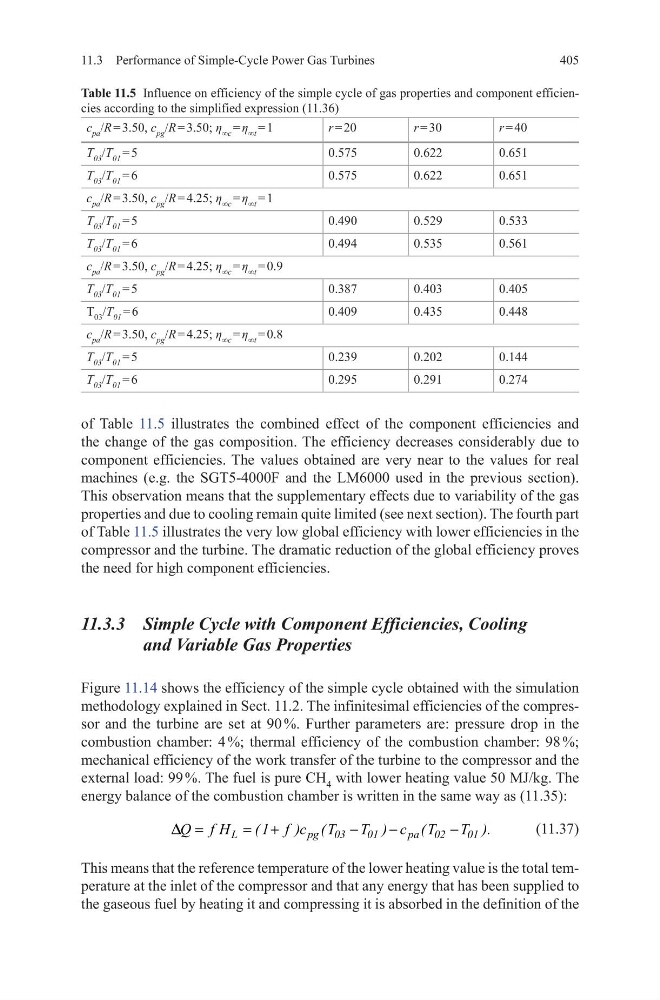
of Table 11.5 illustrates the combined effect of the component efficiencies and
the change of the gas composition. The efficiency decreases considerably due to
component efficiencies. The values obtained are very near to the values for real
machines (e.g. the SGT5-4000F and the LM6000 used in the previous section).
This observation means that the supplementary effects due to variability of the gas
properties and due to cooling remain quite limited (see next section). The fourth part
of Table 11.5 illustrates the very low global efficiency with lower efficiencies in the
compressor and the turbine. The dramatic reduction of the global efficiency proves
the need for high component efficiencies.
11.3.3 Simple Cycle with Component Efficiencies, Cooling
and Variable Gas Properties
Figure 11.14 shows the efficiency of the simple cycle obtained with the simulation
methodology explained in Sect. 11.2. The infinitesimal efficiencies of the compressor and the turbine are set at 90 %. Further parameters are: pressure drop in the
combustion chamber: 4 %; thermal efficiency of the combustion chamber: 98 %;
mechanical efficiency of the work transfer of the turbine to the compressor and the
external load: 99 %. The fuel is pure CH 4 with lower heating value 50 MJ/kg. The
energy balance of the combustion chamber is written in the same way as (11.35):
(11.37)
This means that the reference temperature of the lower heating value is the total temperature at the inlet of the compressor and that any energy that has been supplied to
the gaseous fuel by heating it and compressing it is absorbed in the definition of the
L
pg 03
01
pa 02
01
Q f H
( 1 f )c (T
T ) c (T
T ).
D =
= +
−
−
−
Table 11.5 Influence on efficiency of the simple cycle of gas properties and component efficiencies according to the simplified expression (11.36)
c pa /R = 3.50, c pg /R = 3.50; η ∞c = η ∞t = 1
r = 20
r = 30
r = 40
T 03 /T 01 = 5
0.575
0.622
0.651
T 03 /T 01 = 6
0.575
0.622
0.651
c pa /R = 3.50, c pg /R = 4.25; η ∞c = η ∞t = 1
T 03 /T 01 = 5
0.490
0.529
0.533
T 03 /T 01 = 6
0.494
0.535
0.561
c pa /R = 3.50, c pg /R = 4.25; η ∞c = η ∞t = 0.9
T 03 /T 01 = 5
0.387
0.403
0.405
T 03 /T 01 = 6
0.409
0.435
0.448
c pa /R = 3.50, c pg /R = 4.25; η ∞c = η ∞t = 0.8
T 03 /T 01 = 5
0.239
0.202
0.144
T 03 /T 01 = 6
0.295
0.291
0.274
11.3 Performance of Simple-Cycle Power Gas Turbines
of Table 11.5 illustrates the combined effect of the component efficiencies and
the change of the gas composition. The efficiency decreases considerably due to
component efficiencies. The values obtained are very near to the values for real
machines (e.g. the SGT5-4000F and the LM6000 used in the previous section).
This observation means that the supplementary effects due to variability of the gas
properties and due to cooling remain quite limited (see next section). The fourth part
of Table 11.5 illustrates the very low global efficiency with lower efficiencies in the
compressor and the turbine. The dramatic reduction of the global efficiency proves
the need for high component efficiencies.
11.3.3 Simple Cycle with Component Efficiencies, Cooling
and Variable Gas Properties
Figure 11.14 shows the efficiency of the simple cycle obtained with the simulation
methodology explained in Sect. 11.2. The infinitesimal efficiencies of the compressor and the turbine are set at 90 %. Further parameters are: pressure drop in the
combustion chamber: 4 %; thermal efficiency of the combustion chamber: 98 %;
mechanical efficiency of the work transfer of the turbine to the compressor and the
external load: 99 %. The fuel is pure CH 4 with lower heating value 50 MJ/kg. The
energy balance of the combustion chamber is written in the same way as (11.35):
(11.37)
This means that the reference temperature of the lower heating value is the total temperature at the inlet of the compressor and that any energy that has been supplied to
the gaseous fuel by heating it and compressing it is absorbed in the definition of the
L
pg 03
01
pa 02
01
Q f H
( 1 f )c (T
T ) c (T
T ).
D =
= +
−
−
−
Table 11.5 Influence on efficiency of the simple cycle of gas properties and component efficiencies according to the simplified expression (11.36)
c pa /R = 3.50, c pg /R = 3.50; η ∞c = η ∞t = 1
r = 20
r = 30
r = 40
T 03 /T 01 = 5
0.575
0.622
0.651
T 03 /T 01 = 6
0.575
0.622
0.651
c pa /R = 3.50, c pg /R = 4.25; η ∞c = η ∞t = 1
T 03 /T 01 = 5
0.490
0.529
0.533
T 03 /T 01 = 6
0.494
0.535
0.561
c pa /R = 3.50, c pg /R = 4.25; η ∞c = η ∞t = 0.9
T 03 /T 01 = 5
0.387
0.403
0.405
T 03 /T 01 = 6
0.409
0.435
0.448
c pa /R = 3.50, c pg /R = 4.25; η ∞c = η ∞t = 0.8
T 03 /T 01 = 5
0.239
0.202
0.144
T 03 /T 01 = 6
0.295
0.291
0.274