

399
11.2 Thermodynamic Modelling
The Eqs. (11.16) and (11.18), together with the gas law, are applied to obtain (11.21)
and (11.22). c pg is the differential value of the specific heat. Equations (11.21) and
(11.22) may be integrated exactly. The resulting expressions are rather complex and
do not allow an immediate interpretation. Approximate integration with an average value of the factor 1 + κ( T g − T b ) therefore is more convenient. This factor only
changes little over a small pressure interval. Approximate integration of (11.22)
results in
(11.23)
The average temperature during expansion and the average specific heat appear in
the formula. Now, the interpretation of result (11.23) becomes rather simple. The
relation is polytropic and the exponent increases by cooling. This implies that, for
a given pressure interval, the final temperature with cooling is lower than without
cooling. With (11.23) follows the enthalpy difference over the pressure interval:
(11.24)
With an approximate integration according to the same principle, (11.21) results in
(11.25)
(
)
g b
pg
)
2'
2'
1
1
R
1 ( T T
c
T
p
.
T
p
h
k
∞ +
−
=
2'
pg 1
2'
pg 1
1
T
h c ( T T ) c T ( 1
).
T
D
− =
−
=
−
and
g
b
g
b
g
b
(T T )
W
1
q
.
h 1
(T T )
h 1
(T T )
k
D
D
D
k
D
k
−
−
−
=
=
−
+
−
−
+
−
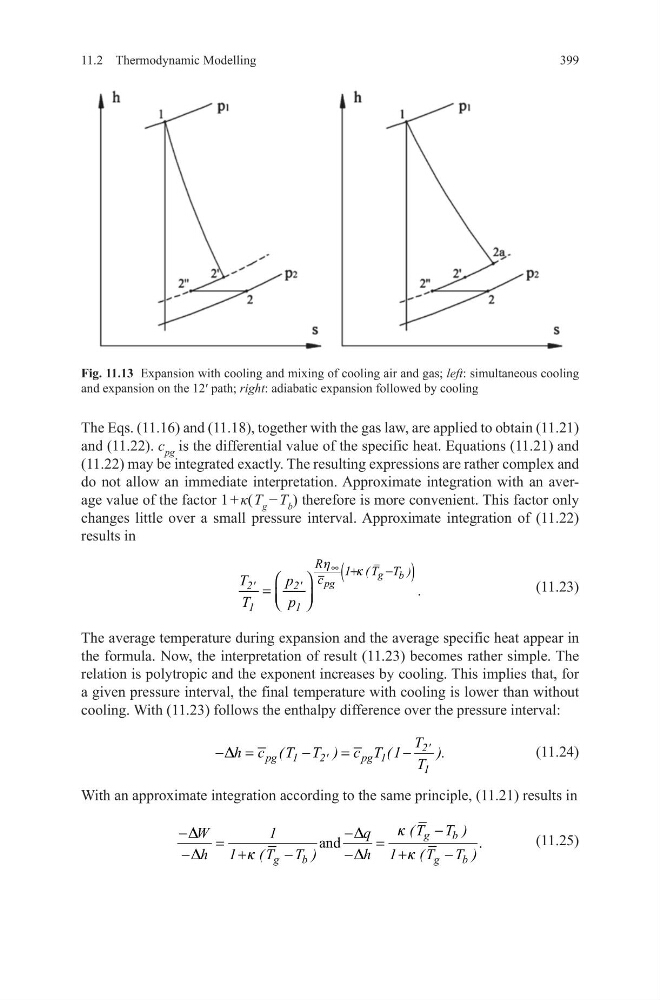
Fig. 11.13 Expansion with cooling and mixing of cooling air and gas; left: simultaneous cooling
and expansion on the 12ʹ path; right: adiabatic expansion followed by cooling
11.2 Thermodynamic Modelling
The Eqs. (11.16) and (11.18), together with the gas law, are applied to obtain (11.21)
and (11.22). c pg is the differential value of the specific heat. Equations (11.21) and
(11.22) may be integrated exactly. The resulting expressions are rather complex and
do not allow an immediate interpretation. Approximate integration with an average value of the factor 1 + κ( T g − T b ) therefore is more convenient. This factor only
changes little over a small pressure interval. Approximate integration of (11.22)
results in
(11.23)
The average temperature during expansion and the average specific heat appear in
the formula. Now, the interpretation of result (11.23) becomes rather simple. The
relation is polytropic and the exponent increases by cooling. This implies that, for
a given pressure interval, the final temperature with cooling is lower than without
cooling. With (11.23) follows the enthalpy difference over the pressure interval:
(11.24)
With an approximate integration according to the same principle, (11.21) results in
(11.25)
(
)
g b
pg
)
2'
2'
1
1
R
1 ( T T
c
T
p
.
T
p
h
k
∞ +
−
=
2'
pg 1
2'
pg 1
1
T
h c ( T T ) c T ( 1
).
T
D
− =
−
=
−
and
g
b
g
b
g
b
(T T )
W
1
q
.
h 1
(T T )
h 1
(T T )
k
D
D
D
k
D
k
−
−
−
=
=
−
+
−
−
+
−
Fig. 11.13 Expansion with cooling and mixing of cooling air and gas; left: simultaneous cooling
and expansion on the 12ʹ path; right: adiabatic expansion followed by cooling