

386
11 Power Gas Turbines
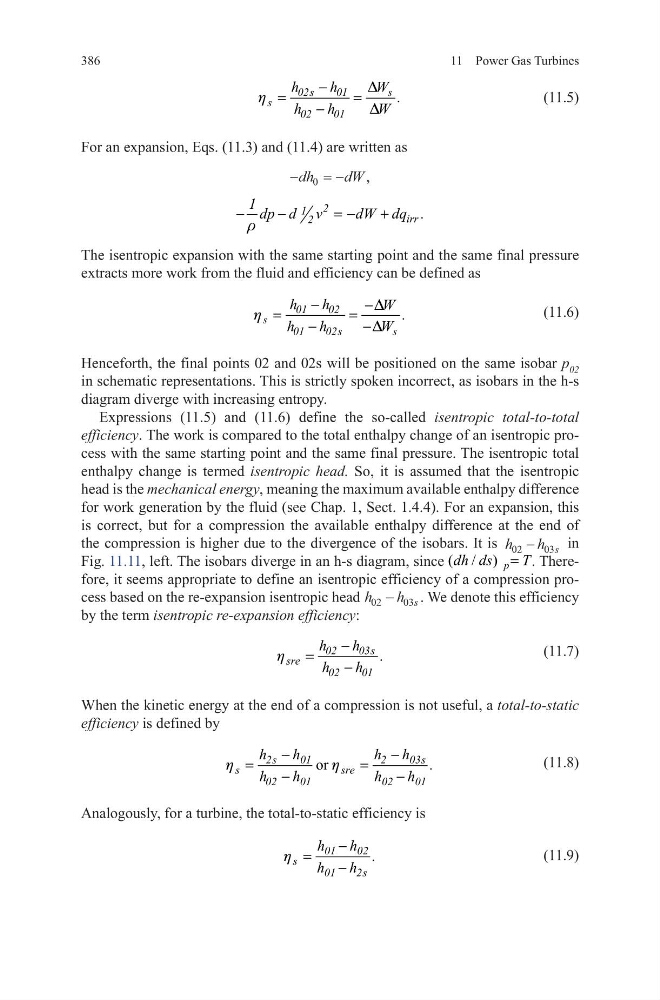
(11.5)
For an expansion, Eqs. (11.3) and (11.4) are written as
The isentropic expansion with the same starting point and the same final pressure
extracts more work from the fluid and efficiency can be defined as
(11.6)
Henceforth, the final points 02 and 02s will be positioned on the same isobar p 02
in schematic representations. This is strictly spoken incorrect, as isobars in the h-s
diagram diverge with increasing entropy.
Expressions (11.5) and (11.6) define the so-called isentropic total-to-total
efficiency. The work is compared to the total enthalpy change of an isentropic process with the same starting point and the same final pressure. The isentropic total
enthalpy change is termed isentropic head. So, it is assumed that the isentropic
head is the mechanical energy, meaning the maximum available enthalpy difference
for work generation by the fluid (see Chap. 1, Sect. 1.4.4). For an expansion, this
is correct, but for a compression the available enthalpy difference at the end of
the compression is higher due to the divergence of the isobars. It is h
h s
02
03
−
in
Fig. 11.11, left. The isobars diverge in an h-s diagram, since ( / ) p
dh ds
T
= . Therefore, it seems appropriate to define an isentropic efficiency of a compression process based on the re-expansion isentropic head h
h s
02
03
−
. We denote this efficiency
by the term isentropic re-expansion efficiency:
(11.7)
When the kinetic energy at the end of a compression is not useful, a total-to-static
efficiency is defined by
(11.8)
Analogously, for a turbine, the total-to-static efficiency is
(11.9)
02s
01
s
s
02
01
h
h
W .
h
h
W
D
h
D
−
=
=
−
−
=−
dh
dW
0
,
2
1
irr
2
1 dp d v
dW dq .
r
−
−
= −
+
01
02
s
01
02s
s
h
h
W .
h
h
W
D
h
D
−
−
=
=
−
−
02
03s
sre
02
01
h
h .
h
h
h
−
=
−
or
2s
01
2
03s
s
sre
02
01
02
01
h
h
h h .
h
h
h
h
h
h
−
−
=
=
−
−
01
02
s
01
2s
h
h .
h
h
h
−
=
−
11 Power Gas Turbines
(11.5)
For an expansion, Eqs. (11.3) and (11.4) are written as
The isentropic expansion with the same starting point and the same final pressure
extracts more work from the fluid and efficiency can be defined as
(11.6)
Henceforth, the final points 02 and 02s will be positioned on the same isobar p 02
in schematic representations. This is strictly spoken incorrect, as isobars in the h-s
diagram diverge with increasing entropy.
Expressions (11.5) and (11.6) define the so-called isentropic total-to-total
efficiency. The work is compared to the total enthalpy change of an isentropic process with the same starting point and the same final pressure. The isentropic total
enthalpy change is termed isentropic head. So, it is assumed that the isentropic
head is the mechanical energy, meaning the maximum available enthalpy difference
for work generation by the fluid (see Chap. 1, Sect. 1.4.4). For an expansion, this
is correct, but for a compression the available enthalpy difference at the end of
the compression is higher due to the divergence of the isobars. It is h
h s
02
03
−
in
Fig. 11.11, left. The isobars diverge in an h-s diagram, since ( / ) p
dh ds
T
= . Therefore, it seems appropriate to define an isentropic efficiency of a compression process based on the re-expansion isentropic head h
h s
02
03
−
. We denote this efficiency
by the term isentropic re-expansion efficiency:
(11.7)
When the kinetic energy at the end of a compression is not useful, a total-to-static
efficiency is defined by
(11.8)
Analogously, for a turbine, the total-to-static efficiency is
(11.9)
02s
01
s
s
02
01
h
h
W .
h
h
W
D
h
D
−
=
=
−
−
=−
dh
dW
0
,
2
1
irr
2
1 dp d v
dW dq .
r
−
−
= −
+
01
02
s
01
02s
s
h
h
W .
h
h
W
D
h
D
−
−
=
=
−
−
02
03s
sre
02
01
h
h .
h
h
h
−
=
−
or
2s
01
2
03s
s
sre
02
01
02
01
h
h
h h .
h
h
h
h
h
h
−
−
=
=
−
−
01
02
s
01
2s
h
h .
h
h
h
−
=
−