

385
11.2 Thermodynamic Modelling
definition is then simple. The efficiency of a machine with work done on a fluid,
i.e. a pump, equals the ratio of the useful part of the work to the total work and the
useful part of the work is the head. Assessment of the efficiency becomes more difficult with a compressible fluid. Integration of the work equation requires a way to
determine a unique dependence between ρ and p. The traditional solution consists
in considering a lossless flow and comparing its performance with the flow with
losses. With dq irr = dh − 1/ρ dp = 0 it follows Tds = dh − 1/ρ dp = 0. Thus the lossless
flow is isentropic. For an isentropic flow, ρ is a unique function of p and integration
of the work equation is possible.
We first notice that the change of gravitational potential energy for a gas is negligible with the processes that we analyse. E.g. for Δz = 1 m is ΔU = g Δz = 9.81 J/
kg. Converted into enthalpy, this means for c p = 1005 J/kgK (air): c p ΔT = ΔU or
ΔT ≈ 0.01 K. Further we apply the concept of total state or stagnation state. This is
the state attained by bringing the flow to zero velocity in a reversible adiabatic way.
We note this state with the subscript 0; especially h 0 = h + ½ v
2
. With the concept
of total enthalpy and ignoring the small changes in gravitational potential energy,
Eqs. (11.1) and (11.2) become
(11.3)
(11.4)
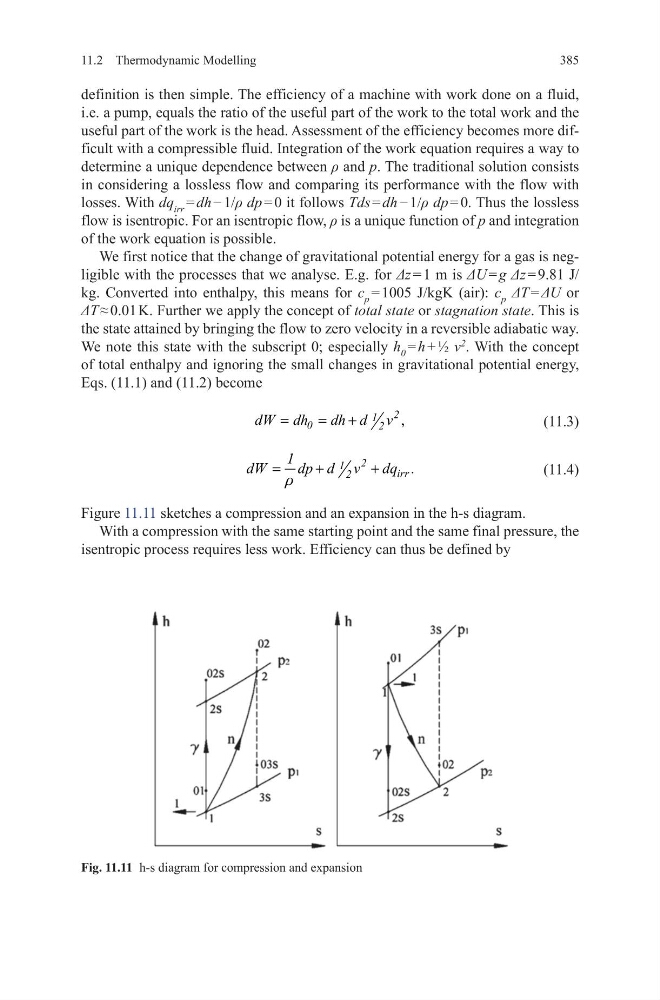
Figure 11.11 sketches a compression and an expansion in the h-s diagram.
With a compression with the same starting point and the same final pressure, the
isentropic process requires less work. Efficiency can thus be defined by
,
2
1
0
2
dW dh
dh d v
=
= +
2
1
irr
2
1
dW
dp d v dq .
r
=
+
+
Fig. 11.11 h-s diagram for compression and expansion
11.2 Thermodynamic Modelling
definition is then simple. The efficiency of a machine with work done on a fluid,
i.e. a pump, equals the ratio of the useful part of the work to the total work and the
useful part of the work is the head. Assessment of the efficiency becomes more difficult with a compressible fluid. Integration of the work equation requires a way to
determine a unique dependence between ρ and p. The traditional solution consists
in considering a lossless flow and comparing its performance with the flow with
losses. With dq irr = dh − 1/ρ dp = 0 it follows Tds = dh − 1/ρ dp = 0. Thus the lossless
flow is isentropic. For an isentropic flow, ρ is a unique function of p and integration
of the work equation is possible.
We first notice that the change of gravitational potential energy for a gas is negligible with the processes that we analyse. E.g. for Δz = 1 m is ΔU = g Δz = 9.81 J/
kg. Converted into enthalpy, this means for c p = 1005 J/kgK (air): c p ΔT = ΔU or
ΔT ≈ 0.01 K. Further we apply the concept of total state or stagnation state. This is
the state attained by bringing the flow to zero velocity in a reversible adiabatic way.
We note this state with the subscript 0; especially h 0 = h + ½ v
2
. With the concept
of total enthalpy and ignoring the small changes in gravitational potential energy,
Eqs. (11.1) and (11.2) become
(11.3)
(11.4)
Figure 11.11 sketches a compression and an expansion in the h-s diagram.
With a compression with the same starting point and the same final pressure, the
isentropic process requires less work. Efficiency can thus be defined by
,
2
1
0
2
dW dh
dh d v
=
= +
2
1
irr
2
1
dW
dp d v dq .
r
=
+
+
Fig. 11.11 h-s diagram for compression and expansion