

360
10 Wind Turbines
through the rotor, allowing the assumption that there is atmospheric pressure p 0 on
the envelope of the outer tube (Fig. 10.8). There is no work in the second streamtube. As a consequence, the outlet velocity is v 0 . A momentum balance on both
streamtubes together results in (10.6), without any further assumptions.
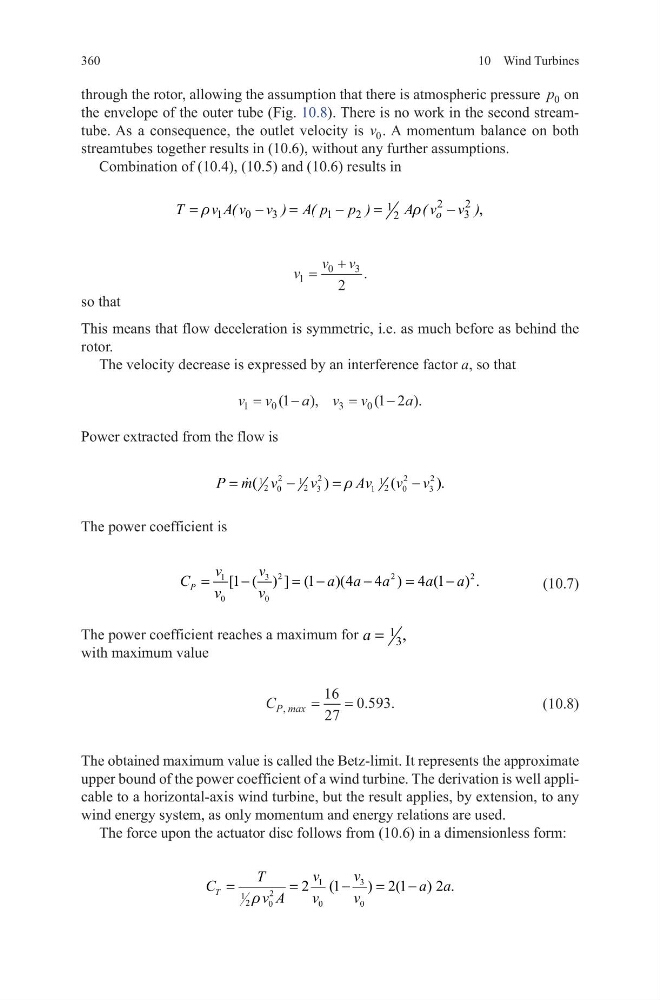
Combination of (10.4), (10.5) and (10.6) results in
so that
This means that flow deceleration is symmetric, i.e. as much before as behind the
rotor.
The velocity decrease is expressed by an interference factor a, so that
Power extracted from the flow is
The power coefficient is
(10.7)
The power coefficient reaches a maximum for
1 3 ,
a =
with maximum value
(10.8)
The obtained maximum value is called the Betz-limit. It represents the approximate
upper bound of the power coefficient of a wind turbine. The derivation is well applicable to a horizontal-axis wind turbine, but the result applies, by extension, to any
wind energy system, as only momentum and energy relations are used.
The force upon the actuator disc follows from (10.6) in a dimensionless form:
2
2
1
1
0
3
1
2
3
2
,
o
T
v A( v v ) A( p p )
A ( v v )
r
r
=
−
=
−
=
−
v
v v
1
0
3
2
=
+ .
v v
a
v v
a
1
0
3
0
1
1 2
=
−
=
−
(
),
(
).
2
2
2
2
1
1
1
2
2
2
0
3
1
0
3
(
)
(
).
P m v
v
Av
v v
r
=
−
=
−
2
2
2
3
1
0
0
[1 ( ) ] (1 )(4 4 ) 4 (1 ) .
P
v
v
C
a a a
a
a
v
v
=
−
= −
−
=
−
C P,
.
.
max = =
16
27
0 593
3
1
2
1 2
0
0
0
2 (1
) 2(1 ) 2 .
T
v
v
T
C
a a
v
v
v A
r
=
=
−
=
−
10 Wind Turbines
through the rotor, allowing the assumption that there is atmospheric pressure p 0 on
the envelope of the outer tube (Fig. 10.8). There is no work in the second streamtube. As a consequence, the outlet velocity is v 0 . A momentum balance on both
streamtubes together results in (10.6), without any further assumptions.
Combination of (10.4), (10.5) and (10.6) results in
so that
This means that flow deceleration is symmetric, i.e. as much before as behind the
rotor.
The velocity decrease is expressed by an interference factor a, so that
Power extracted from the flow is
The power coefficient is
(10.7)
The power coefficient reaches a maximum for
1 3 ,
a =
with maximum value
(10.8)
The obtained maximum value is called the Betz-limit. It represents the approximate
upper bound of the power coefficient of a wind turbine. The derivation is well applicable to a horizontal-axis wind turbine, but the result applies, by extension, to any
wind energy system, as only momentum and energy relations are used.
The force upon the actuator disc follows from (10.6) in a dimensionless form:
2
2
1
1
0
3
1
2
3
2
,
o
T
v A( v v ) A( p p )
A ( v v )
r
r
=
−
=
−
=
−
v
v v
1
0
3
2
=
+ .
v v
a
v v
a
1
0
3
0
1
1 2
=
−
=
−
(
),
(
).
2
2
2
2
1
1
1
2
2
2
0
3
1
0
3
(
)
(
).
P m v
v
Av
v v
r
=
−
=
−
2
2
2
3
1
0
0
[1 ( ) ] (1 )(4 4 ) 4 (1 ) .
P
v
v
C
a a a
a
a
v
v
=
−
= −
−
=
−
C P,
.
.
max = =
16
27
0 593
3
1
2
1 2
0
0
0
2 (1
) 2(1 ) 2 .
T
v
v
T
C
a a
v
v
v A
r
=
=
−
=
−