

348
10 Wind Turbines
10.2 Types of Wind Energy Conversion Systems
10.2.1 Drag Machines
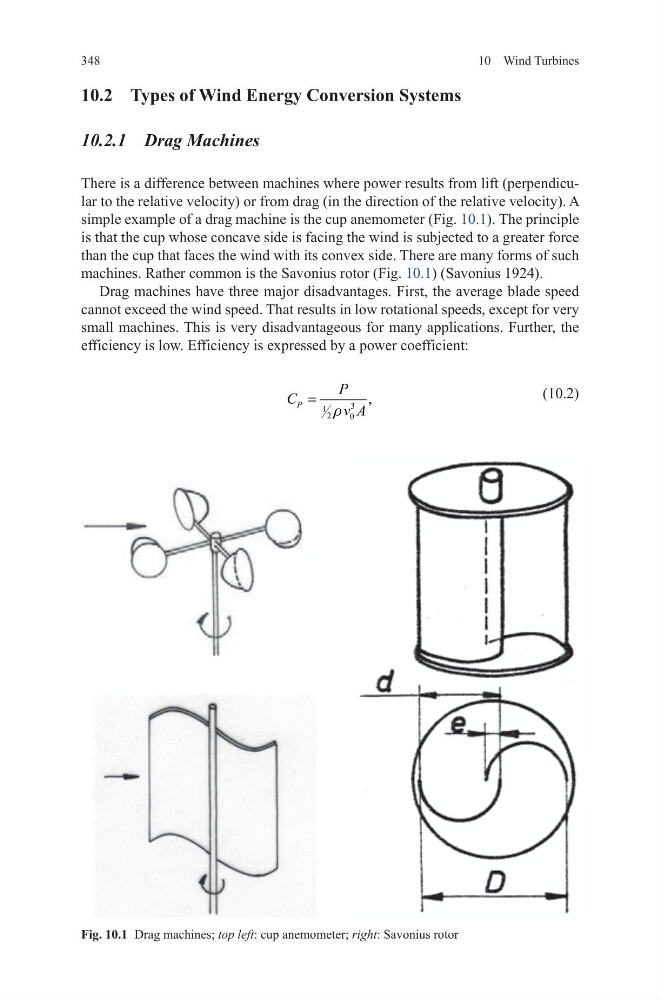
There is a difference between machines where power results from lift (perpendicular to the relative velocity) or from drag (in the direction of the relative velocity). A
simple example of a drag machine is the cup anemometer (Fig. 10.1). The principle
is that the cup whose concave side is facing the wind is subjected to a greater force
than the cup that faces the wind with its convex side. There are many forms of such
machines. Rather common is the Savonius rotor (Fig. 10.1) (Savonius 1924).
Drag machines have three major disadvantages. First, the average blade speed
cannot exceed the wind speed. That results in low rotational speeds, except for very
small machines. This is very disadvantageous for many applications. Further, the
efficiency is low. Efficiency is expressed by a power coefficient:
(10.2)
3
1 2
0
,
P
P
C
v A
r
=
Fig. 10.1 Drag machines; top left: cup anemometer; right: Savonius rotor
10 Wind Turbines
10.2 Types of Wind Energy Conversion Systems
10.2.1 Drag Machines
There is a difference between machines where power results from lift (perpendicular to the relative velocity) or from drag (in the direction of the relative velocity). A
simple example of a drag machine is the cup anemometer (Fig. 10.1). The principle
is that the cup whose concave side is facing the wind is subjected to a greater force
than the cup that faces the wind with its convex side. There are many forms of such
machines. Rather common is the Savonius rotor (Fig. 10.1) (Savonius 1924).
Drag machines have three major disadvantages. First, the average blade speed
cannot exceed the wind speed. That results in low rotational speeds, except for very
small machines. This is very disadvantageous for many applications. Further, the
efficiency is low. Efficiency is expressed by a power coefficient:
(10.2)
3
1 2
0
,
P
P
C
v A
r
=
Fig. 10.1 Drag machines; top left: cup anemometer; right: Savonius rotor