

9 Hydraulic Turbines
332
With η i ≈ 0 92
. (optimal efficiency), it thus follows
(9.5)
The relations (9.4) and (9.5) are very universal. They are compatible with the Pelton
turbine result (9.1). They are also compatible with the findings for steam turbines
in Chap 6. Conditions for achieving relation (9.5) are assumption of an axial outlet flow and a constant meridional component of the velocity. In real machines
these conditions are very well met. Note that relation (9.4) was also obtained by the
analysis of radial fans in Chap. 3. With the relation (9.4), the degree of reaction may
be read from the velocity triangles. For example, in Fig. 9.10 velocity triangles are
drawn with v u
5
1u 1
/
. .
= 0 The corresponding degree of reaction is R = 0.75. From
this we learn that the degree of reaction is a kinematic parameter. We may apply it
instead of the tangential velocity coefficient. Note that work coefficient (9.4) and
speed ratio (9.5) are kinematic parameters as well.
9.4.4 Velocity Triangles with Varying Degree of Reaction
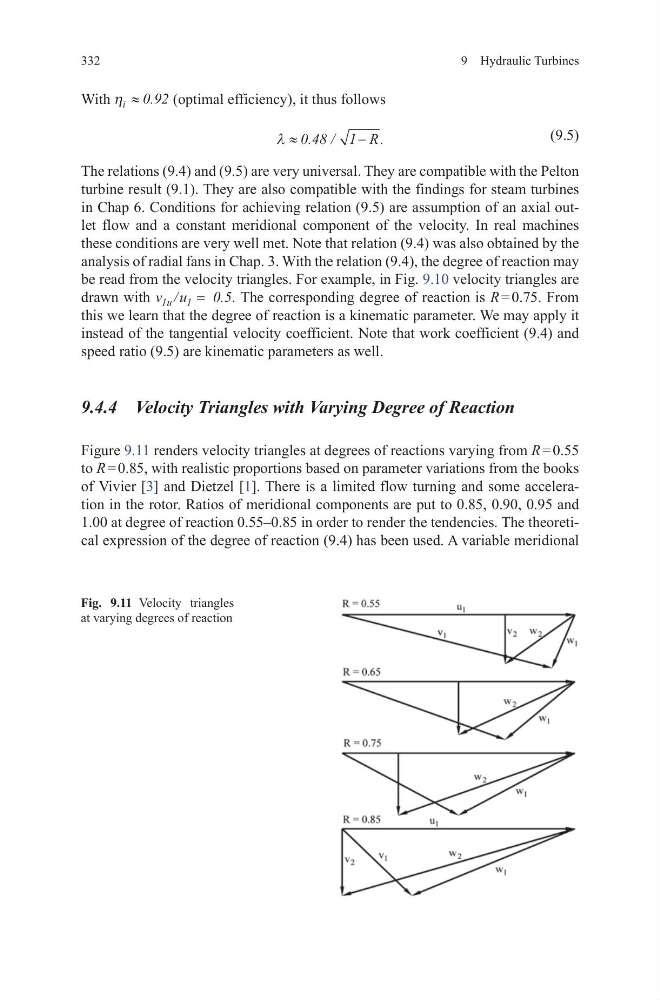
Figure 9.11 renders velocity triangles at degrees of reactions varying from R = 0.55
to R = 0.85, with realistic proportions based on parameter variations from the books
of Vivier [3] and Dietzel [1]. There is a limited flow turning and some acceleration in the rotor. Ratios of meridional components are put to 0.85, 0.90, 0.95 and
1.00 at degree of reaction 0.55–0.85 in order to render the tendencies. The theoretical expression of the degree of reaction (9.4) has been used. A variable meridional
λ ≈
−
0 48 1
. /
.
R
Fig. 9.11 Velocity triangles
at varying degrees of reaction
332
With η i ≈ 0 92
. (optimal efficiency), it thus follows
(9.5)
The relations (9.4) and (9.5) are very universal. They are compatible with the Pelton
turbine result (9.1). They are also compatible with the findings for steam turbines
in Chap 6. Conditions for achieving relation (9.5) are assumption of an axial outlet flow and a constant meridional component of the velocity. In real machines
these conditions are very well met. Note that relation (9.4) was also obtained by the
analysis of radial fans in Chap. 3. With the relation (9.4), the degree of reaction may
be read from the velocity triangles. For example, in Fig. 9.10 velocity triangles are
drawn with v u
5
1u 1
/
. .
= 0 The corresponding degree of reaction is R = 0.75. From
this we learn that the degree of reaction is a kinematic parameter. We may apply it
instead of the tangential velocity coefficient. Note that work coefficient (9.4) and
speed ratio (9.5) are kinematic parameters as well.
9.4.4 Velocity Triangles with Varying Degree of Reaction
Figure 9.11 renders velocity triangles at degrees of reactions varying from R = 0.55
to R = 0.85, with realistic proportions based on parameter variations from the books
of Vivier [3] and Dietzel [1]. There is a limited flow turning and some acceleration in the rotor. Ratios of meridional components are put to 0.85, 0.90, 0.95 and
1.00 at degree of reaction 0.55–0.85 in order to render the tendencies. The theoretical expression of the degree of reaction (9.4) has been used. A variable meridional
λ ≈
−
0 48 1
. /
.
R
Fig. 9.11 Velocity triangles
at varying degrees of reaction